If you've ever wondered why some generic drugs hit the market almost immediately after a patent expires while others take years-or never arrive at all-the answer usually lies in how the drug gets into your body. For a simple tablet, the goal is straightforward: dissolve in the stomach and enter the bloodstream. But for an inhaler, a skin patch, or a nanoparticle injection, the delivery mechanism is just as important as the drug itself. This is where bioequivalence standards come into play. It's not just about having the same active ingredient; it's about proving that the delivery system performs identically to the original version.
The core problem is that traditional tests for bioequivalence, like measuring the peak concentration (Cmax) or the total exposure (AUC) in the blood, don't always tell the full story. If a steroid inhaler works locally in the lungs, a blood test won't show if the drug actually reached the bronchioles. Because of this, regulatory agencies have moved toward a "totality-of-the-evidence" approach. This means developers must prove equivalence through a mix of chemistry, physics, and clinical data before a product can be approved.
| Delivery System | Primary Focus | Key Metrics | Approval Rate (Approx.) |
|---|---|---|---|
| Standard Oral | Systemic Absorption | Cmax, AUC (80-125%) | 78% |
| Inhalers | Lung Deposition | Particle size, Plume geometry | 38% |
| Transdermal Patches | Skin Permeation | In vitro release, Adhesion | 52% |
| Complex Injectables | Physicochemical Stability | Zeta potential, Polydispersity | 58% |
The Challenge of Inhalers: More Than Just a Mist
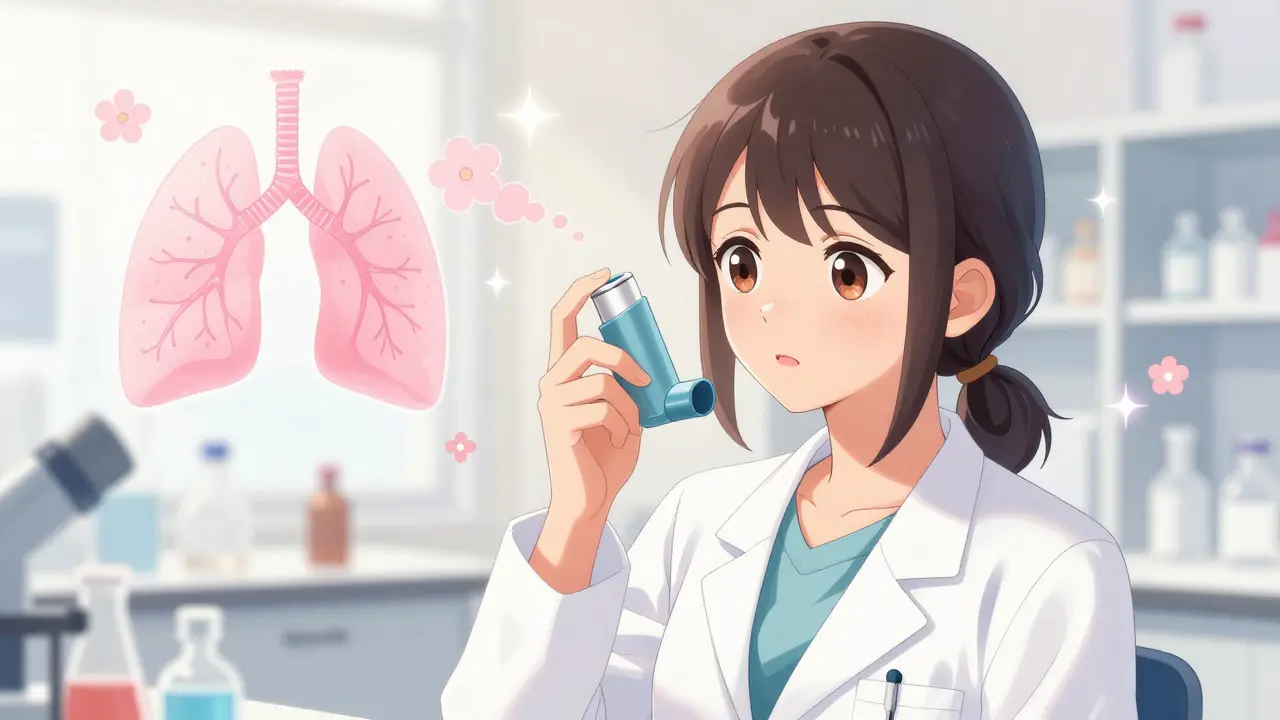
When dealing with Inhalers devices used to deliver medication directly into the lungs, including Metered Dose Inhalers (MDI) and Dry Powder Inhalers (DPI), the physics of the device are as critical as the chemistry of the drug. You can't just measure the drug in the blood because many inhaled medications are designed to stay in the lungs.
To prove bioequivalence, developers must use a tiered approach. First, they look at in vitro performance. This means checking if 90% of the particles are between 1 and 5 micrometers. If the particles are too large, they get stuck in the throat; too small, and they are exhaled. They also check the "plume geometry"-the shape and speed of the spray. One developer recently had a generic albuterol product rejected simply because the spray temperature was 2°C higher than the reference drug, even though the drug amount was identical.
For the in vivo part, regulators like the FDA the U.S. Food and Drug Administration, the federal agency responsible for protecting public health by ensuring the safety and efficacy of drugs may require pharmacodynamic endpoints. Instead of a blood test, they might measure FEV1 (Forced Expiratory Volume in 1 second) to see if the patient's lung function actually improves in the same way it does with the brand-name version.
Transdermal Patches: Managing the Slow Release
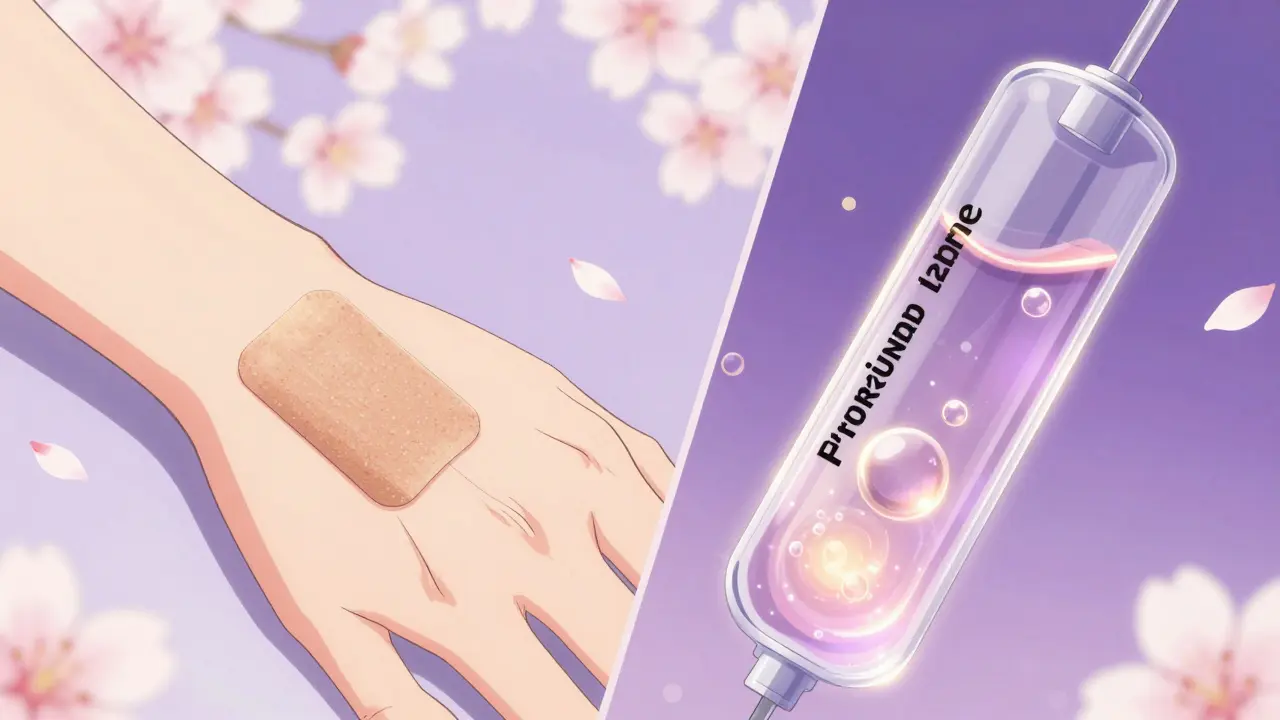
A Transdermal Patch a medicated adhesive patch placed on the skin to deliver a dose of medication through the skin and into the bloodstream is essentially a slow-release pump. The goal is a steady state of medication over hours or days. Because of this, the standard 80-125% rule for Cmax isn't always the primary focus; the total amount of drug delivered over time (AUC) is much more important.
The difficulty here is the skin itself. Developers must use Franz diffusion cells a specialized laboratory device used to measure the diffusion of drugs through a membrane or skin to show that the drug moves through the skin at the same rate as the original. They also have to prove the patch stays stuck. If a generic patch peels off two hours earlier than the reference, it's not bioequivalent, regardless of the drug's purity.
Complex Injectables: The Nano-Scale Battle
Injectables aren't always simple liquids. When you get into liposomes or nanoparticles, you're dealing with "complex generics." For these, the EMA the European Medicines Agency, the agency responsible for the scientific evaluation and monitoring of medicines in the EU and FDA require a deep dive into the physicochemical properties.
Key metrics include the Polydispersity Index (PDI), which must typically be less than 0.2 to ensure the particles are uniform in size. They also track the zeta potential (the electrical charge of the particle), which must stay within 5mV of the reference. If these are off, the drug might be cleared by the body too quickly or fail to reach the target organ. For high-risk drugs with a narrow therapeutic index, like enoxaparin, the limits are tightened even further to 90-111%, leaving almost no room for error.
The High Cost of Precision
Developing these systems is a massive financial gamble. A standard generic tablet might cost $5 to $10 million to develop. A complex generic, like a long-acting insulin glargine, can cost upwards of $32 million and take nearly four years to reach the market. This is because the formulation process is an iterative nightmare. One scientist reported needing 17 different iterations just to get the particle size distribution right for a single product.
The risk of failure is also higher. The approval rate for inhalers sits around 38%, compared to 78% for standard generics. A classic example of this was the rejection of a generic Advair Diskus in 2019. Even though the drug levels in the blood were fine, the "fine particle fraction"-the amount of drug actually reaching the deep lungs-wasn't an exact match, leading to a total rejection.

Future Trends and the "Biocreep" Risk
The industry is moving toward PBPK modeling Physiologically Based Pharmacokinetic modeling, a mathematical approach to predict drug absorption and distribution based on physiological data. This allows researchers to simulate how a drug behaves in a virtual human body before running expensive clinical trials. In 2022, about 65% of complex generic submissions used this modeling, up from just 22% a few years prior.
However, there is a growing concern called "biocreep." This happens when a second or third generation of generics is based on a previous generic rather than the original reference drug. Over time, tiny, acceptable differences in each version can accumulate. Eventually, the newest generic might be significantly different from the original, potentially impacting how well the medicine works for the patient.
What is the 80-125% rule in bioequivalence?
The 80-125% rule is the standard statistical criterion where the 90% confidence interval for the ratio of the mean Cmax and AUC of a generic drug to the reference drug must fall between 80% and 125%. While this works for oral tablets, it's often insufficient for complex delivery systems like inhalers where local action is more important than systemic blood levels.
Why are inhalers harder to make as generics than tablets?
Inhalers depend on the physics of aerosolization. The drug must be the right size (usually 1-5 micrometers) to reach the lungs. Factors like plume temperature, device ergonomics, and propellant types can change how much drug actually hits the target site, making it much harder to replicate than a pill that simply dissolves in the stomach.
What is a Franz diffusion cell used for?
A Franz diffusion cell is a tool used to test transdermal patches. It consists of a donor compartment (where the patch is placed) and a receptor compartment separated by a piece of skin or a synthetic membrane. It allows scientists to measure exactly how much drug permeates the skin over a specific period.
What happens if a generic fails the bioequivalence test?
If a generic fails, the regulatory agency (like the FDA or EMA) will reject the application. The company must then go back to the formulation stage to adjust physicochemical properties-such as particle size or release rates-and repeat the studies. This can cost millions of dollars and add years to the development timeline.
Can a drug be bioequivalent but not therapeutically equivalent?
In most cases, bioequivalence is used as a proxy for therapeutic equivalence. However, for complex products, the answer is yes. A drug might show similar blood levels (bioequivalent) but fail to deliver the drug to the specific site of action in the lung or skin, meaning it wouldn't actually treat the patient's condition as effectively as the original.
Next Steps for Developers
If you are navigating the path toward a complex generic, the first step is a gap analysis of the reference product's physicochemical profile. Don't rely solely on pharmacokinetic (PK) studies; invest in high-resolution particle characterization and in vitro release testing early. Many successful firms partner with specialized CROs (Contract Research Organizations) that have a proven track record with cascade impactors or scintigraphy imaging to avoid the costly "trial and error" phase. Finally, keep a close eye on the FDA's Complex Generic Drug Products portal, as guidance for these systems is updated frequently to reflect new scientific standards.