
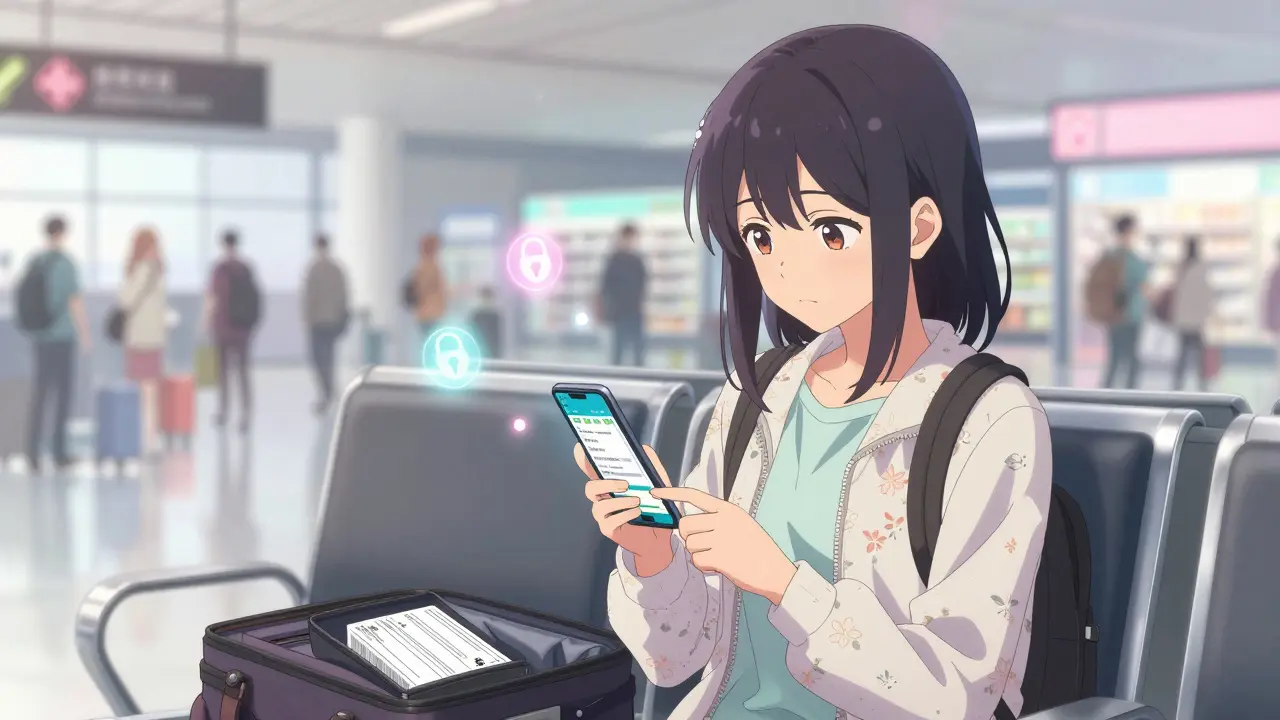
Traveling with medication isn’t just about packing your pills. It’s about making sure you can prove you’re supposed to have them-especially if you’re crossing borders, getting pulled over, or end up in an emergency room halfway across the world. A lost or stolen prescription can turn a simple trip into a medical nightmare. And carrying a paper copy in your wallet? That’s a security risk waiting to happen.
Why You Need Backup Prescriptions-And Why Most People Do It Wrong
Most doctors tell you to bring a backup prescription when you travel. But they rarely explain how to do it safely. You might think snapping a photo of your prescription and saving it in your phone’s gallery is enough. It’s not. That photo is just as exposed as the paper copy in your bag. If your phone gets stolen, so does your medical information. And if someone finds that photo, they could use it to fill a fake prescription-or worse, sell your medication. A 2022 study in the Journal of Patient Safety found that 23% of patients who carried physical copies of prescriptions had experienced theft, loss, or unauthorized access. Even worse, 68% of people using non-integrated apps (like plain photo storage) ended up with outdated or incorrect medication info during emergencies. That’s not just inconvenient-it’s dangerous.Use Your Pharmacy’s App-Not Your Phone’s Gallery
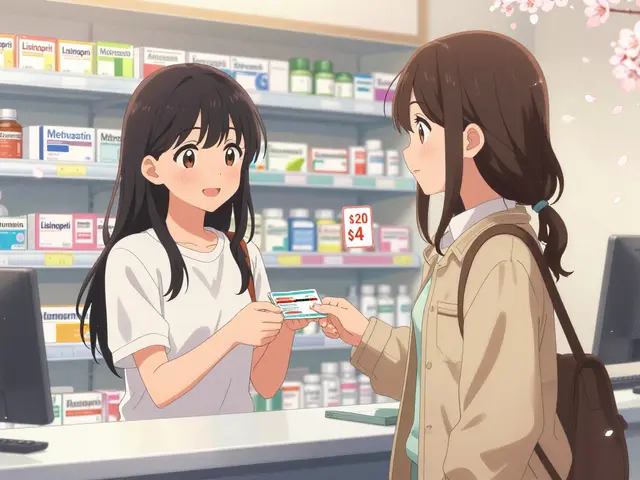
The safest way to carry a digital copy of your prescription isn’t through your camera roll. It’s through your pharmacy’s official app. Major pharmacy chains like CVS, Walgreens, and Rite Aid now offer encrypted prescription storage inside their mobile apps. These aren’t just digital refill trackers-they’re secure portals tied directly to your pharmacy record. When you log in, you can view and download your current prescriptions with full details: drug name, dosage, prescriber, and pharmacy info. These files are encrypted, password-protected, and synced in real time. If your doctor changes your dose, the app updates automatically. As of 2023, CVS Health’s app served over 14 million users with this feature, and Walgreens had rolled it out to 12.7 million. Both apps scored 4.1 stars or higher on the App Store, with users praising the security. One review said: “I used to carry paper copies. Now I just open the app. Even my kids can’t access it without my passcode.” Don’t have a pharmacy app? Call your pharmacy and ask if they offer secure digital access. If they don’t, ask if they can email you a secure PDF-preferably one that requires a password to open. Never accept an unencrypted PDF sent to your personal email.How to Store Physical Copies Without Risk
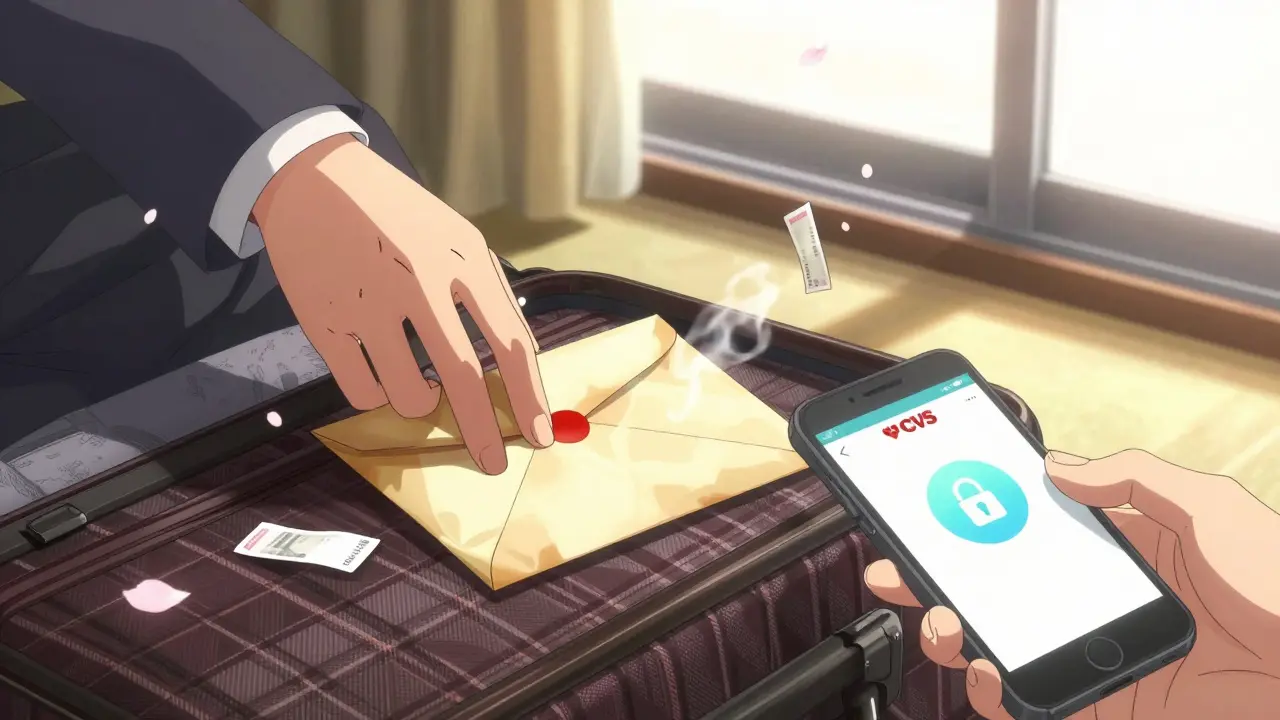
Sometimes, you still need a paper copy. Airports, border crossings, or rural clinics might not accept digital files. But you don’t have to keep it in your wallet. Here’s what works:- Keep the printed copy in a sealed, labeled envelope inside your checked luggage-not your carry-on.
- If you must carry it, put it in a small, lockable travel case (like those used for jewelry or cash). Don’t let it sit loose in your pocket or purse.
- Write only the essentials on the paper: drug name, dosage, prescribing doctor’s name, and pharmacy phone number. Leave out your full medical history or insurance info.
- Never carry more than one backup copy. Extra copies increase risk.
Never Use Generic Medication Apps for Storage
Apps like Medisafe, MyTherapy, or other pill reminder tools are great for tracking when to take your meds. But they’re not designed to store prescription documents securely. A 2022 analysis by the Journal of Medical Internet Research found that only 17% of these apps let you password-protect your files, and just 3% actually encrypt prescription images. That means if someone gets into your phone, they can open your “medication log” and see your controlled substance prescriptions like they’re a grocery list. Even worse, many of these apps sync data to the cloud without encryption. If your account gets hacked, your prescriptions could be exposed. Don’t use them as a backup. Use them for reminders only.What to Do If You’re Stopped or Asked for Proof
If you’re traveling internationally, customs officers might ask for proof you’re legally carrying your medication. In the U.S., TSA doesn’t require prescriptions for pills, but they might ask if you’re carrying controlled substances like opioids or benzodiazepines. Here’s how to respond:- Have your pharmacy app open on your phone and ready to show the prescription details.
- If asked for paper, hand over the sealed copy from your travel case.
- Do not volunteer extra information. Just say: “This is my prescription for [drug name], prescribed by Dr. [Name] at [Pharmacy].”
- Never let someone take your phone or paper copy. Ask to speak to a supervisor if you feel pressured.
Update Your Copies Before Every Trip
Outdated prescriptions are worse than no copies at all. A 2021 study by the Agency for Healthcare Research and Quality found that 38% of patient-managed prescription backups were inaccurate because they weren’t synced with the pharmacy’s system. Before you pack:- Log into your pharmacy app and confirm your current prescriptions.
- Print a new copy if needed-don’t reuse last year’s.
- Check expiration dates. Some countries won’t accept prescriptions older than 6 months.
- If you’ve started a new medication since your last trip, make sure it’s included.
What About Controlled Substances?
If you take opioids, stimulants, or benzodiazepines, you’re at higher risk. These drugs are tightly regulated, and carrying them without proof can trigger serious legal issues-even in countries where they’re legal. For these medications:- Always carry the original prescription bottle with the pharmacy label intact.
- Bring a letter from your doctor explaining why you need it-especially for international travel.
- Check if your destination requires a special permit. Countries like Japan, Singapore, and the UAE have strict bans on certain medications-even if they’re legal in the U.S.
- Never split pills or transfer them to a different container. Customs agents can tell if the bottle doesn’t match the label.
What If You Lose Everything?
If your prescriptions are lost or stolen while traveling:- Contact your pharmacy immediately. Most can fax or email a new copy to a local pharmacy near you.
- If you’re abroad, call your country’s embassy. They can help you find a local doctor who can issue a temporary prescription.
- Don’t try to buy medication over the counter unless you’re absolutely sure it’s the same drug and dosage. Counterfeit drugs are a real threat in some countries.
Final Rule: Keep It Simple, Keep It Secure
The goal isn’t to overcomplicate things. It’s to make sure you can prove you’re entitled to your meds-and that no one else can use them. Here’s your quick checklist:- ✅ Use your pharmacy’s app for digital copies-never your phone gallery.
- ✅ If you need paper, keep it locked and minimal.
- ✅ Never use third-party medication apps to store prescription images.
- ✅ Update your copies before every trip.
- ✅ Know your destination’s rules for controlled substances.
- ✅ Carry your original bottle for controlled meds.
Can I just take a photo of my prescription and save it on my phone?
No. Saving a photo in your phone’s gallery is not secure. Anyone who gets access to your phone can open it. Use your pharmacy’s official app instead-it encrypts your prescriptions and ties them to your account with password protection.
Is it okay to carry my prescription in my wallet?
Only if you have no other choice. Wallets are easy targets for pickpockets. If you must carry a paper copy, keep it in a small lockable case inside your carry-on bag. Never leave it loose in a pocket or purse.
What if I need my meds while traveling and my pharmacy isn’t nearby?
Call your pharmacy. Most can send a digital copy to a local pharmacy near you. If you’re overseas, contact your country’s embassy. They can help you find a doctor who can issue a temporary prescription. Never buy medication from street vendors or unlicensed pharmacies.
Do I need a doctor’s letter for my prescriptions when flying?
For most medications, no. But if you’re carrying controlled substances like opioids, stimulants, or sedatives, a letter from your doctor explaining why you need them is strongly recommended. Some countries require it. Always check the destination’s rules before you fly.
Are there any apps that are safe for storing prescription copies?
Only pharmacy apps like CVS, Walgreens, or Rite Aid. Avoid general medication trackers like Medisafe or MyTherapy-they don’t encrypt prescription documents. Stick to official pharmacy portals that sync directly with your prescription record.
What should I do if my prescription gets stolen while I’m traveling?
Contact your pharmacy immediately. They can issue a new copy and notify your doctor. If you’re abroad, reach out to your embassy. Do not try to refill your prescription at a local pharmacy unless you’re certain the medication and dosage are identical. Counterfeit drugs are common in some countries.



There are 9 Comments
Carolyn Whitehead
Love this. I used to keep my scripts in my phone gallery until my cousin stole my phone and tried to fill a prescription for my pain meds. Scary stuff. Now I use Walgreens app and never look back. So simple, so safe.
Beth Beltway
Typical lazy advice. You’re telling people to rely on corporate pharmacy apps that track every move you make? What about privacy? CVS doesn’t care about your meds-they care about your data. And don’t even get me started on how often those apps glitch and delete your files. Paper with a lockbox is still the only real security.
kate jones
While the pharmacy app recommendation is sound from a technical standpoint, it’s important to clarify that encryption standards vary by platform. CVS and Walgreens use AES-256 encryption for prescription data, which meets HIPAA-compliant thresholds, but users should still enable biometric authentication and avoid sharing login credentials. Additionally, exporting a password-protected PDF from the pharmacy portal-rather than relying solely on app access-is a robust secondary measure, especially for international travel where app connectivity may be unreliable.
Kelly Weinhold
Y’all are overthinking this so hard. I just carry my original bottle + one printed copy in my toiletry bag (locked in a tiny ziplock case) and I’ve never had an issue. I’ve flown to 17 countries with my anxiety meds and no one ever asked. But if they do? I smile and say, ‘Yep, this is mine.’ No drama, no apps, no stress. Keep it simple, people. Your phone doesn’t need to be your medical records vault.
Rob Webber
THIS IS WHY PEOPLE GET ARRESTED ABROAD. I had a friend get detained in Dubai because he had oxycodone in a pill organizer with no label. No bottle. No script. No letter. Just a plastic container with white pills. He spent 3 days in jail. This isn’t ‘be careful’-this is ‘don’t be an idiot.’ If you’re carrying controlled substances, treat it like you’re smuggling gold. Because legally, you are.
Claire Wiltshire
For travelers with chronic conditions, I strongly recommend registering with the U.S. Department of State’s Smart Traveler Enrollment Program (STEP). This allows embassies to proactively assist you in medical emergencies, including prescription replacement. Additionally, carrying a translated summary of your condition and medication list (in the destination language) can prevent misunderstandings at border checkpoints. Digital backups should always be stored in a secure cloud vault with two-factor authentication-not just on a pharmacy app, which may not be accessible overseas.
Mike Rose
why do u need all this fancy stuff? just take the bottle. if they ask, say it’s yours. done. apps are for people who dont trust their own brains. also why is everyone so scared of a paper copy? its just paper. chill out.
Rohit Kumar
In India, we have a different reality. Many pharmacies don’t even have apps. I’ve seen people carry handwritten notes from doctors-sometimes on napkins. But here’s the truth: the real danger isn’t the photo on your phone, it’s the lack of awareness. If you’re carrying opioids or stimulants, even a legal prescription means nothing if local law doesn’t recognize it. I once helped a German tourist in Goa who was detained because his Xanax bottle had no label. He had the script, but in Hindi, it meant nothing. Always get a doctor’s letter. Always. And if your pharmacy won’t help you, find a travel clinic. This isn’t tech advice-it’s survival.
Adarsh Uttral
bro just screenshot it and put it in a folder called 'private' lol. no one's gonna find it. and if they do? they probably need the meds more than u. also why are we treating medicine like a secret treasure? it's not a weapon. just be cool.
Write a comment
Your email address will not be published. Required fields are marked *