

Why Taking Four Pills a Day Is Getting Old
If you’re on meds for high blood pressure, cholesterol, or after a heart attack, you’ve probably been handed a pill organizer with four or five compartments. Morning: one for blood pressure. Lunch: another for cholesterol. Evening: aspirin, maybe a beta-blocker. It’s messy. It’s confusing. And worst of all? People stop taking them.
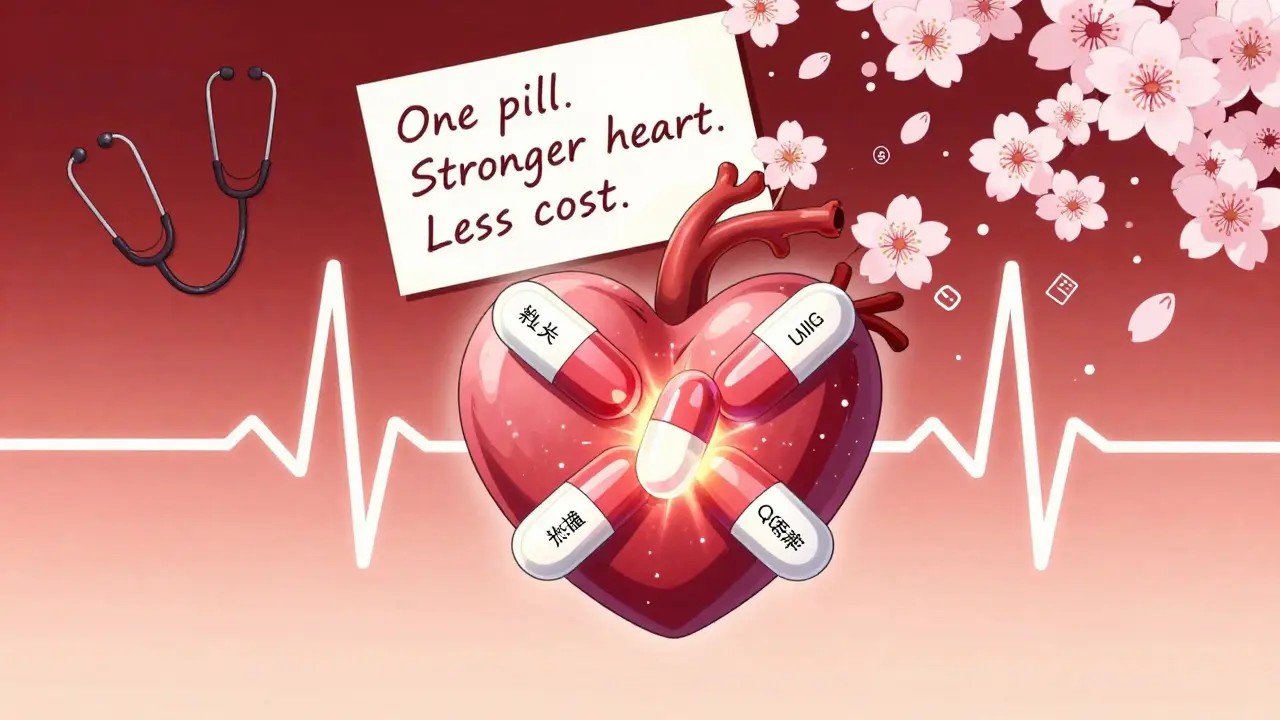
Studies show that when patients have to take four or more separate pills daily, adherence drops to just 25-30%. That’s not laziness-it’s human. Life gets busy. Pills get lost. Side effects pile up. But here’s the fix that’s quietly changing heart care: cardiovascular combination generics. These are single pills that pack two or more heart medications into one. Think of them as the ‘polypill’-a term coined over 20 years ago-and they’re now widely available, cheaper, and just as effective as brand-name versions.
What’s Actually in These Combination Pills?
These aren’t magic pills. They’re smart combinations of proven drugs. The most common ones you’ll see include:
- ACE inhibitors + diuretics (like lisinopril + hydrochlorothiazide)
- Beta-blockers + diuretics (metoprolol + HCTZ)
- Statins + ezetimibe (atorvastatin + ezetimibe, the generic version of Vytorin)
- Calcium channel blockers + ACE inhibitors (amlodipine + benazepril)
- Aspirin + statin (available in some countries, still limited in the U.S.)
Some combos even include three drugs, like amlodipine + atorvastatin + lisinopril-but those are rarer. The most common are two-drug combos. The goal? Reduce pill burden. Cut costs. Improve adherence.
How Much Money Can You Save?
Brand-name combination pills can cost $150-$300 a month. The generic versions? Often under $20.
Medicare data from 2017 showed that brand-name cardiovascular meds cost an average of $85.43 per fill. Generic versions? Just $15.67. That’s an 82% drop. Multiply that by millions of prescriptions, and you’re looking at over $1.3 billion in annual savings if everyone switched.
And it’s not just Medicare. Private insurers, Medicaid, and even pharmacy discount programs like GoodRx now list these generics at $10-$15 for a 30-day supply. For someone on multiple meds, switching to a combo pill can cut monthly drug costs by half-or more.
Are Generic Combos Really as Good as Brand Names?
Yes. And here’s why.
The FDA requires generic drugs to meet strict bioequivalence standards. That means the amount of active ingredient in your generic pill must deliver 80-125% of the same blood concentration as the brand-name version. That’s not a guess-it’s tested in clinical trials with real people.
A 2014 review in the European Heart Journal analyzed 61 studies across dozens of cardiovascular drug classes. The conclusion? Generics performed just as well as brands in lowering blood pressure, reducing cholesterol, and preventing heart attacks.
Even in high-risk patients-those with prior heart attacks or heart failure-studies show no difference in outcomes between brand and generic combos. The American Heart Association even gives single-pill combinations a Class I recommendation (the highest level) for improving adherence.

But What About Side Effects? I Heard Generics Are Different
This is the big worry. People say: “My brand-name metoprolol didn’t make me tired, but the generic did.”
It’s not always the active ingredient. Sometimes, it’s the fillers-the inactive ingredients like dyes, binders, or coatings. These don’t affect how the drug works, but they can affect how your body reacts. For most people, this doesn’t matter. But for a small group-especially those on drugs with a narrow therapeutic index like warfarin-switching can cause issues.
That’s why some doctors still hesitate. And why pharmacists are trained to ask: “Have you noticed any changes since switching?”
On Drugs.com, over 1,200 patients reviewed generic heart meds. 78% said they were just as effective. 12% noticed minor side effects-usually dizziness or mild fatigue-but most said those faded within a few weeks. Only 5% reported serious problems.
What’s Missing? The ‘Full Polypill’ Still Isn’t Here
The dream? One pill with aspirin, a statin, a beta-blocker, and an ACE inhibitor. That’s the original polypill idea from Dr. Salim Yusuf in 2002. It could cut heart disease risk by 75% in people with prior events.
But in the U.S., that pill doesn’t exist. You can get aspirin + statin in some countries. You can get statin + blood pressure meds here. But not all four together.
Why? Regulatory hurdles. Patent issues. And the fact that no single company has pushed to combine all four. But the science is solid. The World Heart Federation is pushing for polypills in low-income countries, where access to multiple meds is a bigger barrier than cost.
For now, the best you can do in the U.S. is a two-drug combo-plus one or two separate pills. Still, that cuts your daily pill count by 50-75%.
What Are the Best Alternatives If a Combo Isn’t Available?
Not every combo exists. For example, metoprolol succinate + hydrochlorothiazide is still brand-only. But here’s the trick: you don’t need to take the combo pill to get the benefit.
If your doctor prescribes metoprolol and HCTZ separately, ask your pharmacist: “Can I get these as generics?” The answer is almost always yes. And you’ll still pay less than the brand-name combo.
Another alternative? Ask about single-pill alternatives that cover the same drugs. For example:
- Instead of brand-name BiDil (isosorbide + hydralazine), use generic versions of both.
- Instead of Entresto (sacubitril + valsartan), use generic valsartan and ask if sacubitril is covered separately.
Even if you’re taking two pills instead of one, you’re still saving hundreds per month.
How to Talk to Your Doctor About Switching
Don’t wait for them to bring it up. Most primary care doctors aren’t even aware of all the combo generics available. A 2018 study found only 45% knew the full list.
Here’s what to say:
- “I’m taking [list your meds]. Is there a combo pill that includes any of these?”
- “I’m worried about forgetting pills. Would a combination help?”
- “I’ve seen these generics cost under $15. Can we switch?”
Pharmacists are your other ally. 89% of them routinely explain bioequivalence to patients. Ask yours to review your script. They can flag if a combo exists, or if switching to generics would save you money.
State Laws Can Block Your Switch-Here’s How to Check
Not every state lets pharmacists swap brand for generic without your okay. In 18 states, you must give written consent before a substitution.
If you get a generic you didn’t ask for, and you’re uneasy, you can say: “I’d prefer to stay on my brand.” But you can also ask: “Is there a generic combo that’s cheaper and just as good?”
Check your state’s pharmacy board website. Search for “generic substitution laws.” If you’re unsure, ask your pharmacist: “Do I need to sign anything to switch?”
What’s New in 2025-2026?
The FDA approved the first generic of Entresto (sacubitril/valsartan) in 2022. That’s huge-it’s a heart failure drug that used to cost over $500 a month. Now, generics are under $30.
More combos are coming. In 2021, the FDA released draft guidance to speed up approval of new fixed-dose combinations. Expect more two- and three-drug combos for hypertension and cholesterol by 2026.
Also, Medicare Advantage plans are now incentivizing combo prescriptions. If you’re on Medicare, your plan may cover a combo pill at $0 copay.
Bottom Line: It’s Time to Ask for a Combo
You don’t have to take five pills a day. You don’t have to pay $200 a month for heart meds. And you don’t have to risk missing doses because it’s too complicated.
Cardiovascular combination generics are safe, proven, and cheaper. They’re not perfect-but they’re the best tool we have right now to keep people alive after a heart attack or stroke.
Ask your doctor. Ask your pharmacist. Ask for a combo. Your heart-and your wallet-will thank you.
Are cardiovascular combination generics as effective as brand-name drugs?
Yes. The FDA requires generics to deliver the same amount of active ingredient as the brand, within a strict 80-125% range. Multiple studies, including a 2014 review of 61 clinical trials in the European Heart Journal, confirm that generic cardiovascular combos work just as well for lowering blood pressure, cholesterol, and preventing heart events.
How much can I save by switching to generic combination pills?
On average, you’ll save 80-85%. Brand-name cardiovascular combos can cost $85-$300 per month. Generic versions typically cost $10-$25. For someone on multiple meds, switching to a single-pill combo can cut monthly drug costs by half or more.
Can I get a pill with aspirin, statin, beta-blocker, and ACE inhibitor all in one?
Not in the U.S. yet. While each of these drugs is available as a generic, no single pill combines all four. Some countries use this ‘polypill’ for secondary prevention, but U.S. regulators haven’t approved a combo with all four. The closest options are two-drug combos like statin + blood pressure med.
Why do some people say generics make them feel worse?
It’s usually not the active drug-it’s the inactive ingredients like dyes or fillers. These can cause minor side effects in sensitive people, especially with drugs like beta-blockers or calcium channel blockers. Most side effects fade after a few weeks. If you notice persistent issues, talk to your doctor about switching brands or trying a different generic.
Do I need to give consent before my pharmacy switches my brand to a generic?
In 42 states, pharmacists can switch to a generic without asking. But in 18 states, you must give written consent. Check your state’s pharmacy board website. If you’re unsure, ask your pharmacist: “Do I need to sign anything to switch?” You always have the right to refuse.




There are 13 Comments
Lily Lilyy
Don't let the fear of generics stop you. They work. I'm alive because of them.
Gabrielle Panchev
Katelyn Slack
Melanie Clark
Harshit Kansal
Brian Anaz
Venkataramanan Viswanathan
Vinayak Naik
Saylor Frye
Kiran Plaha
Matt Beck
Kelly Beck
Molly McLane
Write a comment
Your email address will not be published. Required fields are marked *