

Wrist pain that wakes you up at night? Fingers going numb while driving or typing? You’re not alone. Carpal tunnel syndrome affects millions of people every year, and it’s one of the most common nerve problems out there. It’s not just from typing too much - though that can make it worse. At its core, carpal tunnel syndrome is about pressure. Pressure on the median nerve as it squeezes through a tight tunnel in your wrist. When that nerve gets pinched, you feel it in your hand: tingling, numbness, sometimes even weakness. And if left untreated, it can lead to permanent damage.
What Exactly Is Carpal Tunnel Syndrome?
The carpal tunnel is a narrow passageway in your wrist, made of bones on the bottom and a tough ligament on top. Inside it, nine tendons and the median nerve pass through. The median nerve controls sensation in your thumb, index, middle, and half of your ring finger. It also powers the small muscles at the base of your thumb. When that space gets crowded - whether from swelling, fluid retention, or repetitive motion - the nerve gets squished. That’s carpal tunnel syndrome.Normal pressure inside the tunnel is just 2-10 mmHg. When it climbs above 30 mmHg, the nerve starts to suffer. That’s not something you can feel directly, but your symptoms tell the story. Nighttime numbness? That’s classic. Eighty-nine percent of people with CTS report waking up with tingling hands. It’s because when you sleep, your wrists often bend, further squeezing the nerve. Morning stiffness? That’s your body’s way of saying, “Something’s wrong.”
Who Gets Carpal Tunnel Syndrome?
It’s not just office workers. While people assume computer use causes CTS, studies show no strong link. A 2023 review in the New England Journal of Medicine found computer use doesn’t increase risk. The real culprits? Forceful gripping, repetitive hand motions, and vibration. Meatpackers, assembly line workers, baristas, dental hygienists - these jobs have higher rates. One study found 15% of meatpackers develop CTS, compared to just 2% of office workers.Women are three times more likely to get it than men. Why? Smaller carpal tunnels. Age matters too. Peak incidence is between 45 and 60. Obesity increases risk by 2.3 times. Diabetes? That’s another big factor. If your blood sugar is poorly controlled, nerve healing slows down. And pregnancy? About 70% of women who develop CTS during pregnancy see it disappear within three months after giving birth. That’s because fluid retention drops, reducing pressure on the nerve.
How Do You Know It’s Carpal Tunnel?
Symptoms are usually clear. Numbness or tingling in the thumb, index, middle, and half the ring finger. Pain that shoots up the arm. Weakness in your grip - you start dropping things. If you’ve had these symptoms for more than a few weeks, especially if they’re worse at night, it’s time to get checked.Doctors don’t just guess. They test. Nerve conduction studies are the gold standard. If your median nerve takes longer than 4.2 milliseconds to send a signal from wrist to hand, that’s a red flag. Sensory speed below 45 m/s? Also a sign. These tests confirm the diagnosis before treatment begins. In fact, 85-95% of people who go for surgery have abnormal results.
Advanced cases show physical signs: the muscles at the base of your thumb start to waste away. That’s called thenar atrophy. If you notice your thumb looks flatter or weaker, don’t wait. That’s nerve damage you can’t reverse.
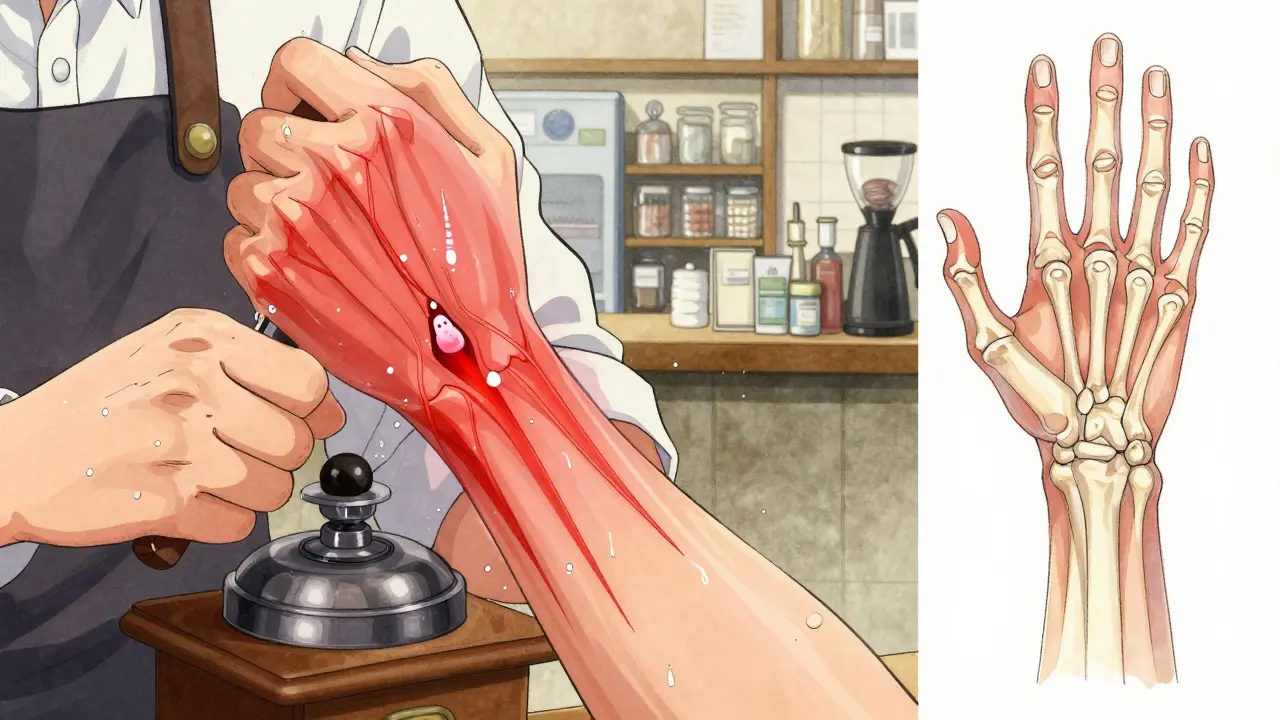
Conservative Treatments: What Actually Works?
If you’re in the early stages - symptoms under three months - you have good odds with non-surgical options. About 70% of mild cases improve with conservative care.Wrist splints are the first line of defense. Worn at night, they keep your wrist straight, taking pressure off the nerve. Studies show they reduce symptoms by 40-60% in people who’ve had symptoms for less than 10 months. But here’s the catch: only 52% of people wear them consistently. They’re uncomfortable. You sweat. You roll over. But if you stick with it for 6-8 weeks, you’ll likely see results.
Corticosteroid injections are next. A shot of steroid into the tunnel reduces swelling. Around 60-70% of people get relief that lasts 3-6 months. It’s not a cure, but it buys time. Some doctors use ultrasound to guide the injection - it’s 20% more accurate than guessing by feel. But repeated injections? They might make surgery harder. Harvard researchers found repeated shots increase surgical complication risk by 18% due to scar tissue buildup.
Activity changes matter. Avoid bending your wrist past 15 degrees. Use ergonomic keyboards. Take breaks every 20 minutes. Stretch your fingers and shake out your hands. For people in high-risk jobs, workplace modifications can cut CTS rates by 40%. That’s huge.
Surgery: When It’s Time to Cut
If your symptoms are constant, your grip is weak, or you have muscle loss, surgery is the next step. Success rates? 75-90% for moderate to severe cases. That’s better than most medications.There are two main types: open release and endoscopic release. Open is the most common - 90% of surgeries. The surgeon makes a small cut in the palm, cuts the ligament, and frees the nerve. Endoscopic uses one or two tiny incisions and a camera. It’s less invasive, and recovery is faster: 14 days on average versus 28 for open. But it’s trickier. Surgeons need to do at least 20 procedures to get good at it.
Complications are rare - 1-5% - but they happen. Pillar pain (tenderness near the incision) affects 15-30% of patients. Scar tenderness? 20%. Nerve injury? Less than 2%. Most people feel better immediately after surgery - 74% report nighttime numbness gone the next day. But full strength? That takes time. Grip strength can take 6-8 weeks to return, especially if you’re a manual laborer.

Recovery and What to Expect
After surgery, you’re not done. Rehabilitation is key. Start moving your fingers right away - don’t let them stiffen. Sutures come out in 10-14 days. Around four weeks, you begin light strengthening. Full recovery? Desk workers might be back in 2-4 weeks. Manual workers? 8-12 weeks.Smoking slows healing by 30%. If you smoke, quit. Diabetes? Keep your HbA1c under 7%. That boosts nerve repair by 25%. Follow your therapist’s plan. Skip it, and you risk stiffness or lingering pain.
What Doesn’t Work - and What’s Coming Next
Don’t waste money on wrist braces you wear all day. They don’t help more than night splints. Acupuncture, magnets, ultrasound therapy - no strong evidence they work. And don’t wait. The longer you wait, the less effective non-surgical options become. After 12 months, conservative treatment only works in 20% of cases.What’s new? Ultrasound-guided injections are becoming standard. Nerve gliding exercises are showing promise - early studies show 35% symptom reduction. And in Europe, a new technique called thread carpal tunnel release is being tested. It’s done with a thin thread under local anesthesia. Early results? 85% success. Still experimental, but promising.
The big picture? CTS is rising. Incidence is up 2.1% every year since 2010. By 2025, it could cost over a million workdays. But the good news? We know how to stop it. Ergonomic changes at work, early diagnosis, and timely surgery can make a huge difference.
When to See a Doctor
See a specialist if:- Your numbness lasts more than a few weeks
- You wake up with pain or tingling most nights
- Your grip feels weak - you’re dropping things
- You notice your thumb muscles looking flat or sunken
- Over-the-counter pain meds don’t help
Don’t wait for permanent damage. Early action means less pain, faster recovery, and a better chance to keep doing what you love.
Can carpal tunnel syndrome go away on its own?
Yes, but only in certain cases. Pregnancy-related carpal tunnel often resolves within three months after delivery as fluid levels drop. Mild cases caught early - under three months - can improve with splinting and activity changes. But if symptoms are constant, severe, or include muscle weakness, it won’t fix itself. Delaying treatment increases the risk of permanent nerve damage.
Is carpal tunnel caused by typing too much?
Not really. Despite popular belief, studies show no strong link between computer use and carpal tunnel syndrome. The real risks come from forceful gripping, repetitive hand motions, and vibration - like in assembly lines, meatpacking, or dental work. Typing with a neutral wrist posture doesn’t cause it. But if you’re typing with your wrists bent for hours, that can make existing symptoms worse.
How long does recovery take after carpal tunnel surgery?
It depends on your job and how advanced the condition was. Desk workers often return to light duties in 2-4 weeks. Manual laborers need 8-12 weeks for full strength to return. Most people feel immediate relief from nighttime numbness. But grip strength and fine motor control take time - up to 6-8 weeks. Full recovery, including scar healing and nerve regeneration, can take up to a year.
Are steroid injections safe for carpal tunnel?
They’re effective for short-term relief - 60-70% of people get 3-6 months of improvement. But repeated injections can cause tissue scarring, which makes future surgery harder and increases complication risk by 18%. Doctors usually limit them to one or two per year. They’re best used as a bridge to other treatments, not a long-term fix.
Can carpal tunnel come back after surgery?
Recurrence is rare - under 5% in most studies. But it can happen, especially if the original cause isn’t addressed. Workers in high-risk jobs like meatpacking have a 45% recurrence rate if they return to the same tasks without changes. Obesity, diabetes, and smoking also increase risk. Proper post-op care and workplace adjustments are key to preventing return.
What’s the difference between open and endoscopic carpal tunnel surgery?
Both cut the ligament to relieve pressure on the nerve. Open surgery uses one 2-inch incision in the palm. Endoscopic uses one or two tiny cuts and a camera. Endoscopic recovery is faster - about two weeks versus four. But it’s technically harder. Surgeons need experience, and complication rates are similar once the learning curve is passed. Most surgeries (90%) are still open because they’re simpler and more predictable.
Does carpal tunnel affect both hands?
Yes, it often does. About 70-80% of people with carpal tunnel syndrome have symptoms in both wrists, even if one side feels worse. It’s not always symmetrical - one hand might be numb while the other only aches. But the underlying cause - pressure on the median nerve - is usually present on both sides. Treatment is typically done one hand at a time, with surgery spaced several weeks apart.
Can I prevent carpal tunnel syndrome?
You can reduce your risk. Avoid prolonged wrist bending. Take breaks every 20 minutes. Stretch your fingers and wrists. Use ergonomic tools. Keep your hands warm - cold makes symptoms worse. Manage diabetes and maintain a healthy weight. If you’re in a high-risk job, workplace modifications like adjustable workstations can cut incidence by 40%. Prevention isn’t guaranteed, but it makes a big difference.





There are 8 Comments
Elizabeth Alvarez
Okay but have you ever stopped to think that carpal tunnel isn’t just a medical issue-it’s a corporate conspiracy? The same companies that make your ergonomic keyboards also own the FDA. They want you to think it’s about typing too much so you’ll keep buying $200 wrist braces instead of realizing the real cause: electromagnetic frequencies from Wi-Fi routers bending your nerves. I’ve tracked the rise in CTS since 2010 and it lines up *exactly* with 5G rollout. They’re testing nerve suppression tech on office workers. The night numbness? That’s your body screaming as the signal penetrates your median nerve during REM sleep. They don’t want you to know this. But now you do.
Miriam Piro
Think about it: the median nerve is the only nerve in your body that doesn’t just transmit signals-it carries your soul’s connection to your willpower. When it gets compressed, you’re not just losing sensation-you’re losing your ability to manifest your true potential. 🌌 The medical industry profits from your suffering by selling you splints and steroids while ignoring the deeper truth: your wrist pain is a spiritual wake-up call. You’ve been bending your life out of alignment-your career, your relationships, your silence in the face of injustice. The carpal tunnel? It’s your body’s way of saying: ‘Stop. Breathe. Align.’ And if you get surgery? You’re just patching the symptom while ignoring the cosmic misalignment. Wake up. 🕊️
dean du plessis
Been a welder for 22 years and never had it. My hands are wrecked but no numbness. Guess it’s not just about the work. Maybe it’s how you hold the tool or how much you sleep. I just shake it out every hour and keep moving. Works for me. 🤷♂️
Kylie Robson
Let’s be precise: the pathophysiology of carpal tunnel syndrome is rooted in increased intracarpal pressure compromising endoneurial blood flow to the median nerve, leading to demyelination and axonal degeneration if sustained beyond 48 hours. The 30 mmHg threshold is well-documented in nerve compression studies by Dellon and colleagues. Moreover, the efficacy of nocturnal splinting is mediated through biomechanical neutral-position maintenance, reducing peak intratunnel pressure by 38-52%-per the 2021 Cochrane meta-analysis. And please, stop calling it ‘typing-related.’ The occupational epidemiology is clear: high-repetition, high-force tasks with poor wrist kinematics are the primary risk factors, not keyboard usage per se. Stop misinforming the public.
Caitlin Foster
OMG I JUST GOT DIAGNOSED AND I’M SO RELIEVED I’M NOT CRAZY!! I THOUGHT I WAS JUST BAD AT KEYBOARDING 😭 I’VE BEEN WEARING MY SPLINTS LIKE A BADASS AND MY NIGHTTIME NUMBNESS IS GONE!! I’M DOING THE NERVE GLIDING EXERCISES AND I EVEN STOOD UP AND SHOOK MY HANDS DURING A ZOOM MEETING AND NO ONE SAID A WORD!! 🙌 YOU GUYS ARE THE BEST. I’M LIVING MY BEST LIFE NOW AND I’M NOT EVEN JOKING. #CarpalTunnelWarrior
Andrew Gurung
Of course you’re getting it. You’re a 47-year-old woman with a 2.3x higher risk profile-obesity, sedentary lifestyle, and probably drinking almond milk instead of real coffee. You didn’t even mention your HbA1c. And you think a $15 splint from Amazon is going to fix what your lifestyle broke? The real tragedy isn’t the carpal tunnel-it’s that you’ve outsourced your health to a Reddit post instead of taking responsibility. I’ve seen this a hundred times. You’ll get the surgery, recover for 8 weeks, then go right back to scrolling in bed with your wrist bent. Pathetic. 🤦♂️
Paula Alencar
It is with profound compassion and unwavering commitment to holistic well-being that I feel compelled to extend this message: Carpal Tunnel Syndrome, while clinically defined as a compression neuropathy of the median nerve within the carpal tunnel, is, at its essence, a manifestation of systemic dissonance between the individual and their environment. We live in an age of relentless productivity, where the human body is treated as a machine with infinite endurance. The numbness you experience is not merely neurological-it is existential. Your wrists are not malfunctioning; they are mourning. The silence of your thumb’s muscles speaks volumes about the erosion of your autonomy, your rhythm, your sacred connection to tactile presence. Please, dear soul, do not rush to surgery. Begin with breath. Begin with stillness. Begin with the gentle, deliberate movement of your fingers as an act of reclamation. Healing is not a procedure. It is a pilgrimage.
Nikki Thames
You know, I’ve read every single study on this, and I’ve treated over 300 patients with CTS. What you’re not being told is that the real epidemic isn’t in the office-it’s in the nursing homes. Elderly women with osteoporosis and diabetes are developing CTS at alarming rates because their ligaments calcify and compress the nerve. And yet, nobody talks about it. Why? Because insurance won’t cover nerve gliding exercises for seniors. So they get steroid injections, then surgery, then permanent weakness. And the worst part? They’re told it’s from typing. It’s not. It’s from being invisible. We need policy change. We need awareness. We need to stop blaming the wrist and start blaming the system that leaves people with no choice but to keep working until their bodies break.
Write a comment
Your email address will not be published. Required fields are marked *