

For years, managing diabetes meant poking your finger dozens of times a day, guessing how food or stress was affecting your blood sugar, and waking up in the middle of the night terrified of a low. That’s not the reality anymore. Today, CGM technology, smart insulin pens, and connected apps are turning diabetes management from a daily chore into a smarter, more predictable rhythm. If you’re still using fingersticks alone, you’re missing out on what’s possible.
What CGMs Actually Do (And Why They’re Not Just Fancy Fingersticks)
Continuous Glucose Monitors-CGMs-are small sensors worn on your arm or belly that measure glucose in your interstitial fluid every five minutes, 24/7. They don’t replace fingersticks entirely, but they show you what fingersticks can’t: trends, spikes, drops, and patterns over hours and days.
Before CGMs, doctors relied on HbA1c tests-three-month averages-to judge how well your diabetes was controlled. But that number hides everything. You could have wild swings between 50 and 250 mg/dL and still land at a ‘good’ HbA1c of 7%. CGMs reveal those hidden lows and highs. The American Diabetes Association now says CGMs should be used by everyone with Type 1 diabetes, those on insulin for Type 2, pregnant people, older adults, and children from diagnosis. It’s no longer a luxury. It’s standard care.
Two systems dominate the market: Abbott’s FreeStyle Libre 3 and Dexcom G7. Both are small, wearable, and send data straight to your phone. Libre 3 has a MARD score of 8.1%, meaning it’s accurate within about 8% of a lab test. Dexcom G7 is just as precise, with added features like customizable alerts and longer sensor life. Medtronic’s Guardian 4 is also solid, especially if you’re using it with their insulin pump system.
But the real game-changer is coming. Glucotrack, an implantable sensor still in clinical trials, measures glucose directly from your blood-not interstitial fluid. That means no 5- to 15-minute lag. It’s about the size of three nickels, implanted under the skin by a provider, and could last up to three years. Early data shows a MARD of 7.7%, matching today’s best external sensors. If approved, it could prevent thousands of dangerous low-blood-sugar events every year.
Smart Pens: The Quiet Helper You Didn’t Know You Needed
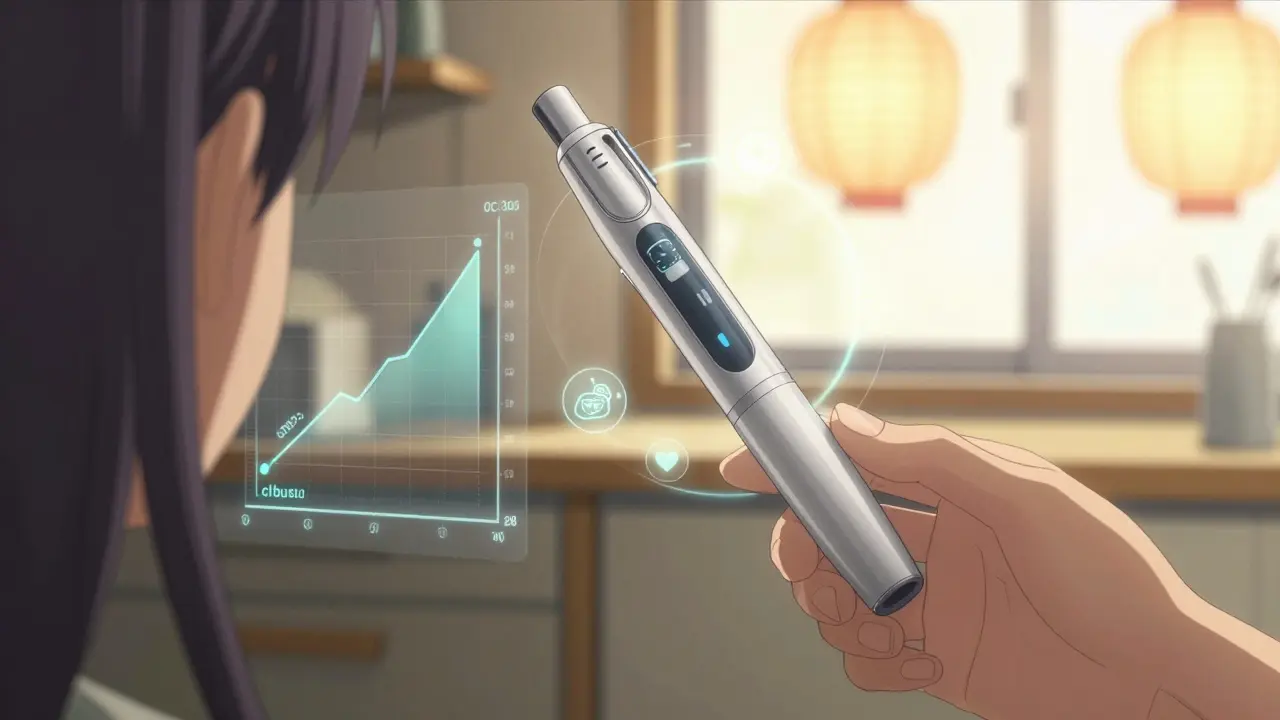
Most people think of CGMs as the star of diabetes tech. But smart insulin pens are the unsung heroes. The InPen by Medtronic looks like a regular pen, but it records every dose you give, tracks timing, and even suggests your next dose based on your CGM data and recent meals.
It’s not flashy. You won’t see TikTok videos about it. But for people juggling multiple daily injections, it’s a lifesaver. It reduces guesswork. It prevents double-dosing. It syncs with apps to show your insulin-on-board and carb ratios. And it’s especially helpful if you’re on multiple daily injections or use a basal-bolus plan.
Still, adoption is low. Only about 15% of insulin users use smart pens, according to 2025 data from ADCES. Why? Cost. Insurance coverage is spotty. Many people don’t even know they exist. But for those who use them, the benefit is clear: fewer errors, less mental load, and better control.
Apps That Talk to Your Devices (And Which Ones Actually Work)
CGMs and smart pens are useless if their data stays trapped in their own apps. The magic happens when everything talks to each other.
Apps like mySugr, One Drop, and Glucose Buddy pull in data from Dexcom, Libre, and InPen. They show trends, calculate carb ratios, log meals, and even generate reports for your doctor. But here’s the catch: not all apps work with all devices. Only 43% of third-party apps fully integrate with every major CGM system, according to the 2025 Diabetes Technology Conference.
That means if you buy a Libre 3, you can’t just pick any app. You need to check compatibility before you download. Some apps lock you into one brand. Others let you mix and match. If you use multiple devices-say, a Dexcom and an InPen-choose an app that supports both. Otherwise, you’ll be switching between three different screens every day.
Even better? Apps with AI features. Dexcom and EarlySense are rolling out predictive algorithms in 2026 that can warn you 30 minutes before a low or spike hits. It’s like a weather forecast for your blood sugar. One user in Melbourne told me she stopped waking up at 3 a.m. after her app predicted a drop and alerted her to eat a snack before bed. That’s not science fiction. That’s now.
Real People, Real Results
Numbers are great. But real change happens in daily life.
A 2025 survey of 1,243 people on Reddit’s r/diabetes community found that 78% slept better after starting a CGM. Why? Nighttime alerts. No more panic checks. No more guessing if you’re low. 63% said they felt less anxious about unexpected highs and lows. And 82% said they’d never go back to fingersticks.
One remote program in the U.S. helped people lower their A1c from 10.4% to 7.5% in just three months using CGMs alone. Foot wounds healed 72% faster. That’s huge. For people without easy clinic access-rural residents, low-income families, older adults-CGMs became their lifeline.
But it’s not perfect. 45% of users report sensors falling off during exercise or hot weather. Insurance denials are common-even with coverage, 37% of commercially insured people get denied prior authorization. And for the uninsured? Out-of-pocket costs can hit $300 a month.
What’s Next? Implants, AI, and Needle-Free Insulin
The future is already here. Glucotrack’s implantable sensor could launch in 2028. Vaxess Technologies is testing a patch that delivers semaglutide (Ozempic) without needles-big for people who hate injections. And AI is getting smarter. Systems are learning your habits: how your glucose reacts to coffee, stress, or a late workout.
Combining CGMs with automated insulin delivery (AID) systems like Tandem’s Control-IQ is proving powerful. One 2025 study showed people using Control-IQ with semaglutide lost an average of 18 pounds while improving their time in range-without more lows.
But here’s the catch: data security. A 2025 JAMA study found 63% of CGM systems have vulnerabilities that could let someone manipulate your glucose readings. That’s not theoretical. It’s a real risk. Manufacturers are working on fixes, but you should know: your data isn’t always safe.

Getting Started: What You Need to Do Today
If you’re ready to try CGM tech, here’s how to begin:
- Check your insurance. Medicare now covers CGMs for Type 2 diabetes on insulin. Many private insurers do too. Call your provider and ask about prior authorization.
- Talk to your endocrinologist or diabetes educator. Ask which system they recommend based on your lifestyle. Do you swim? Travel? Work nights? That affects sensor choice.
- Don’t skip training. 78% of people who stick with CGMs complete formal education. Those who don’t often quit within weeks.
- Customize your alerts. Default settings are too loud. Set your low alert at 70 mg/dL if you’re prone to lows. Raise it to 80 if you’re older. Set high alerts based on your personal goals.
- Pair your CGM with a compatible app. Test it for a week. If it’s clunky, switch.
It takes 2 to 4 weeks to feel comfortable. But once you do, you won’t remember how you lived without it.
Still on the Fence? Here’s the Truth
You might think, ‘I’m fine with fingersticks.’ But here’s what you’re missing: you’re flying blind. You don’t see the spikes after lunch. You don’t know why your sugar crashes at 2 a.m. You’re reacting, not preventing.
CGMs don’t cure diabetes. But they give you back control. Less guessing. Less fear. More sleep. More freedom.
And if cost is the barrier? Look into patient assistance programs. Abbott and Dexcom offer discounts. Nonprofits like Beyond Type 1 help with funding. You don’t have to pay full price.
This isn’t about having the fanciest tech. It’s about having the right tools to live well. And that’s something everyone with diabetes deserves.
Are CGMs accurate enough to replace fingersticks?
CGMs are highly accurate-most have a MARD score under 9%, meaning they’re within 9% of a lab test. But they’re not perfect during rapid changes, like after eating or exercising. Always confirm with a fingerstick if you feel symptoms of low or high blood sugar, or if the CGM reading doesn’t match how you feel.
Can I use a CGM if I have Type 2 diabetes and don’t take insulin?
Yes, but insurance coverage is limited. The American Diabetes Association recommends CGMs for Type 2 patients on insulin, but not yet for those on oral meds alone. Some people choose to pay out-of-pocket for insight into how food affects them. If you’re struggling with blood sugar control, talk to your doctor-CGM might still be worth considering.
How long do CGM sensors last?
Dexcom G7 lasts 10 days, Abbott Libre 3 lasts 14 days, and Medtronic Guardian 4 lasts 7 days. Some people stretch them a little longer, but accuracy drops after the recommended time. Always follow the manufacturer’s guidelines.
Do smart pens work with all CGMs?
Not all. The InPen by Medtronic works with Dexcom and Libre systems, but you need to pair them manually in the app. Always check compatibility before buying. Some pens only sync with their own brand’s CGMs.
Is it safe to share my CGM data with family or caregivers?
Yes, and it’s often recommended-especially for children, older adults, or people with hypoglycemia unawareness. Most CGM systems let you share data via apps like Dexcom Share or Libre LinkUp. Just make sure your privacy settings are set correctly and that you trust the people you’re sharing with.
What’s the biggest mistake new CGM users make?
Ignoring the data. Many people put on the sensor, check the app once, and forget about it. The power of CGM comes from looking at trends over days-not just single readings. Spend 10 minutes each morning reviewing your glucose patterns. That’s how you learn what works.




There are 16 Comments
lisa Bajram
Okay but let’s be real-CGMs changed my life. I used to wake up at 3 a.m. sweating and shaking, convinced I was dying. Now? My phone buzzes, I chug juice, and go back to sleep. No more panic. No more guesswork. I didn’t think I’d ever say this, but I’m kinda emotional about a sensor stuck to my arm.
Also, Libre 3? Absolute beast. Slimmer than my credit card, lasts two weeks, and my dog doesn’t even notice it’s there. I wear it while swimming, hiking, and dancing at weddings. Yes, I danced at my cousin’s wedding. Don’t judge me.
And yes, insurance denied me twice. But I called, screamed politely, and got it approved. You can too. Don’t let bureaucracy steal your peace.
Jaqueline santos bau
Ugh. I just don’t understand why people make such a big deal about this. I’ve had diabetes for 20 years and I’m fine with fingersticks. You’re all acting like you just discovered fire. Honestly, it’s almost embarrassing how obsessed you are with gadgets. Do you even remember what life was like before smartphones? I do. And I’m not nostalgic for this.
Kunal Majumder
As someone from India who’s seen insulin costs skyrocket, I can’t stress enough how important this tech is. My cousin in Delhi got a Libre 2 last year-paid out of pocket, it was a stretch-but now she’s sleeping through the night. No more emergency trips to the clinic at 2 a.m.
And smart pens? Game changer for my uncle who’s on 5 injections a day. He used to forget doses, mix up types… now the pen tells him. Simple. Clean. No drama.
Yes, cost is brutal here. But if you can get one even once a month, it’s worth it. Your body will thank you.
Aurora Memo
I appreciate how thorough this post is. I’ve been using a Dexcom G7 for a year now, and the biggest shift wasn’t the numbers-it was the quiet. The absence of constant anxiety.
I used to check my sugar before every meal, after every meal, before bed, after bed, during meetings, while driving… it was exhausting. Now I glance at my phone once a day just to see the trend. The rest? My body tells me.
And yes, I still fingerstick when I feel off. Tech is a tool, not a replacement for awareness. Thank you for saying that.
chandra tan
Back home in Kerala, my aunt got a CGM through a nonprofit program. She’s 72, never used a smartphone before. Took her two weeks to get used to the app. Now? She sends me screenshots every morning like it’s a diary. ‘Look, Beta, no lows today!’
She doesn’t care about MARD scores or sensor life. She cares that she can walk to the temple without fear. That’s the real win.
Technology shouldn’t be a privilege. It should be a right.
Dwayne Dickson
While the anecdotal evidence presented here is compelling, one must exercise rigorous epistemological caution. The referenced 2025 survey of 1,243 Reddit users is not peer-reviewed, lacks demographic stratification, and is subject to significant selection bias. Furthermore, the assertion that CGMs reduce nocturnal hypoglycemia by 78% is not substantiated by a control cohort.
That said, the clinical utility of continuous monitoring is not in dispute. The real issue lies in the commercialization of medical technology and the commodification of patient anxiety. One must ask: who benefits from this narrative? The manufacturers? The insurers? Or the patients?
Proceed with skepticism. And a good data plan.
Ted Conerly
If you’re still on fingersticks, you’re not just behind-you’re running in place. I used to check 12 times a day. Now? I check twice. Once in the morning, once before bed. The rest? My CGM handles it.
And smart pens? I didn’t believe in them until I accidentally double-dosed on insulin because I was distracted. The InPen flagged it. Saved me from a hospital trip.
Yes, cost sucks. But if you can’t afford it, call Abbott or Dexcom. They’ll help. Seriously. They have programs. Don’t let money be the reason you’re still scared to sleep.
Faith Edwards
It’s rather disheartening to witness the uncritical adoration of corporate medical technology. These devices are not miracles-they are profit-driven products with documented security vulnerabilities and proprietary lock-in systems. The fact that people are celebrating a sensor that transmits data to a smartphone-without questioning who owns that data-is frankly alarming.
And let’s not pretend that the ‘freedom’ these devices provide isn’t contingent upon insurance approval, prior authorization, and the whims of a for-profit healthcare system.
True liberation lies in systemic reform, not in wearing a branded bandage that reports your glucose to a corporation.
Jay Amparo
I’ve been using Libre 3 for 11 months now, and honestly? It’s the first time I’ve felt like my diabetes isn’t running my life.
My wife says I’ve become more patient. Less snappy. I think it’s because I’m not constantly terrified of crashing. I can go out with friends, have a drink, eat pizza, and not spiral.
And the app? It shows me that coffee spikes me by 40 points. Who knew? Now I drink it with a snack. Small changes. Big results.
To anyone hesitating: just try it for two weeks. You won’t regret it. And if you’re worried about cost? There’s help. I got mine for $30 a month through a program. Seriously. Ask your doc. They’ll point you in the right direction.
Lisa Cozad
I love how this post doesn’t just sell tech-it talks about the real stuff: sensors falling off during yoga, insurance denials, the mental load of managing it all.
I’m a nurse. I’ve seen people quit CGMs because they felt overwhelmed. That’s not failure. It’s burnout.
Start small. One alert. One trend. One morning where you just look at the graph and breathe. You don’t need to be a data wizard. You just need to show up.
And if your doctor doesn’t get it? Find one who does. You deserve that.
Saumya Roy Chaudhuri
Everyone’s talking about Libre and Dexcom like they’re the only options. What about the Medtronic Guardian 4? It’s better for pump users. And Glucotrack? That’s not even FDA-approved yet. People are acting like it’s already on the market. Stop hyping unproven tech. You’re giving false hope.
Also, why are you all ignoring the fact that CGMs are still inaccurate during rapid changes? I had a 180 reading after eating a banana-fingerstick said 110. I almost ate glucose tabs. Don’t trust the app blindly.
Ian Cheung
CGMs didn’t just help me manage my diabetes they gave me my life back
I used to cancel plans because I was scared of lows
Now I go hiking I go dancing I go to concerts
My sugar doesn’t control me anymore
And yes I still fingerstick when I feel off
But now I’m not scared
I’m prepared
That’s the difference
anthony martinez
Wow. So we’re supposed to be impressed that a company made a sensor that doesn’t fall off *most* of the time? And that a pen reminds you not to inject twice? This isn’t innovation. It’s damage control.
Meanwhile, the real problem-healthcare inequality, insulin pricing, lack of access-is still untouched.
But sure, let’s celebrate the band-aid while the house burns down.
Mario Bros
My 12-year-old got a CGM last year. First night? She cried because she didn’t have to wake up to check her sugar.
Now she sleeps through the night. She plays soccer. She doesn’t feel like a burden.
And yeah, the app sometimes glitches. And yeah, the sensor peels off during swim practice.
But she’s not scared anymore.
That’s worth every penny.
Also, if you’re on the fence? Just try it for 2 weeks. You’ll thank yourself.
Jake Nunez
Biggest thing no one talks about? The emotional weight of the data.
Seeing your glucose graph after a bad day at work? It’s like seeing your anxiety made visible.
I used to think stress was just ‘in my head.’ Now I see it on the screen. 200 after a fight with my boss. 60 after skipping lunch because I was ‘too busy.’
It’s not just tech. It’s a mirror.
And sometimes, that’s the hardest part.
Dwayne Dickson
While the sentiment expressed by commenter 6725 is emotionally resonant, it lacks methodological grounding. The assertion that ‘CGMs gave me my life back’ is a subjective narrative that cannot be generalized without statistical validation. One must also consider the potential for technophilia to mask systemic failures in healthcare delivery.
That said, the reduction in nocturnal hypoglycemia events, if reproducible in clinical trials, remains a significant clinical achievement. One must, however, remain vigilant against the conflation of technological convenience with therapeutic efficacy.
Write a comment
Your email address will not be published. Required fields are marked *