

When you pick up a generic pill at the pharmacy, you expect it to work just like the brand-name version. But how do regulators know it really does? The answer lies in something called dissolution profile comparison-a scientific test that shows how quickly and completely a drug dissolves in the body. This isn’t just technical jargon. It’s the backbone of proving that a generic drug is safe and effective without running expensive and time-consuming human trials.
Why Dissolution Profiles Matter
Every pill you swallow has to break down in your stomach or intestines before the medicine can get into your bloodstream. If a generic drug dissolves too slowly, too quickly, or unevenly compared to the brand-name version, it might not work the same way. That’s why regulators don’t just look at the active ingredient-they look at the entire release pattern over time. The FDA and other global agencies accept dissolution profile comparison as a stand-in for clinical bioequivalence studies under specific conditions. In fact, about 78% of generic drug applications submitted to the FDA between 2022 and 2023 used this method. Why? Because it cuts development costs by up to 60% and speeds up approval by 12 to 18 months. For patients, that means faster access to affordable medications. For manufacturers, it means less risk and lower prices.How Dissolution Testing Works
Imagine a machine that mimics your digestive system. That’s what a dissolution apparatus does. The most common setup uses USP Apparatus 2 (paddles) spinning at 50 to 100 revolutions per minute in a liquid bath held at exactly 37°C-the same temperature as your body. The drug tablet or capsule is placed in this solution, and samples are taken at regular intervals-usually every 5 to 30 minutes-to measure how much drug has dissolved. Testing isn’t done on one or two tablets. You test 12 individual units for both the generic and the brand-name product. Why? Because real-world products vary slightly. One tablet might dissolve a little faster than another due to minor manufacturing differences. Testing 12 units gives you a real picture of the batch’s behavior, not just an ideal case. The test runs until at least one product reaches 85% dissolution. The media used (the liquid) depends on the drug. For most oral tablets, that means starting with pH 1.2 (like your stomach), then moving to pH 4.5 and pH 6.8 (like your small intestine). For poorly soluble drugs, surfactants might be added to better mimic real digestion.The f2 Similarity Factor: The Gold Standard
The most widely accepted way to compare two dissolution profiles is the f2 similarity factor. Developed in 1996 by Moore and Flanner, it’s now used in over 92% of FDA submissions. Here’s how it works: The f2 formula compares the percentage of drug dissolved at each time point between the test (generic) and reference (brand) products. A value of 100 means the profiles are identical. A value between 50 and 100 means they’re similar enough to be considered equivalent. For example, if both the brand and generic release 20% at 15 minutes, 55% at 30 minutes, and 85% at 60 minutes, the f2 score will likely be above 60. That’s good. But if the brand hits 85% at 45 minutes and the generic only gets to 60% at that point, the f2 score drops-sometimes below 50. That’s a red flag. But here’s the catch: f2 isn’t perfect. It doesn’t care about the shape of the curve, only the numbers. Two profiles could have the same f2 score but different release mechanisms-one might burst open quickly, the other might release slowly and steadily. That’s why experts say f2 > 50 is necessary, but not sufficient.When f2 Isn’t Enough
Some drugs are tricky. Highly soluble drugs (like amlodipine or metoprolol) dissolve so fast that even tiny differences in tablet hardness or coating cause wild variability. In these cases, f2 scores often fall just below 50-even when the drugs work the same in patients. That’s where alternatives come in. One option is f2 bootstrapping: running the f2 calculation 1,000 to 10,000 times with random data samples to estimate a confidence interval. If the lower bound of that interval is still above 50, regulators may accept it. Another option is the Mahalanobis Distance Test (MDT). It looks at the entire profile as a multi-dimensional shape, not just individual time points. In one 2021 study, MDT correctly flagged dissimilar profiles 94% of the time, compared to 82% for f2 bootstrapping. But MDT needs specialized software and trained statisticians-something smaller labs can’t always afford. For drugs with a narrow therapeutic index (like warfarin or levothyroxine), regulators are tightening the rules. The FDA’s 2023 draft guidance suggests f2 ≥ 65 instead of 50. Why? Because small differences in absorption can lead to serious side effects or treatment failure.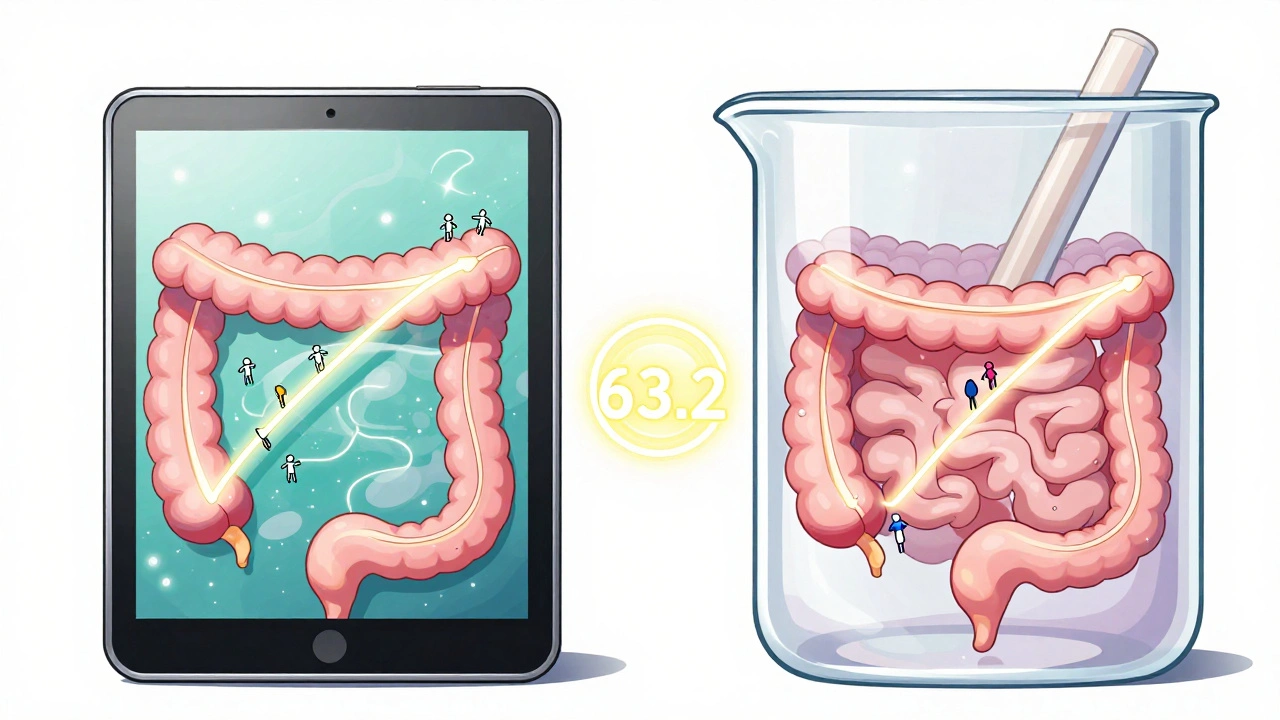
What About the AUC?
Many experts now combine f2 with another metric: the area under the dissolution curve (AUC). Think of AUC as the total amount of drug released over time. If the AUC ratio between generic and brand is between 0.80 and 1.25, and the f2 is above 50, the chances of true bioequivalence jump by 23%. This combo approach is now standard for biowaiver applications-requests to skip human trials based on dissolution data alone. The FDA reviewed 87 drugs in 2019 and found that f2 + AUC was far more predictive than f2 alone. For BCS Class I drugs (highly soluble and highly permeable), this is often enough to get approval without a single human subject.Real-World Challenges
It’s not all smooth sailing. A 2022 survey of 127 quality control labs found that 73% of failed dissolution comparisons were due to problems with the testing method-not the product. Things like poorly calibrated paddles, temperature drift, or inconsistent media pH can make a good drug look bad. One Pfizer scientist shared on a pharmaceutical forum that his team once had to completely redesign a formulation because f2 scored 49.8-even though clinical data showed no difference in patient outcomes. That’s the paradox: the test is so sensitive, it sometimes rejects products that work perfectly. On the flip side, Teva Pharmaceuticals got approval for a generic amlodipine tablet with an f2 of 63.2 by simply improving paddle alignment and ensuring sink conditions (enough liquid to keep the drug dissolved). They saved $1.2 million by avoiding a full bioequivalence study.What Makes a Good Dissolution Method?
A good test doesn’t just measure dissolution-it distinguishes. The FDA requires that the method can detect differences caused by stress conditions: overheating, aging, or under-compressing tablets. If your method can’t tell apart a well-made tablet from a damaged one, it’s not discriminatory enough. Developing such a method takes 8 to 12 weeks. You test multiple pH levels, different agitation speeds, and stressed samples. You validate every step. You document everything: calibration records, software code, raw data. The FDA’s 2021 Data Integrity guidance makes this non-negotiable.
What This Means for You
If you’re a patient, this system means you can trust your generic medication. The same standards apply whether you’re taking brand-name Lipitor or its generic version. The difference isn’t in effectiveness-it’s in cost. If you’re a pharmacist, understanding dissolution profiles helps you answer patient questions with confidence. You can explain why generics are safe, even when they look different. If you’re in the industry, mastering dissolution profile comparison isn’t optional-it’s essential. The global market for dissolution testing equipment is growing at 7.2% per year. Companies that invest in better methods, better training, and better data systems are the ones that get approvals faster and stay ahead.What’s Next?
The future of dissolution testing is smarter and more personalized. Biorelevant media-liquids that mimic real stomach and gut conditions-are becoming standard, especially for drugs that don’t dissolve well. Machine learning is being piloted by 37% of top pharma companies to predict how a dissolution curve will translate to human absorption. Regulators are moving toward risk-based approaches. For a low-risk drug like ibuprofen, f2 ≥ 50 might be enough. For a high-risk drug like digoxin, you’ll need f2 ≥ 65, AUC checks, and maybe even in vivo data. By 2026, the FDA and EMA plan to fully align on biorelevant dissolution standards. That means one global rulebook for generic drug approval. For patients, that means more consistent access to safe, affordable medicines worldwide.Key Takeaways
- Dissolution profile comparison proves generic drugs work like brand-name versions without human trials.
- The f2 similarity factor (50-100) is the industry standard, but it’s not foolproof.
- For accurate results, test 12 units under controlled conditions with validated methods.
- Combine f2 with AUC ratios (0.80-1.25) to improve prediction of bioequivalence.
- Highly soluble drugs (BCS Class I) are easiest to approve via dissolution testing.
- Method variability causes more failures than product differences-calibration matters.
- Regulators are tightening criteria for high-risk drugs and embracing new tech like AI and biorelevant media.
What is the f2 similarity factor and why is it important?
The f2 similarity factor is a mathematical tool used to compare how similar two drug dissolution profiles are. It calculates the difference between the test (generic) and reference (brand) products at each time point. A value between 50 and 100 means the profiles are similar enough to be considered equivalent. It’s important because it allows regulators to approve generic drugs without running expensive and time-consuming human bioequivalence studies.
Can a generic drug have a different dissolution profile and still be safe?
Yes, but only if the differences are minor and don’t affect how the drug is absorbed. If the f2 score is below 50, regulators usually require additional testing. However, there are cases where f2 scores slightly below 50 still correspond to clinically equivalent outcomes. That’s why experts now recommend looking at the full profile-not just the f2 number-and using other tools like AUC and statistical modeling to make the final call.
Why do some generic drugs look different from the brand name?
Generic drugs can look different because they use different inactive ingredients (like dyes, fillers, or coatings) to avoid patent issues. These changes don’t affect the active ingredient’s performance as long as the dissolution profile matches the brand. The FDA requires that generics have the same strength, dosage form, route of administration, and dissolution behavior-appearance is not part of the requirement.
How do regulators ensure dissolution tests are accurate?
Regulators require strict validation of dissolution methods. Equipment must meet USP <711> standards for paddle alignment, temperature control, and vessel concentricity. Labs must use NIST-traceable thermometers and calibrated instruments. Testing must be done in triplicate across multiple time points, and all raw data, calibration logs, and statistical code must be preserved for audit. Any method that can’t detect differences in stressed samples is rejected.
Are dissolution tests used for all types of drugs?
No. Dissolution profile comparison is mainly used for immediate-release solid oral dosage forms-like tablets and capsules. It’s most reliable for BCS Class I (highly soluble, highly permeable) and Class III (highly soluble, low permeability) drugs. For poorly soluble drugs (Class II and IV) or modified-release products, additional testing, including biorelevant media or in vivo studies, is often required.
What’s the difference between f1 and f2?
f1 is the difference factor-it measures absolute differences between two profiles and should be between 0 and 15. f2 is the similarity factor-it measures how close the curves are overall and should be between 50 and 100. While f1 gives you raw numbers, f2 gives you a more intuitive sense of similarity. Regulatory submissions typically use f2 as the primary metric, with f1 as a secondary check.



There are 11 Comments
Raja Herbal
So let me get this straight-we’re trusting our lives to a number between 50 and 100 that some machine spat out after spinning a paddle in warm water? And we call this science? I mean, I get it, cheaper meds = good. But also… what if my grandma’s blood pressure meds dissolve like a sugar cube in tea and the brand’s is a slow-burn candle? 😅
Iris Carmen
fr tho i just took my generic adderall and it felt like someone replaced the caffeine with a wet sock. i mean, the pill looks the same, but… why does my brain feel like it’s running on dial-up now? 🤔
Rich Paul
Bro the f2 factor is literally just a glorified R-squared for dissolution curves. You got your 12-unit batch, you fit a spline, you calculate mean squared deviation across timepoints, normalize it, and boom-you get a number that statistically says ‘close enough’ but ignores kinetics, surface area, polymorph shifts, and sink conditions. And don’t even get me started on how most labs use expired USP media. I’ve seen f2 scores of 68 on drugs that had 15% crystalline impurity. The system’s broken. It’s not the drugs-it’s the method.
Lauren Dare
Oh wow, so the FDA lets you skip human trials based on a paddle spinning in a beaker? That’s… wild. I mean, I get cost savings, but if your ‘bioequivalence’ is based on a machine that can’t even replicate the actual churning of a human gut, maybe we should stop pretending this is medicine and start calling it… corporate math.
Gilbert Lacasandile
I really appreciate how thorough this breakdown is. It’s easy to be skeptical about generics, but seeing the actual science behind it-like testing 12 units and using biorelevant media-makes me feel way more confident. Thanks for explaining why this isn’t just ‘same pill, cheaper price’ but actual rigor.
Lola Bchoudi
Just a quick note for anyone new to this: f2 > 50 is the minimum, but it’s not the finish line. Pair it with AUC and you’re talking real predictive power. Also, don’t underestimate calibration-your paddle alignment can make or break your entire batch. Invest in the tools, train your techs, and document everything. It’s not optional anymore. The FDA’s watching.
Morgan Tait
Have you ever wondered why the same generic pill from different manufacturers gives you different side effects? It’s not coincidence. Big Pharma owns the dissolution standards. They design the tests. They control the reference drugs. And if your generic doesn’t match their proprietary curve? You’re ‘not equivalent’-even if your body says otherwise. This isn’t science. It’s a patent-protected monopoly disguised as regulation.
Darcie Streeter-Oxland
It is, of course, deplorable that the regulatory framework for generic drug approval has been reduced to a mathematical approximation of dissolution kinetics, with minimal consideration for inter-individual pharmacokinetic variability. One might reasonably argue that the absence of in vivo data constitutes a profound epistemological deficit in the evidentiary chain supporting therapeutic equivalence.
Katie Harrison
As someone who’s had to switch generics three times due to insurance changes… I’ve noticed differences. Not always dramatic-but sometimes, yes. I’m not saying the system is broken. I’m saying it’s fragile. And we need more transparency-not just about f2 scores, but about which company made the pill, what excipients were used, and whether the dissolution method was validated under real-world conditions. Patients deserve that.
Mona Schmidt
One thing this post doesn’t mention enough: the role of excipients. Even if the active ingredient matches perfectly, changes in fillers, binders, or coatings can alter dissolution rates. That’s why some generics cause stomach upset even when f2 > 70. We need better labeling-not just for pharmacists, but for patients. ‘Contains lactose’ or ‘has enteric coating’ should be as visible as the dosage.
Guylaine Lapointe
Wow. Just… wow. You spent 2,000 words explaining how a paddle in a beaker is the cornerstone of modern drug approval, and no one’s asking: Why do we still use 1970s technology to test 2024 medicines? We have AI models that can simulate gut motility, we have microfluidic chips that mimic intestinal flow, and we’re still spinning metal blades in warm water? This isn’t innovation. It’s inertia. And it’s dangerous.
Write a comment
Your email address will not be published. Required fields are marked *