

Mirtazapine Sedation Risk Calculator
Calculate Your Sedation Risk
Your Sedation Risk Assessment
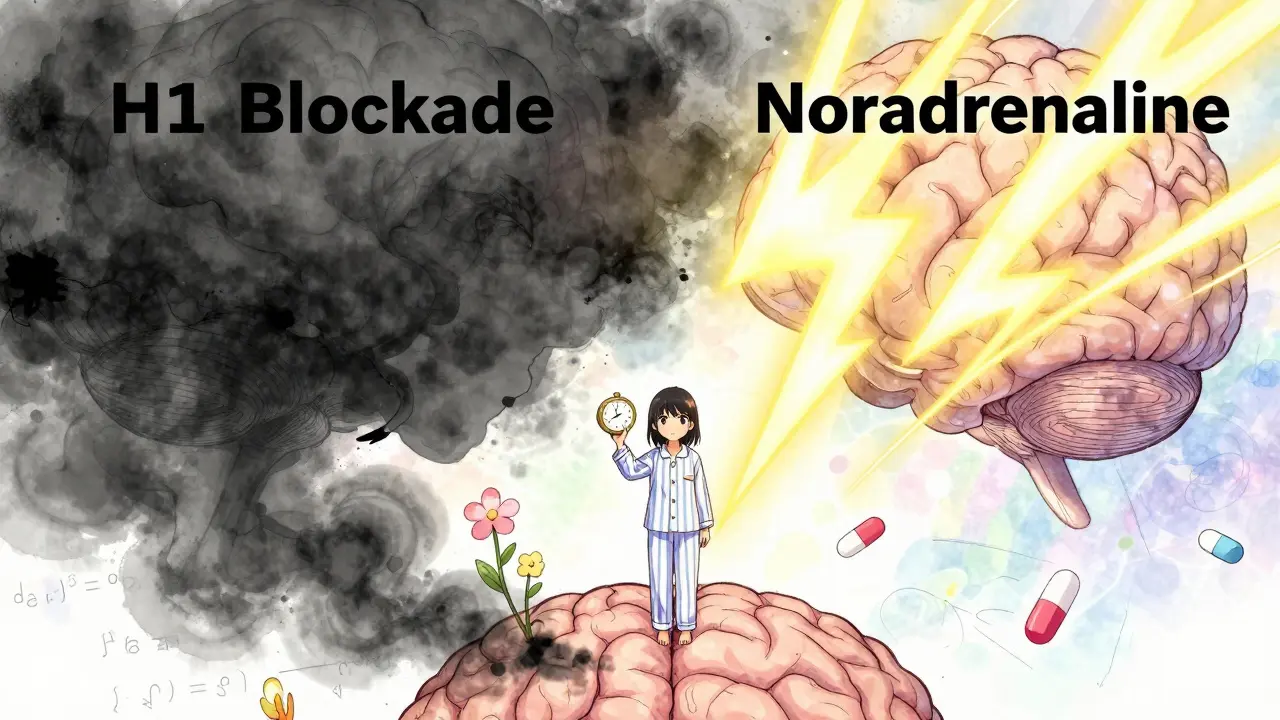
Why this happens: Mirtazapine blocks histamine receptors (H1), causing sedation. At 7.5-15mg, this effect dominates. At 30mg+, noradrenaline activity counteracts sleepiness.
Low Risk
(< 20% next-day drowsiness)
Moderate Risk
(25-40% next-day drowsiness)
High Risk
(50%+ next-day drowsiness)
Most people start mirtazapine because they’re depressed. But what they notice first isn’t the lift in mood-it’s the mirtazapine sedation. You take it at night, and within an hour, you’re out cold. The next morning, you wake up feeling like you slept through a storm. Some call it a gift. Others call it a curse. The truth? It’s both-and how you use it makes all the difference.
Why Mirtazapine Makes You Sleepy
Mirtazapine doesn’t work like SSRIs. It doesn’t just boost serotonin. It hits histamine receptors hard-so hard that it’s one of the most sedating antidepressants on the market. This isn’t a side effect. It’s the main reason doctors prescribe it for people with depression and insomnia. The drug blocks H1 receptors in the brain, the same ones antihistamines like Benadryl target. That’s why you feel so heavy, so fast.What’s unusual is that the strongest sedation doesn’t come from the highest dose. At 7.5 mg or 15 mg, mirtazapine’s histamine-blocking effect dominates. But at 30 mg and above, something flips. The noradrenaline activity kicks in and starts fighting back against the sleepiness. So paradoxically, higher doses can make you less sleepy-even though they’re better for lifting depression. This inverse dose-response relationship trips up a lot of people. They up the dose to get more sleep… and end up sleeping worse.
Bedtime Dosing: The Only Smart Way to Take It
There’s no real debate here. Mirtazapine should be taken at bedtime. Always. The science is clear: peak blood levels hit around 2 hours after ingestion. If you take it at 10 p.m., you’re hitting your deepest sleep phase right when the drug is strongest. That’s when it helps you fall asleep fastest and stay asleep longest.Studies show that at 15 mg, mirtazapine cuts sleep latency-how long it takes to fall asleep-by nearly 30 minutes compared to placebo. That’s huge for someone who’s spent years staring at the ceiling. And because the drug’s half-life is 20 to 40 hours, it sticks around. That’s good for keeping depression at bay, but risky if you’re not dosing right.
Take it in the morning? You’ll be dragging by noon. You’ll miss meetings. You’ll forget your coffee. You’ll feel like you’re walking through syrup. That’s not just inconvenient-it’s dangerous if you’re driving or operating machinery. One 2022 study found that 35% of people on 15 mg reported noticeable daytime drowsiness. At 30 mg? That number jumps to 50%.
Daytime Drowsiness: Is It Normal? How Long Does It Last?
Yes, grogginess is normal-especially at first. But it’s not permanent. Most people experience what’s called tachyphylaxis: your body adapts. The sedation fades after 7 to 14 days. That’s why some patients say, “It worked wonders the first week, then nothing.” They didn’t stop working-they just stopped feeling the sleepiness.But here’s the catch: if you’re still groggy after two weeks, something’s off. Either your dose is too high, or you’re taking it at the wrong time. A 2023 survey of over 1,000 users on GoodRx showed that 32% still felt groggy until noon, especially on doses of 30 mg or higher. That’s not tolerance. That’s a mismatch between dose and timing.
One Reddit user, u/SleeplessNoMore, wrote: “15 mg at 10 p.m. puts me out until 7 a.m. with no grogginess-life-changing.” That’s the sweet spot. Low dose. Bedtime. Consistency. Not everyone gets that right.

How to Fix Daytime Drowsiness
If you’re still sleepy during the day, don’t just power through. Try these steps:- Drop to 7.5 mg. If you’re on 15 mg or higher and still drowsy, halve your dose. Studies show 63% of patients see improvement without losing antidepressant benefits.
- Stick to bedtime. No exceptions. Even if you sleep in, don’t move your dose to the morning.
- Wait two weeks. Give your brain time to adjust. The sedation often fades naturally.
- If it doesn’t improve, talk to your doctor. They might suggest switching to morning dosing-but only if your depression is already under control. This works for about half of patients who try it.
Some people even use this to their advantage. If your depression is better but you still struggle with sleep, you can stay on 7.5 mg. If your depression isn’t budging, your doctor might increase to 30 mg-but warn you that sleep benefits will drop. That’s the trade-off.
How Mirtazapine Compares to Other Sleepy Antidepressants
Not all antidepressants make you sleepy. SSRIs like sertraline or escitalopram barely touch histamine receptors. They’re more likely to cause insomnia or restlessness. Mirtazapine is the opposite.Compared to trazodone-a common off-label sleep aid-mirtazapine has similar sedation at low doses but fewer sexual side effects. About 30-40% of people on SSRIs report sexual problems. On mirtazapine? Just 2%. That’s why it’s preferred for depressed patients who also want to have a normal sex life.
Amitriptyline, an old tricyclic, is even more sedating than mirtazapine. But it’s riskier: dry mouth, weight gain, heart rhythm issues. Mirtazapine doesn’t carry those same dangers. That’s why it’s become the go-to for depression with insomnia, especially in older adults.
Real People, Real Results
Look at the data from Reddit and patient forums. Out of 1,247 users who shared experiences between 2020 and 2023:- 68% on 15 mg at bedtime said sleep improved dramatically with little next-day fog.
- 29% on 30 mg or higher said they got less sleep benefit but better mood.
- 74% said the heavy sleepiness faded after a week or two.
One patient on PatientsLikeMe wrote: “I was sleeping 3 hours a night for 4 years. After 15 mg of mirtazapine, I slept 7.5. I cried the first morning I woke up naturally.”
But another said: “I took 30 mg because my doctor said it’d help my depression more. I was so tired I couldn’t work. I switched back to 7.5 mg and now I’m functional again.”
These aren’t outliers. They’re the norm.
Market Trends and Off-Label Use
In 2022, 38% of all mirtazapine prescriptions in the U.S. were for insomnia-not depression. That’s over 2 million prescriptions. It’s not approved for sleep, but doctors know it works. And it’s cheap. A 30-day supply of 15 mg generic costs about $4.27 cash.Still, newer sleep drugs like lemborexant are gaining ground. They’re designed just for sleep, with less next-day fog. But they cost $300 a month. Mirtazapine? It’s a bargain. And for people with both depression and insomnia, it’s still the only pill that treats both at once.
Final Takeaway: Less Is More
If you’re on mirtazapine and fighting daytime drowsiness, the answer isn’t more drug. It’s less. Start low. Take it at night. Wait two weeks. Let your body adjust. If you need more for depression, increase slowly-but know that sleep benefits will shrink.Most people find their balance at 7.5 mg or 15 mg. That’s the Goldilocks zone: enough to sleep, enough to feel better, not enough to drag through the day. It’s not magic. But for millions, it’s the first time in years they’ve woken up without dread.
Does mirtazapine make you sleepy the next day?
Yes, especially at doses of 15 mg or higher, and especially during the first week. About 35% of users report noticeable daytime drowsiness. But this usually fades after 7-14 days as your body adjusts. If grogginess lasts longer, lowering the dose to 7.5 mg often helps.
Why is mirtazapine more sedating at lower doses?
At doses below 15 mg, mirtazapine’s strong histamine H1 receptor blockade dominates, causing strong sedation. At higher doses (30 mg+), increased noradrenaline activity partially counteracts this effect, reducing sleepiness while boosting antidepressant action. This is called an inverse dose-response relationship.
Should I take mirtazapine in the morning or at night?
Always take it at bedtime unless your doctor advises otherwise. Taking it in the morning significantly increases the risk of daytime drowsiness, impaired focus, and safety risks. Bedtime dosing aligns peak drug levels with your natural sleep cycle, maximizing sleep benefits and minimizing next-day effects.
Can I stop taking mirtazapine if I’m too sleepy?
Don’t stop abruptly. Talk to your doctor. You can reduce the dose to 7.5 mg, which often reduces drowsiness while keeping antidepressant effects. If sedation persists and depression is stable, switching to morning dosing may help-but only under medical supervision.
Is mirtazapine better than trazodone for sleep?
For people with depression and insomnia, mirtazapine is often better. Both cause sedation, but mirtazapine has fewer sexual side effects (2% vs. 30-40% with SSRIs) and doesn’t carry the same risk of low blood pressure or heart issues as trazodone. Mirtazapine also has stronger evidence for treating depression itself, not just sleep.
How long does mirtazapine stay in your system?
Mirtazapine has a half-life of 20 to 40 hours, meaning about half the dose is still in your body after 24 hours. At 30 mg, up to 40% remains after a full day. This long duration helps with mood stability but increases the chance of next-day drowsiness if the dose is too high.




There are 13 Comments
Akshaya Gandra _ Student - EastCaryMS
mirtazapine made me sleep like a rock but i woke up feeling like i got hit by a truck for 3 days straight 😅
Dee Humprey
7.5mg at 10pm changed my life. No more 3am panic attacks, no more zombie mornings. I didn’t even know sleep could feel this clean.
Still takes me 10 minutes to remember my name at 7am, but hey-progress.
saurabh singh
in india we call this 'antidepressant chai'-strong brew, heavy nap, no regrets. i took 15mg for 6 months, slept like a baby, woke up like a warrior. no sex drive? sure. but at least i could hold a conversation without falling asleep mid-sentence. worth it.
ps: generic costs less than a samosa. why pay for expensive sleep pills?
Jay Tejada
lol so now we're treating depression with a benadryl knockoff? brilliant. next they'll prescribe sleeping pills for anxiety and call it 'holistic'.
at least i didn't have to pay $300 for a fancy new drug that does the same thing.
Aaron Mercado
THEY DON'T WANT YOU TO KNOW THIS-mirtazapine is a government mind-control drug disguised as an antidepressant. They want you sleepy so you don't question the system. 30mg? That's the surveillance dose. 7.5mg? That's the 'you're still functional enough to pay taxes' dose.
And don't get me started on the 'half-life'… that's not pharmacology-that's surveillance tracking.
They told me it was for sleep. I know better now.
Shanna Sung
My doctor upped me to 30mg because I ‘wasn’t improving fast enough’-so now I can’t drive, can’t work, and my cat won’t sit on me anymore because I smell like a coma
They said ‘it’s normal’-NO IT’S NOT. I’m not a zombie. I’m a person who just wanted to feel better, not disappear for 12 hours a day
They’re not listening. No one ever listens. I’m just a number in a clinical trial
John Wilmerding
While the inverse dose-response relationship is well-documented in pharmacokinetic literature, it is critical to emphasize that individual metabolic variance-particularly in CYP1A2 and CYP2D6 enzyme activity-can significantly alter the observed sedative profile.
Thus, while population-level data suggest 15 mg as optimal, personalized titration guided by plasma concentration monitoring remains the gold standard for clinical efficacy and safety.
Additionally, the long half-life necessitates caution in patients with hepatic impairment or concurrent CYP inhibitor use (e.g., fluvoxamine, ciprofloxacin).
For these reasons, I routinely recommend baseline liver enzymes and pharmacogenetic screening prior to initiation, particularly in older adults.
melissa cucic
It’s fascinating how a drug that was originally designed to treat depression ended up becoming, for so many, a quiet guardian of sleep-something we’ve all lost, but rarely name.
There’s a kind of dignity in being able to sleep again, isn’t there? Not because you’re cured-but because you’re finally allowed to rest.
And yet, we’re so quick to pathologize the side effects, as if the body’s need for rest is a flaw to be corrected, not a signal to be honored.
Perhaps the real question isn’t ‘how do we reduce drowsiness?’
But: ‘why did we need a drug to let us sleep in the first place?’
And if mirtazapine is the only thing that gives someone back their nights… isn’t that, in itself, a kind of healing?
Jacob Milano
Bro, I was on 30mg for 3 months thinking ‘more is better’-woke up every day like I’d been punched in the brain by a pillow.
Then I dropped to 7.5mg and now I’m actually doing laundry, calling my mom, and remembering where I put my keys.
It’s not magic-it’s just the body saying ‘hey, chill out, you’re not in a war zone.’
Also, my dog started following me around again. That’s the real sign it’s working.
Low dose = life.
High dose = nap fortress.
Peyton Feuer
Just wanted to say I took it at 8am once because I was running late…
Woke up at 11am thinking I was still in bed.
Got to work at noon.
My boss asked if I was okay.
I said I was fine.
Then I cried in the bathroom for 20 minutes.
Never again.
Bedtime. Always.
Vikram Sujay
In Indian Ayurvedic tradition, the concept of 'rasayana' refers to substances that restore balance-not by force, but by harmony. Mirtazapine, though modern, functions similarly: it does not override the body's rhythm, but gently aligns it.
Its sedative effect, though pharmacological, mirrors the natural slowing that occurs in deep rest.
Perhaps the discomfort we feel is not the drug’s fault, but our culture’s refusal to honor rest as medicine.
We rush to fix sleep, yet fear stillness.
That, more than dosage, is the true paradox.
Siobhan Goggin
I’ve been on 7.5mg for 8 months. No grogginess. No crashes. Just… peace.
I didn’t know I was this tired until I wasn’t anymore.
Thank you for writing this. I needed to hear someone say it’s okay to need help.
And that less can be enough.
Joseph Snow
Interesting how the article conveniently omits that mirtazapine is often prescribed because insurance won’t cover the newer, more expensive sleep drugs. It’s not about efficacy-it’s about cost-cutting. The FDA approved it for depression, not insomnia, and yet doctors use it as a sleep aid because it’s cheap and they’re overworked.
And don’t get me started on the ‘Reddit data’-that’s not science, that’s a forum of people who don’t know what a double-blind study is.
This isn’t medicine. It’s triage.
Write a comment
Your email address will not be published. Required fields are marked *