

LDL Cholesterol Reduction Calculator
Your Cholesterol Management
Current LDL
0 mg/dL
After Statins
0 mg/dL
After Adding PCSK9 Inhibitor
0 mg/dL
Key Insight: PCSK9 inhibitors typically reduce LDL by an additional 50-61% when added to statins.
Insurance Note: PCSK9 inhibitors require proof of statin failure (LDL >70 mg/dL despite max statin) or documented intolerance.
Monthly Cost (Statins)
$4-$10
Monthly Cost (PCSK9 Inhibitor)
$400-$1,200
When it comes to lowering cholesterol, two main players dominate the conversation: statins and PCSK9 inhibitors. Both work to reduce LDL - the "bad" cholesterol - but they do it in completely different ways. And while statins have been the go-to for decades, PCSK9 inhibitors are changing the game for people who can’t tolerate them or still struggle to reach their targets.
How They Work: Two Different Paths
Statins have been around since the late 1980s. They block an enzyme in your liver called HMG-CoA reductase. That enzyme is responsible for making cholesterol. When it’s slowed down, your liver pulls more LDL out of your blood to make up for the loss. It’s a simple, effective system - and it’s why statins are taken by over 40 million Americans.
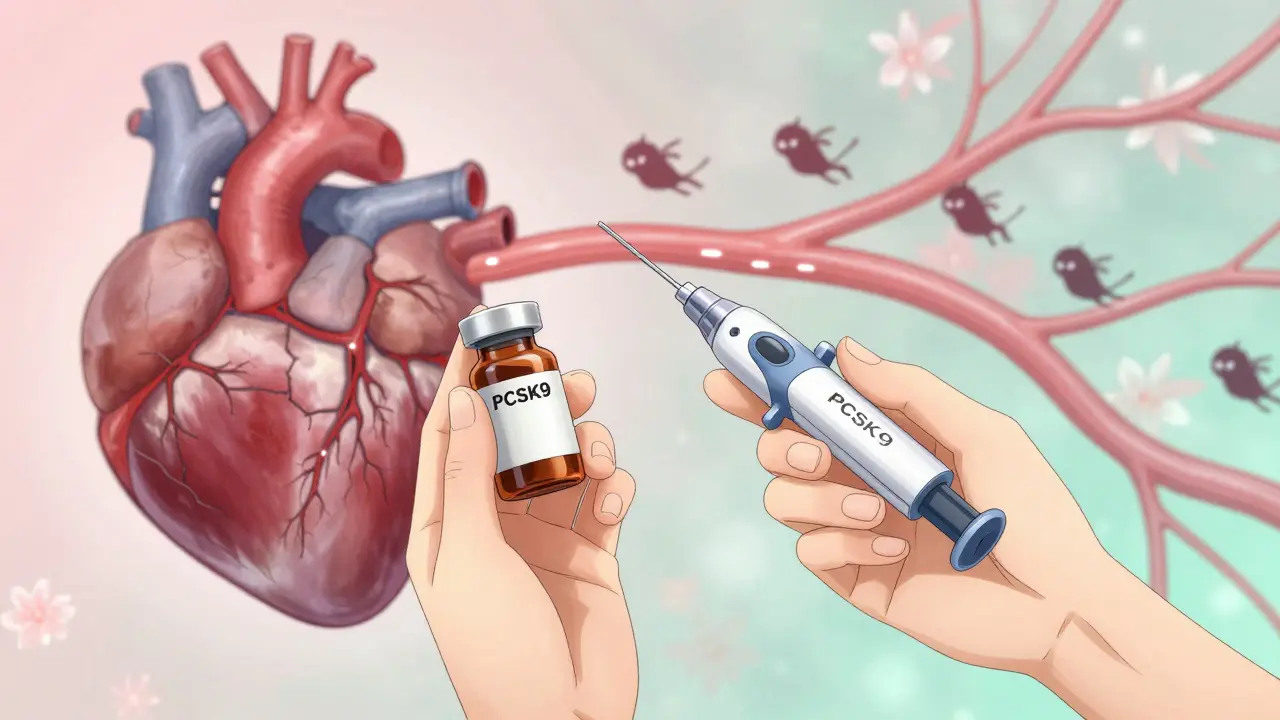
PCSK9 inhibitors, on the other hand, are newer. They’re injectable drugs like alirocumab and evolocumab, approved in 2015. Instead of stopping cholesterol production, they block a protein called PCSK9. That protein normally tells your liver to destroy LDL receptors. When you block PCSK9, your liver keeps more of those receptors on its surface. More receptors mean more LDL pulled out of your bloodstream. Think of statins as turning down the faucet, and PCSK9 inhibitors as opening more drains.
The result? Statins typically lower LDL by 30% to 50%. PCSK9 inhibitors drop it by 50% to 61%. For someone with very high risk - like a history of heart attack or familial hypercholesterolemia - that extra 20% can make a real difference.
Safety: What You Might Feel
Statins are effective, but they come with side effects that are common enough to be a dealbreaker for many.
About 5% to 10% of people on statins report muscle pain - sometimes mild, sometimes severe enough to stop the drug. In rare cases, this can lead to rhabdomyolysis, a serious muscle breakdown. Some people also report brain fog or memory issues, though studies haven’t proven a direct link. The good news? These side effects often go away if you switch to a different statin or lower the dose.
PCSK9 inhibitors don’t cause muscle pain. That’s one of their biggest advantages. In patient surveys, 79% of users say they don’t experience muscle issues after switching from statins. They also don’t affect the liver the same way statins do. No need for regular liver enzyme checks.
But they’re not side-effect-free. Injection site reactions - redness, swelling, or itching - happen in about 10% of users. Some people feel anxious about giving themselves shots, especially at first. And while long-term safety data is strong (over five years in major trials), we still don’t have decades of data like we do with statins.
Here’s another key point: statins slightly increase the risk of hemorrhagic stroke in certain people - especially those with high blood pressure or a history of bleeding in the brain. PCSK9 inhibitors show no such signal across 36 clinical trials. For someone at high risk for this type of stroke, that’s a major plus.
Effectiveness: Numbers That Matter
Let’s talk real-world outcomes. In the FOURIER trial, people with heart disease who took evolocumab (a PCSK9 inhibitor) on top of a statin cut their risk of heart attack, stroke, or death by 27% over two years. That’s not small. In the ODYSSEY trial, alirocumab showed similar results.
Statins, too, have proven they save lives. Over 40 years of data show they reduce heart attacks and strokes, especially in people with existing heart disease or diabetes. But for some, even the highest dose of a statin isn’t enough. If your LDL stays above 70 mg/dL despite taking the strongest statin possible, adding a PCSK9 inhibitor can get you to target - often below 55 mg/dL, which is now recommended for very high-risk patients.
Combining both? That’s the powerhouse approach. Together, they can drop LDL by up to 75%. That’s not just a number - it’s a shield against future heart events.
Cost: The Big Hurdle
This is where the gap gets wide.
Generic statins cost between $4 and $10 a month. You can get them at Walmart, Target, or Costco for under $5. They’re covered by almost every insurance plan. No prior authorization needed.
PCSK9 inhibitors? They cost $5,000 to $14,000 a year. That’s $400 to $1,200 a month. Insurance companies don’t just hand them out. Most require proof that you tried and failed on at least two statins, or that you have a documented intolerance - like muscle pain that didn’t go away with dose changes. Over 87% of insurers in the U.S. have these strict rules.
Some manufacturers offer support programs. Amgen and Sanofi have teams that help you navigate insurance paperwork, get copay assistance, or even provide free injections for a while. But if you’re uninsured or underinsured, these drugs are out of reach for most people.
And here’s the twist: even though PCSK9 inhibitors are expensive, they might save money long-term. One study found that for very high-risk patients, each quality-adjusted life year gained costs about $45,000 - which is considered cost-effective by most health economists. But that’s only true if you’re able to access the drug.
Who Gets Which?
Not everyone needs both. Here’s how most doctors decide:
- If you’re at moderate risk - say, high cholesterol with no heart disease - start with a statin. It’s cheap, safe, and proven.
- If you have a history of heart attack, stroke, or diabetes with high LDL, go for a high-intensity statin. If your LDL doesn’t drop enough after 3 to 6 months, add a PCSK9 inhibitor.
- If you have familial hypercholesterolemia - a genetic condition that skyrockets LDL from birth - you’re likely to need both. Many people with this condition can’t reach target levels with statins alone.
- If you can’t take statins because of muscle pain, memory issues, or liver problems, PCSK9 inhibitors are often the next step. They’re the only alternative with strong evidence of reducing heart events.
There’s also a new player: inclisiran (Leqvio). It’s a twice-yearly injection that works like a PCSK9 inhibitor but only needs two shots a year. It’s already approved and may become more common as insurance coverage improves.

Real People, Real Stories
On patient forums, the stories tell the real story.
One man in his 40s had familial hypercholesterolemia. His LDL was 286 mg/dL on high-dose rosuvastatin. After adding alirocumab, it dropped to 58. He says, "I went from being terrified of a heart attack to feeling normal again."
Another woman switched from atorvastatin to evolocumab after 10 years of muscle pain. "I didn’t realize how tired I was until I stopped feeling it," she wrote. "Now I walk three miles a day."
But not all stories are happy. Many people on Reddit and Facebook talk about insurance denials. "Denied again. They say I need to try ezetimibe first. But my LDL is still 120."
Cost isn’t just a number - it’s a barrier. For some, it’s the difference between life and death.
What’s Next?
There’s exciting stuff on the horizon. Merck is testing an oral PCSK9 inhibitor in Phase II trials. If it works, it could change everything - no more needles, lower cost, easier access.
Meanwhile, doctors are getting better at using these tools. More clinics now have lipid specialists who can help patients navigate the system. More insurers are starting to cover PCSK9 inhibitors for people with very high LDL, even if they haven’t tried every statin.
But the bottom line hasn’t changed: statins are still the foundation. They’re cheap, safe, and save lives. PCSK9 inhibitors aren’t a replacement - they’re a lifeline for those who need more.
Can PCSK9 inhibitors replace statins entirely?
Not for most people. Statins are still the first choice because they’re affordable, well-studied, and reduce overall heart disease risk. PCSK9 inhibitors are used when statins aren’t enough or can’t be tolerated. They’re powerful add-ons, not replacements.
Do PCSK9 inhibitors cause muscle pain like statins?
No. Unlike statins, PCSK9 inhibitors don’t interfere with muscle cells. In fact, many patients who switched from statins to PCSK9 inhibitors say their muscle pain disappeared. This is one of the biggest reasons doctors recommend them for people with statin intolerance.
How often do you inject PCSK9 inhibitors?
Most PCSK9 inhibitors - like alirocumab and evolocumab - are injected either every two weeks or once a month. There’s also inclisiran (Leqvio), which is given just twice a year. The injection is simple and can be done at home after a quick training session.
Why are PCSK9 inhibitors so expensive?
They’re biologic drugs made from living cells, which makes them harder and costlier to produce than pills. When they first launched, prices were set high to recoup R&D costs. Since then, prices have dropped slightly, and patient assistance programs help, but they’re still far more expensive than statins. Insurance coverage is key.
Are PCSK9 inhibitors safe for long-term use?
Yes. Studies tracking patients for up to five years show no increase in serious side effects. There’s no evidence of liver damage, cancer, or neurological problems. The main concerns remain injection site reactions and cost - not safety.
Can I take a PCSK9 inhibitor if I have liver disease?
Yes. Unlike statins, which are processed by the liver and can raise liver enzymes, PCSK9 inhibitors don’t rely on liver metabolism. They’re cleared through the body’s natural protein breakdown system. That makes them a safer option for people with fatty liver disease, hepatitis, or other liver conditions.




There are 10 Comments
John McDonald
Statins are the OG here, no doubt. I’ve been on rosuvastatin for 5 years and honestly? My LDL dropped from 190 to 68. No muscle pain, no brain fog. Just felt better. But I get it - not everyone’s that lucky. My brother couldn’t even handle low-dose atorvastatin. Muscle cramps so bad he couldn’t climb stairs. Then he switched to alirocumab and now he’s hiking every weekend. It’s wild how different people react.
Cost is the real kicker though. I pay $5 a month. My brother’s insurance covers his PCSK9 inhibitor, but only after 3 denials and a mountain of paperwork. It’s a system designed to make you suffer before you get help.
Chelsea Cook
Oh sweet mercy, here we go again with the ‘statins are fine’ crowd. Like, did you read the part where 1 in 10 people can’t tolerate them? Or that the muscle pain isn’t ‘in their head’? I had a client last year - 42, diabetic, LDL stuck at 130 despite max-dose statin. She cried in my office because she couldn’t walk to her car without aching. Then she got evolocumab. Now she dances at her kid’s recitals. And yes, it cost her $0 out of pocket thanks to the manufacturer’s program. So don’t act like this is just about numbers. It’s about dignity.
Andy Cortez
PCSK9 inhibitors? LOL. Big Pharma’s way of making you pay $12k a year so they can buy another yacht. Statins work fine. I’ve been on generic simvastatin since 2010. My cholesterol’s fine. My liver’s fine. My legs? Slightly stiff sometimes, whatever. You think your ‘muscle pain’ is real? Nah. You just don’t wanna move. Also, injections? Who has time for that? I’d rather take a pill and live my life. And don’t get me started on ‘familial hypercholesterolemia’ - sounds like a made-up disease to sell more drugs.
Joshua Smith
Just wanted to say thanks for laying this out so clearly. I’ve been researching this for my dad - he’s 68, had a stent last year, and his LDL is still at 98 on high-dose atorvastatin. We were confused about whether adding a PCSK9 inhibitor was worth it. The part about the FOURIER trial data really helped. Also, didn’t realize inclisiran exists - twice-a-year shot? That’s a game-changer for someone with arthritis who can’t handle monthly injections. Appreciate the breakdown.
Jessica Klaar
I’m from Nigeria and I just wanted to share that this conversation feels so American. Here, statins are barely available outside big cities, and if you can get them, you pay 3x the U.S. price. PCSK9 inhibitors? Forget it. We don’t even have lipid clinics in most regions. But I’ve seen people on YouTube - Nigerian patients sharing how they’ve managed with diet, exercise, and maybe a low-dose statin if they’re lucky. It makes me sad that we’re having this debate about ‘which drug is better’ while so many can’t even access the basics. Maybe the real issue isn’t statins vs. PCSK9 - it’s equity.
PAUL MCQUEEN
Why are we even talking about this? Statins have been around since the 80s. If you can’t tolerate them, maybe you’re just lazy. Or maybe you’re eating too much sugar. Or maybe you’re just mad you can’t eat bacon anymore. I’ve never met anyone who actually had rhabdomyolysis. It’s a 1 in 10,000 thing. And PCSK9 inhibitors? You’re paying for a placebo with needles. I’d rather just eat less cheese.
glenn mendoza
It is with profound gratitude that I extend my appreciation for the comprehensive and evidence-based exposition presented herein. The comparative pharmacodynamics of statins and PCSK9 inhibitors have been articulated with exceptional clarity. One must acknowledge, however, that while the clinical efficacy of PCSK9 inhibitors is statistically significant, the socioeconomic barriers to access represent a profound ethical challenge within the American healthcare apparatus. The disparity in affordability between a $5 monthly generic and a $12,000 annual biologic is not merely a fiscal issue - it is a moral one. May our systems evolve toward justice, not just efficacy.
Patrick Jarillon
EVERYTHING YOU JUST SAID IS A LIE. Statins are a government-Pharma conspiracy to make you dependent on pills so they can track you through your bloodwork. The real cause of high cholesterol? 5G towers. They mess with your liver’s ability to process fats. PCSK9 inhibitors? Same thing. They’re just the next step - injecting nano-robots into your bloodstream so the elites can control your heart rate. I’ve seen the documents. They’re hiding the truth about how cholesterol is actually caused by fluoride in the water. And don’t even get me started on the ‘injections’ - they’re just portals. I’m not taking it. I’m eating raw garlic and standing on my head every morning. My LDL is 82. I’m winning.
Randy Harkins
Just wanted to say - this thread is so helpful. 🙌 I’ve been on evolocumab for 8 months. The first shot? Nervous as hell. Now? I do it while watching my cat sleep. No more muscle pain. No more doctor visits for liver tests. My LDL went from 140 to 42. And yeah, insurance was a nightmare - but the reps from Sanofi walked me through it step by step. Seriously, if you’re struggling, reach out to their support line. They’re actual humans. Also, I started walking 30 mins a day. Not because I had to - but because I finally had the energy. 🐱❤️
Chima Ifeanyi
Let’s deconstruct this with a systems-based lens. Statins inhibit HMG-CoA reductase via competitive inhibition - a well-characterized pharmacodynamic pathway. However, the downstream pleiotropic effects - including CRP reduction and endothelial stabilization - are often conflated with LDL-lowering efficacy. PCSK9 inhibitors, as monoclonal antibodies, operate via receptor-mediated endocytosis modulation, which is a more targeted, non-metabolic intervention. The real issue? Cost-effectiveness analysis is flawed. QALYs are a proxy metric that ignores social determinants. In low-resource settings, even $5 statins are unaffordable. We need a paradigm shift from pharmaceutical-centric models to integrated lipid management ecosystems - community health workers, dietary interventions, and AI-driven risk stratification. Otherwise, we’re just optimizing for the 1%.
Write a comment
Your email address will not be published. Required fields are marked *