
Opioid Testosterone Risk Calculator
How Long Have You Been on Opioids?
Enter your duration of opioid therapy to estimate testosterone risk
When people think about the side effects of long-term opioid use, they usually focus on addiction, constipation, or drowsiness. But there’s another serious, often overlooked problem: low testosterone. This isn’t just a minor inconvenience-it’s a real hormonal disorder called Opioid-Induced Androgen Deficiency (OPIAD), and it affects between 50% and 90% of people on long-term opioid therapy. If you or someone you know has been on opioids for months or years and is feeling constantly tired, losing interest in sex, or gaining weight without reason, this could be why.
How Opioids Lower Testosterone
Your body makes testosterone through a chain reaction called the hypothalamic-pituitary-gonadal (HPG) axis. It starts in the brain, where the hypothalamus sends signals to the pituitary gland, which then tells the testes to produce testosterone. Opioids disrupt this whole system. They bind to receptors in the hypothalamus and block the release of gonadotropin-releasing hormone (GnRH). No GnRH means less luteinizing hormone (LH), and without LH, your testes stop making testosterone.
This isn’t a quick fix issue. It builds up over time. Studies show that after just 90 days of continuous opioid use, testosterone levels drop by 35-50%. After a year, they can be 50-75% below normal. The longer you’re on opioids, the worse it gets. And it’s not just about street drugs-prescription opioids like methadone and buprenorphine are the biggest culprits. Methadone users, for example, have average testosterone levels around 245 ng/dL, while those on buprenorphine are closer to 387 ng/dL. Normal range for adult men is 300-1000 ng/dL.
Symptoms You Can’t Ignore
Low testosterone doesn’t just make you feel "off." It changes your body and mind in ways that can ruin your quality of life. Here’s what it looks like in real life:
- Low libido - Nearly 7 out of 10 men on long-term opioids report little to no interest in sex.
- Erectile dysfunction - Affects 60-75% of users. This isn’t just about performance-it’s about hormonal failure.
- Chronic fatigue - People with OPIAD score 2.5 times higher on fatigue scales than healthy men. You’re not lazy; your body is running on empty.
- Mood changes - Irritability, depression, and brain fog are common. One study found 40% higher depression symptoms in opioid users with low testosterone.
- Body composition shifts - Muscle mass drops. Fat, especially around the belly, increases. Bone density can fall by 15-20%, raising fracture risk.
- Anemia - Hemoglobin levels average 12.3 g/dL in affected men, compared to the normal 14-18 g/dL. This means less oxygen in your blood, which adds to the fatigue.
These symptoms creep in slowly. Many people think they’re just getting older or stressed. But if you’ve been on opioids for more than three months and notice these changes, it’s not normal.
Testing for Low Testosterone
You can’t guess your testosterone level. You need a blood test. But here’s the catch: timing matters. Testosterone peaks in the morning, so the best time to test is between 7 and 10 a.m. A single low reading isn’t enough. The Endocrine Society says you need two low measurements, taken weeks apart, to confirm a diagnosis.
Doctors should test both total and free testosterone. Free testosterone is the active part your body can actually use. If your total is borderline, free testosterone tells the real story. The Androgen Deficiency in Aging Males (ADAM) questionnaire can help flag possible cases-if you answer "yes" to three or more questions like "Do you have less energy than before?" or "Has your sex drive decreased?"-it’s time to get tested.

Treatment: Testosterone Replacement Therapy (TRT)
For many men, testosterone replacement therapy (TRT) is the most effective solution. Multiple studies show it works. One randomized trial found that after six months of TRT, men on opioids saw:
- Sexual function improve from a score of 12.5 to 19.8 on the International Index of Erectile Function (IIEF).
- Body fat drop by 2.1 kg while lean muscle increased by 3.2 kg.
- Pain sensitivity decrease by 30%, meaning they felt less pain overall.
And it’s not just about feeling better. A major study in JAMA Network Open found that men on TRT had:
- 49% lower risk of dying from any cause.
- 42% lower risk of heart attacks or strokes.
- 35% lower risk of hip or femur fractures.
- 26% lower chance of developing anemia.
TRT isn’t one-size-fits-all. Options include:
- Injections - Testosterone cypionate or enanthate, 100-200 mg every 1-2 weeks. Fast, effective, but can cause mood swings if levels spike.
- Gels - 50-100 mg daily. Applied to skin (shoulders, arms). Easy to use, but you have to avoid skin-to-skin contact for hours after application.
- Patches - 5-7.5 mg daily. Stick to skin, like a bandage. Can cause irritation.
- Buccal tablets - 30 mg twice daily. Placed between gum and cheek. Less common, but avoids skin contact issues.
Target levels? Keep total testosterone between 350-750 ng/dL. Too low and symptoms return. Too high and risks increase.
Risks and Warnings
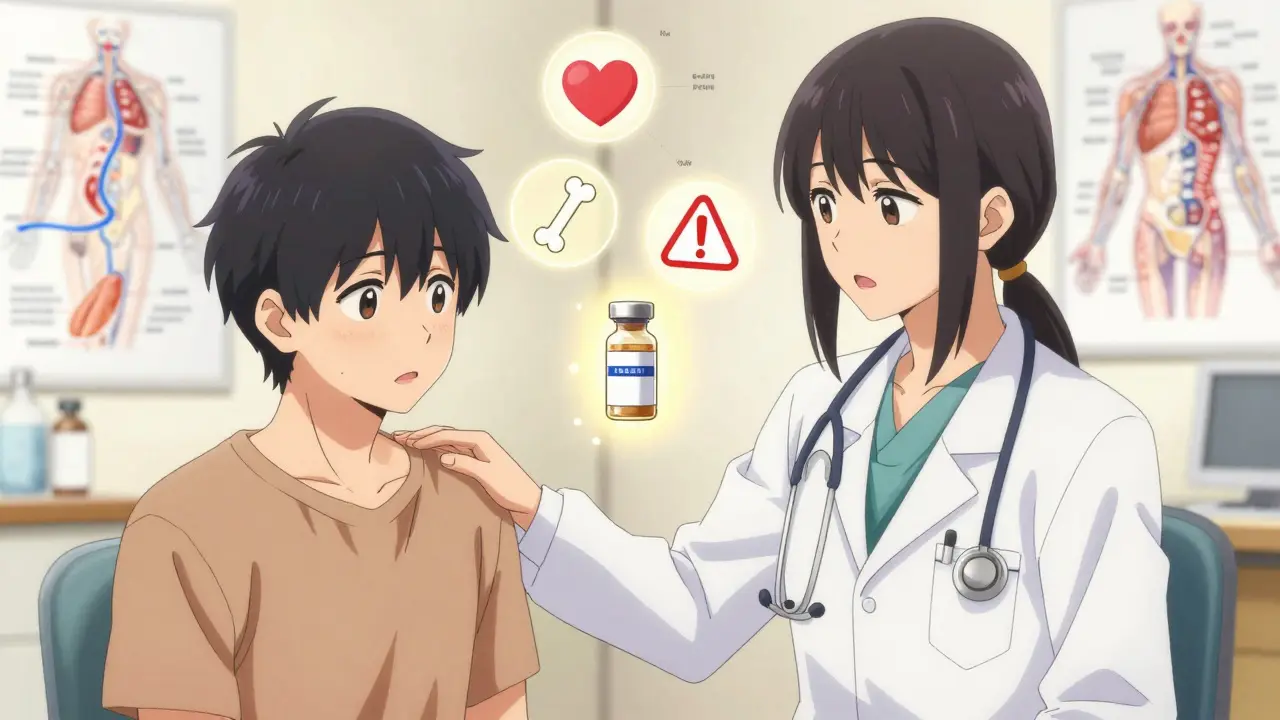
TRT isn’t risk-free. The FDA requires black box warnings because of potential dangers:
- Polycythemia - Red blood cell count spikes in 15-20% of users. This thickens blood and raises stroke risk.
- Lower HDL (good cholesterol) - Drops by 10-15 mg/dL. Not ideal for heart health.
- Prostate concerns - If you have or are at risk for prostate cancer, TRT is strictly off-limits. PSA levels must be checked every 6 months for men over 50.
- Increased clotting risk - Studies show a 1.4-2x higher chance of blood clots and a 1.3-1.8x higher stroke risk.
- Acne and hair loss - Common with gels and patches.
Also, once you start TRT, your body stops making its own testosterone. Stopping suddenly can crash your levels. It’s not a quick fix-it’s a long-term commitment.
What You Can Do Without Medication
If you’re not ready for TRT-or your doctor advises against it-there are natural ways to support testosterone:
- Maintain a healthy weight - BMI under 25 is linked to 20-30% higher testosterone levels.
- Exercise regularly - Three sessions of weight training per week can boost testosterone by 15-25%.
- Get 7-9 hours of sleep - Poor sleep cuts testosterone by up to 20%.
- Avoid smoking - Smokers have 15-20% lower levels.
- Limit alcohol - More than 14 drinks a week drops testosterone by 25%.
- Manage blood sugar - Diabetics have 25-35% lower testosterone. Avoid sugar and refined carbs.
These won’t fully reverse OPIAD, but they can help you feel better while you decide on next steps.
When to Talk to a Doctor
If you’re on long-term opioids and have any of the symptoms above, don’t wait. Talk to your doctor. Ask for a testosterone blood test. If you’re on methadone or buprenorphine for opioid use disorder, ask specifically about OPIAD. Many addiction clinics don’t screen for it-but they should.
Screening is simple: use the ADAM questionnaire, check your symptoms, and get blood work done. If your levels are low and you’re not getting better with lifestyle changes, TRT may be the right move. The evidence is clear: treating low testosterone in opioid users improves not just your sex life, but your heart, bones, energy, and even your lifespan.
But remember: this isn’t about chasing a quick boost. It’s about fixing a real medical problem. OPIAD is underdiagnosed, under-treated, and under-discussed. You deserve to feel like yourself again.
Can opioids cause low testosterone even if I’m not addicted?
Yes. Opioid-Induced Androgen Deficiency (OPIAD) happens because of how opioids affect your hormones-not because of addiction. Even people taking prescribed opioids for chronic pain, with no history of misuse, can develop low testosterone. The key factor is duration of use, not dependency. If you’ve been on opioids for more than 90 days, your testosterone may already be dropping.
Is testosterone replacement safe for older men on opioids?
It can be, but only with careful monitoring. Men over 50 need regular PSA tests to screen for prostate cancer before starting TRT. Studies show older opioid users on testosterone have lower rates of heart attacks, fractures, and death. But they also have higher risks of blood clots and polycythemia. Your doctor should check your blood count, cholesterol, and liver function every 3-6 months after starting treatment. If your levels stabilize and side effects are minimal, TRT can be safe and life-improving.
How long does it take for testosterone to improve after starting TRT?
Symptoms change at different speeds. Libido and energy often improve within 4-6 weeks. Muscle mass and fat loss take 3-6 months. Mood and concentration can take up to 6 months to fully improve. Blood tests should be repeated at 3 months to check if levels are in the target range (350-750 ng/dL). Don’t expect overnight results-this is a slow, steady process.
Can I stop opioids to fix my low testosterone?
Stopping opioids may help restore natural testosterone production, but it’s not simple. For people with opioid use disorder, sudden withdrawal can be dangerous. For those on chronic pain regimens, stopping may mean returning to severe pain. In both cases, tapering under medical supervision is essential. Some men regain normal testosterone levels after stopping, especially if they’re younger and used opioids for less than a year. Others need TRT even after stopping opioids. It depends on how long and how much you were exposed.
Are women affected by opioids the same way?
Yes, but differently. Women on long-term opioids also experience suppressed sex hormone production, leading to low estrogen and DHEA. Symptoms include loss of libido, irregular periods, fatigue, and mood changes. Testosterone replacement isn’t typically used in women due to risks of masculinization. Instead, DHEA supplementation is sometimes considered, though evidence is limited. The same screening principles apply: if you’re on long-term opioids and notice hormonal changes, talk to your doctor.



There are 11 Comments
Denise Jordan
Kenneth Zieden-Weber
Chris Bird
Bridgette Pulliam
Mike Winter
Randall Walker
LiV Beau
Adam Kleinberg
Gene Forte
David L. Thomas
Miranda Varn-Harper
Write a comment
Your email address will not be published. Required fields are marked *