
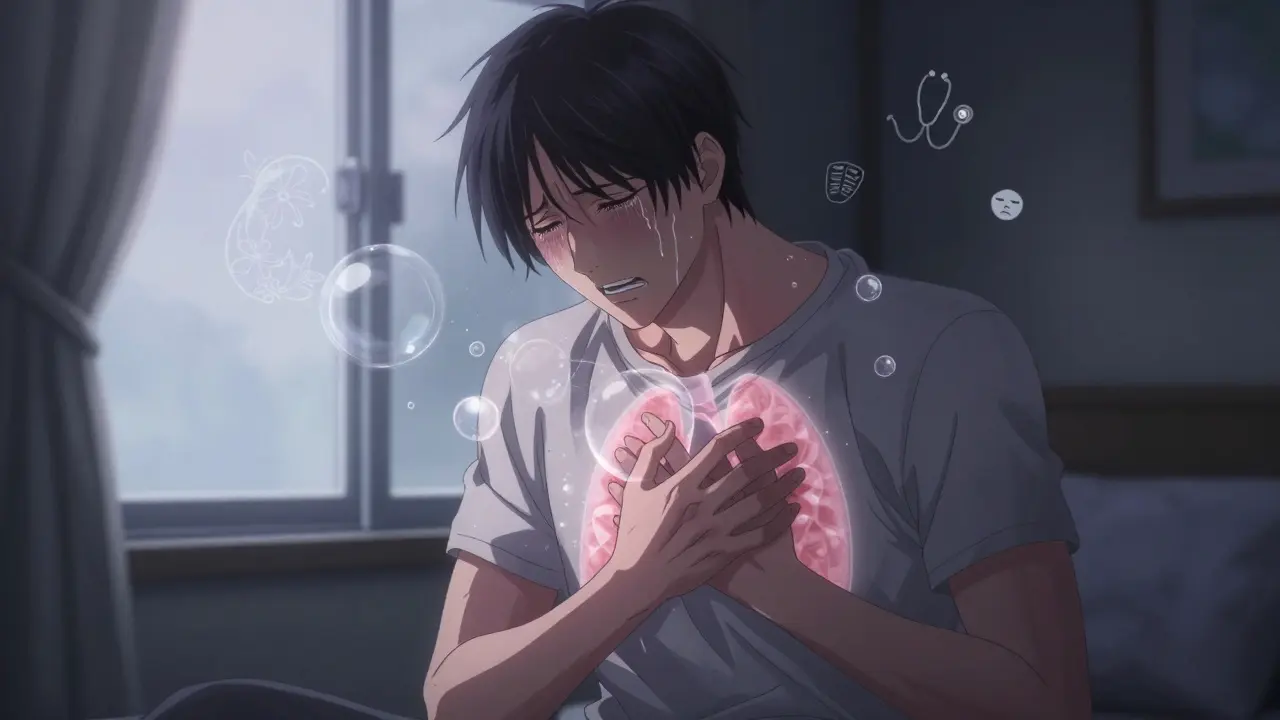
What Exactly Is a Collapsed Lung?
A collapsed lung, or pneumothorax, happens when air leaks out of the lung and gets trapped between the lung and the chest wall. This air builds up pressure, pushing the lung inward so it can’t expand properly when you breathe. It’s not a heart attack, and it’s not just a bad cough - it’s a medical emergency that needs quick action. Even a small amount of trapped air can make breathing feel impossible, and if it gets worse, it can stop your heart.
This isn’t rare. Around 1 in 5,000 people will have a spontaneous collapsed lung at some point. Young, tall men who smoke are at highest risk, but it can happen to anyone - even someone who’s never smoked or had lung problems. The good news? If caught early, most cases can be treated successfully. The danger comes from waiting.
Signs You’re Having a Collapsed Lung
If your lung collapses, your body sends clear signals. These aren’t vague discomforts - they’re sharp, unmistakable warning signs.
- Sharp, stabbing chest pain - This is the #1 symptom. It hits suddenly, usually on one side, and gets worse when you inhale deeply or cough. It doesn’t feel like heartburn or muscle strain. It feels like something inside your chest is being poked with a knife.
- Shortness of breath - You might feel like you can’t get enough air, even when sitting still. If more than 30% of your lung has collapsed, you’ll be gasping even at rest. People often say it feels like breathing through a straw.
- Pain radiating to the shoulder - This isn’t random. In over 90% of cases, the pain travels up to the same-side shoulder. It’s a classic clue doctors look for.
- Fast heartbeat and low oxygen - Your heart races because your body is struggling. If your oxygen level drops below 90%, you’re in serious danger. Cyanosis - a bluish tint to lips or fingertips - means your body is running out of oxygen.
These symptoms don’t fade with rest. If you feel this way and you’ve had no recent injury, don’t assume it’s anxiety or a pulled muscle. Call for help immediately.
Tension Pneumothorax: The Life-Threatening Twist
Not all collapsed lungs are the same. The worst kind is called tension pneumothorax. This happens when air keeps leaking in but can’t escape, building pressure like a balloon being overinflated. That pressure doesn’t just squash your lung - it pushes your heart and major blood vessels to the other side of your chest.
This is a race against time. Without treatment, you can die within minutes. Signs include:
- Severe trouble breathing, even at rest
- Heart rate over 134 beats per minute
- Systolic blood pressure below 90 mmHg
- Trachea (windpipe) shifting away from the painful side
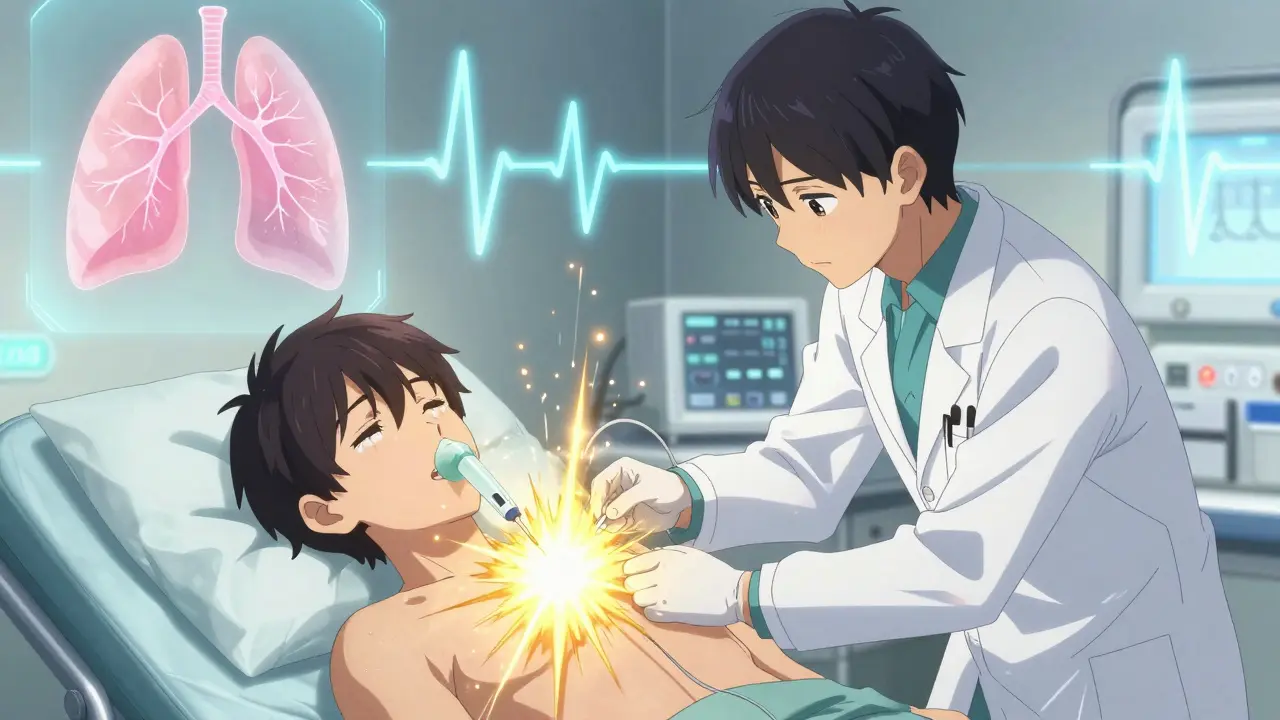
Here’s the critical point: you don’t need an X-ray to confirm this. If a patient is gasping, pale, and has low blood pressure - and you suspect pneumothorax - you treat it now. Waiting for imaging kills people. Emergency teams are trained to do needle decompression right there in the ambulance or ER - a quick needle inserted into the chest to release the trapped air. It’s simple, fast, and saves lives.
How Doctors Diagnose It
Speed matters. The faster they know what’s wrong, the faster they can fix it.
First, they listen. A doctor using a stethoscope will hear reduced or absent breath sounds on the affected side. That’s a strong clue. Then they tap on your chest - if it sounds unusually hollow or “hyperresonant,” that’s another red flag.
But the real confirmation comes from imaging. In most hospitals, the first test is a chest X-ray. It catches 85-94% of cases. But if you’re lying down after a trauma - say, from a car crash - the X-ray might miss it. That’s why many ERs now use ultrasound. A trained provider can detect a collapsed lung with over 94% accuracy in under a minute using a handheld device. It’s called the “lung point” sign - a specific movement on the screen where the lung stops sliding against the chest wall. That’s the spot where air has pushed the lung away.
CT scans are the most detailed - they can spot air pockets as small as a teaspoon. But they take longer, involve radiation, and aren’t needed for stable patients. In emergencies, they skip the CT unless the diagnosis is still unclear after X-ray and ultrasound.
What Happens in the Emergency Room
What you get depends on how big the collapse is and whether you’re stable.
Small collapse (less than 30%) and no breathing trouble? You might just get oxygen through a mask - 10 to 15 liters per minute. Extra oxygen helps your body reabsorb the trapped air faster. Studies show it speeds up healing by over three times. You’ll go home with instructions to rest and return for a follow-up X-ray in 1-2 weeks.
Large collapse or trouble breathing? You’ll need a chest tube. A thin plastic tube is inserted between your ribs into the chest cavity. It’s connected to a suction device that pulls the air out and lets your lung re-expand. This is done under local anesthesia. Most people feel pressure, not pain. You’ll stay in the hospital for a day or two while the tube drains and your lung heals.
Tension pneumothorax? No waiting. No X-ray. A needle is inserted immediately into the second rib space on the affected side. Air hisses out. Oxygen levels rise. Blood pressure improves. Then they follow up with a chest tube. This is the difference between life and death.

What Happens After You Leave the Hospital
Recovery isn’t just about healing - it’s about preventing it from happening again.
Smoking is the biggest risk factor. If you smoke, quitting cuts your chance of another collapse by 77% in the first year. No sugarcoating - if you don’t stop, you’re likely to have another episode.
You can’t fly for at least 2-3 weeks after your lung has fully re-expanded. Air pressure changes in planes can cause the air to expand again. Scuba diving? Forget it - unless you’ve had surgery to permanently seal the lung. The risk of a dive-triggered collapse is 12%.
Follow-up is non-negotiable. You need a chest X-ray at 4-6 weeks to make sure your lung is fully healed. If you skip it, 8% of people develop delayed complications - like fluid buildup or a second collapse without warning.
And if you’ve had two episodes on the same side? Surgery is usually recommended. A procedure called VATS - video-assisted thoracic surgery - uses tiny cameras and tools to remove the weak spots in the lung lining. It cuts your recurrence risk from 40% down to 3-5%.
Who’s Most at Risk?
It’s not random. Certain people are far more likely to get a collapsed lung.
- Tall, thin men under 30 - Their lungs are more likely to have weak spots called blebs. Odds are over 6 times higher than in women.
- Smokers - Smoking increases your risk 22 times compared to non-smokers. Even occasional smoking counts.
- People with lung disease - COPD, emphysema, cystic fibrosis, or even severe asthma raise your risk dramatically. If you have one of these and your lung collapses, your risk of dying is over 16% within a year.
- Those who’ve had it before - After one episode, you have a 15-40% chance of another within two years. After two, it’s over 60%.
If you fit any of these profiles, know the symptoms. Don’t ignore sharp chest pain or sudden breathlessness. Time is everything.
When to Call 911 - Not Wait and See
Some people think, “I’ll just rest and see if it gets better.” That’s how people die.
Call emergency services immediately if you have:
- Sudden, severe chest pain that doesn’t go away
- Difficulty breathing, even when sitting still
- Blue lips or fingertips
- Inability to speak in full sentences
- Feeling dizzy, faint, or your heart is racing uncontrollably
There’s no such thing as “maybe it’s nothing.” If you’re unsure, call anyway. Emergency responders are trained to evaluate this fast. Better to be checked and be safe than to wait and regret it.
Can a collapsed lung heal on its own?
Yes, but only if it’s small and you’re otherwise healthy. For a primary spontaneous pneumothorax with less than 30% lung collapse and no breathing trouble, the body can reabsorb the air over 1-2 weeks with supplemental oxygen. But this only works if you’re monitored. Large collapses, secondary cases, or unstable patients need immediate medical intervention - they won’t heal on their own.
Is pneumothorax the same as a pulmonary embolism?
No. A pulmonary embolism is a blood clot in the lung, while pneumothorax is air outside the lung. Both cause sudden chest pain and shortness of breath, but they’re treated completely differently. A clot needs blood thinners; a collapsed lung needs air removed. Doctors use imaging and clinical signs to tell them apart - misdiagnosis can be deadly.
Can I fly after having a collapsed lung?
Not for at least 2-3 weeks after full recovery, and only after a follow-up X-ray confirms your lung is completely expanded. Flying too soon risks the air pocket expanding at altitude, causing another collapse. The FAA and medical guidelines are clear: no air travel until cleared by a doctor. Scuba diving is permanently off-limits unless you’ve had surgery to prevent recurrence.
Does smoking really increase my risk that much?
Yes - dramatically. Smokers are 22 times more likely to have a spontaneous pneumothorax than non-smokers. The chemicals in smoke weaken the lung tissue, creating tiny air-filled sacs called blebs that can rupture. Quitting reduces your risk by 77% in the first year. It’s the single most effective way to prevent a second episode.
What’s the recovery time after a chest tube?
Most people stay in the hospital 1-3 days after chest tube insertion. You’ll feel sore for a week or two, but breathing improves quickly once the air is gone. Full healing takes 4-6 weeks. You’ll need a follow-up X-ray to confirm your lung is fully expanded. Avoid heavy lifting or strenuous activity during recovery. Return to normal activity gradually, based on your doctor’s advice.





There are 15 Comments
clarissa sulio
Ansley Mayson
Bob Hynes
Marc Durocher
Nick Flake
Akhona Myeki
Chinmoy Kumar
Bridget Molokomme
Vatsal Srivastava
Brittany Marioni
phara don
Hannah Gliane
Murarikar Satishwar
Dan Pearson
Eli Kiseop
Write a comment
Your email address will not be published. Required fields are marked *