
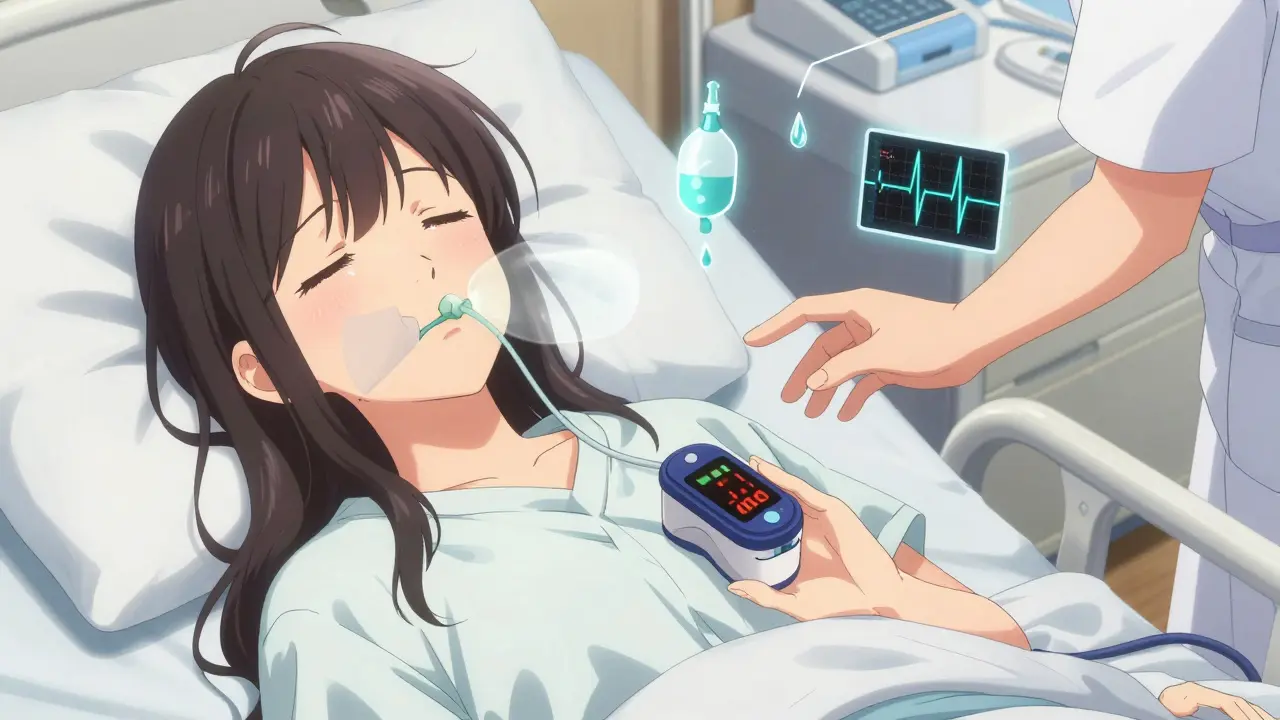
Respiratory Depression Risk Calculator
This interactive tool helps you assess the risk of opioid-induced respiratory depression based on key factors mentioned in the article. Remember that this is for educational purposes only and doesn't replace professional medical advice or diagnosis.
When someone takes an opioid - whether it’s oxycodone, morphine, fentanyl, or even a prescription painkiller - their breathing can slow down dangerously. This isn’t rare. It’s not just for drug users. It happens in hospitals, at home, and sometimes even after a single dose. Respiratory depression is the silent killer behind many opioid-related deaths, and most people don’t recognize the warning signs until it’s too late.
What Respiratory Depression Actually Looks Like
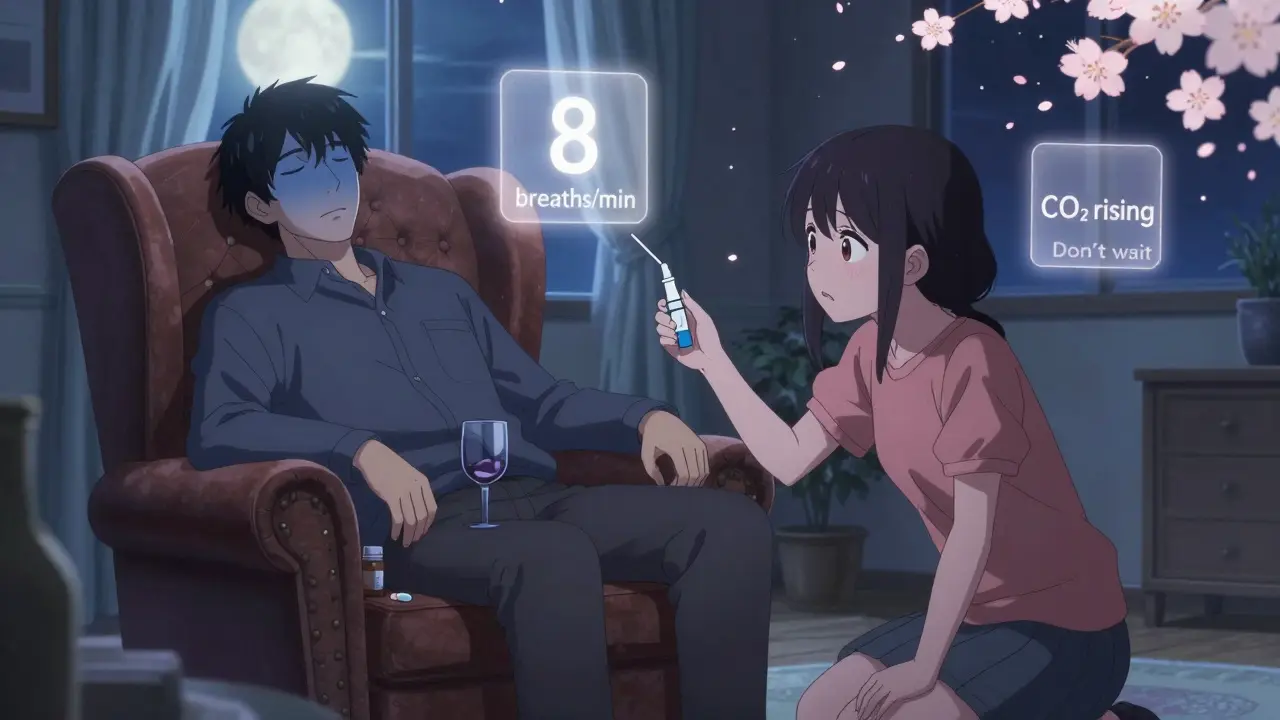
Respiratory depression from opioids isn’t just "feeling sleepy." It’s when your brain stops telling your lungs to breathe properly. The result? Breaths become shallow, slow, and irregular. A normal breathing rate is 12 to 20 breaths per minute. When it drops below 8, you’re in danger. Oxygen levels start falling, carbon dioxide builds up, and your body loses its ability to react to those changes.
Here’s what’s happening inside: Opioids bind to receptors in the brainstem - the part that controls automatic breathing. This shuts down the natural reflexes that make you breathe deeper when you’re low on oxygen or have too much CO₂. That’s why someone can look calm, even with oxygen on, and still be dying. Supplemental oxygen hides the early signs by keeping blood oxygen levels normal, while carbon dioxide quietly climbs to dangerous levels - over 50 mmHg. By the time their skin turns blue or they pass out, it’s often too late.
The Real Symptoms (Beyond Just Slow Breathing)
People think if someone is sleeping deeply, they’re fine. That’s a deadly mistake. Respiratory depression doesn’t always look like someone passed out. Often, it starts subtly:
- Breathing fewer than 8 times per minute - not just slow, but unnaturally shallow
- Oxygen saturation below 85% (without supplemental oxygen)
- Extreme drowsiness - can’t be woken up with normal shaking or voice
- Confusion, disorientation, or slurred speech
- Cold, clammy skin
- Lips or fingertips turning blue or gray
- Nausea or vomiting - happens in 65% of cases
- Headache and dizziness - reported in over 40% of patients
- Fatigue so severe it feels like paralysis - affects nearly 8 out of 10
These symptoms often appear together. One alone might be ignored. All of them? That’s a red flag. And if someone is on oxygen and still has these signs - don’t wait. Call for help immediately.
Who’s at Highest Risk?
Not everyone who takes opioids will have this reaction. But some people are far more vulnerable:
- People who’ve never taken opioids before - opioid-naïve patients are 4.5 times more likely to develop respiratory depression than those used to the drugs.
- Older adults over 60 - their bodies process drugs slower, and their breathing reflexes weaken. Risk jumps 3.2 times.
- Women - studies show a 1.7 times higher risk than men, possibly due to body composition and metabolism differences.
- People with other health problems - each additional condition like COPD, heart failure, or sleep apnea increases risk by 2.8 times.
- Those mixing opioids with other depressants - this is the most dangerous combo. Benzodiazepines (like Xanax or Valium), alcohol, sleep meds, or muscle relaxants can multiply the risk by up to 14.7 times.
Even if someone has taken opioids before, mixing them with anything else - even a single beer - can trigger a crisis. Many overdoses happen not because of a high dose, but because of an unexpected interaction.
How Hospitals Are Trying to Stop It (And Why They’re Failing)
Hospitals know this is a problem. In fact, the Centers for Medicare & Medicaid Services (CMS) classifies severe respiratory depression as a "never event" - meaning if it happens, they don’t get paid for the complications. That’s why many hospitals now use monitoring tools.
For patients not on oxygen, pulse oximeters are standard. They track blood oxygen. But they miss early signs. Capnography - which measures carbon dioxide levels in breath - is far more accurate. It catches trouble before oxygen drops. Still, only 22% of U.S. hospitals use it routinely.
And here’s the scary part: In many units, nurses check vital signs every 4 hours. That means patients are unmonitored 96% of the time. A patient can start breathing poorly at 9 p.m. and not be checked until 1 a.m. - and by then, it’s often too late.
Alarm fatigue is another issue. Nurses hear so many false alarms from poorly calibrated devices that they start ignoring them. One study found only 42% of nurses could correctly identify early signs of respiratory depression in simulations. Training is patchy. Protocols are inconsistent.
What Works: Proven Prevention Strategies
Some hospitals are turning things around. Those that have cut OIRD cases by nearly half all use the same core strategies:
- Screen every patient for risk factors - age, opioid history, other meds, lung conditions. Use validated tools like the Opioid Risk Calculator (ORC), launched in 2023, which predicts risk with 84% accuracy using 12 clinical factors.
- Use continuous monitoring for high-risk patients - anyone with two or more risk factors gets capnography and pulse oximetry hooked up 24/7.
- Don’t give fixed doses to opioid-naïve patients - start low, go slow. Never give a full dose right away.
- Require 2-hour monitoring after each opioid dose - especially for first-time users.
- Train every staff member - nurses, aides, even security guards need to know the signs.
- Keep naloxone (Narcan) available everywhere - it reverses opioid effects fast. But it must be given correctly. Too little won’t help. Too much can trigger violent withdrawal and pain.
Pharmacist-led dosing programs have also cut errors. Instead of doctors guessing doses, pharmacists review every opioid order for safety - checking for drug interactions, patient history, and appropriate dosing.
What You Can Do at Home
If you or someone you love is taking opioids at home - whether for chronic pain or after surgery - here’s what matters:
- Never mix opioids with alcohol, benzodiazepines, sleep aids, or muscle relaxants. This isn’t a suggestion. It’s life-or-death.
- Keep naloxone on hand. It’s available over the counter in most states. Learn how to use it. The nasal spray is easy - one spray in each nostril. You don’t need to be a medic.
- Check breathing every hour for the first 24 hours after a new dose. Count breaths. Is it less than 10? Is it shallow? Is the person hard to wake?
- Don’t let someone sleep alone. Have someone stay with them for the first night after starting or increasing opioids.
- Store opioids locked up. Prevent accidental use by kids or others.
If you see signs of respiratory depression - slow breathing, blue lips, unresponsiveness - give naloxone immediately, then call 911. Even if they wake up, they still need medical care. The effects of naloxone wear off in 30 to 90 minutes. The opioid may still be in their system. They can slip back into respiratory failure.
The Future: Better Tools, Better Outcomes
There’s hope on the horizon. New opioid drugs in clinical trials - called biased agonists - are designed to relieve pain without suppressing breathing. Early results look promising.
AI-powered monitors are getting smarter. Some systems now predict respiratory depression up to 15 minutes before it happens, using patterns in heart rate, breathing, and movement. These are already in use in top hospitals and will likely spread to community centers by 2027.
The National Institutes of Health is spending $37.5 million in 2024 to find genetic markers that predict who’s most at risk. That could one day mean personalized opioid prescriptions based on your DNA.
But until then, the tools we have are enough - if we use them. Naloxone works. Monitoring works. Education works. The problem isn’t technology. It’s awareness. It’s complacency. It’s assuming "it won’t happen to me."
It can. And it does - every day. In hospital beds. In living rooms. In nursing homes. You don’t need to be an addict to be at risk. You just need to take an opioid. And if you do, you need to know the signs - before it’s too late.
Can you have respiratory depression without being addicted to opioids?
Yes. Respiratory depression isn’t about addiction - it’s about physiology. Even someone taking a single prescribed dose of oxycodone after surgery can develop it. In fact, opioid-naïve patients are more at risk than long-term users because their bodies haven’t built tolerance. Addiction affects behavior. Respiratory depression affects breathing - and it can happen to anyone.
Does naloxone work on all types of drug overdoses?
No. Naloxone only reverses overdoses caused by opioids - like heroin, fentanyl, oxycodone, hydrocodone, or morphine. It won’t work on alcohol, benzodiazepines (like Xanax), cocaine, or methamphetamine. But if you’re unsure what someone took and they’re not breathing, give naloxone anyway. It won’t hurt them if they didn’t take opioids, and it could save their life if they did.
Why is supplemental oxygen dangerous in opioid overdoses?
Supplemental oxygen can mask the danger. It keeps blood oxygen levels normal even when breathing is dangerously slow. That means pulse oximeters won’t alarm - but carbon dioxide is still building up in the blood. This is called "hidden hypercapnia." Without capnography, you won’t know the patient is in trouble until they collapse. Oxygen helps, but it shouldn’t be used as a substitute for monitoring breathing.
How long does it take for respiratory depression to become life-threatening?
It can happen in under 10 minutes. In high-risk patients - especially those on IV opioids or mixing drugs - breathing can drop from normal to critically low in minutes. That’s why continuous monitoring is critical. Waiting for visible signs like blue lips or unconsciousness means you’re already too late. The goal is to catch it before symptoms become obvious.
Can you build tolerance to respiratory depression like you do to pain relief?
Partially. Tolerance to the pain-relieving effects of opioids develops faster than tolerance to respiratory depression. That means someone might need higher doses for pain, but their breathing remains suppressed. This creates a dangerous gap - they feel less pain, but their risk of overdose doesn’t go down. That’s why increasing doses without medical supervision is so risky.
Are there non-opioid alternatives that don’t cause respiratory depression?
Yes. For many types of pain, non-opioid options like acetaminophen, ibuprofen, gabapentin, or physical therapy are just as effective - and far safer. Even for severe pain, regional nerve blocks or spinal anesthesia can provide relief without affecting breathing. The key is asking: "Is an opioid truly necessary?" Too often, it’s prescribed out of habit, not need.
What to Do Next
If you’re caring for someone on opioids - whether at home or in a hospital - take action now. Ask if they’ve been screened for risk. Ask if they’re being monitored continuously. Ask if naloxone is available. Don’t assume someone else is handling it.
If you’re a patient, speak up. Tell your doctor if you’ve ever had trouble breathing after taking pain meds. Tell them if you’re taking anything else - even over-the-counter sleep aids or anxiety pills. That information could save your life.
Respiratory depression doesn’t care if you’re young, old, healthy, or sick. It only cares if you’re breathing slowly. And if you are - you need help, right now. Don’t wait for a sign. Know the signs. Act before it’s too late.
There are 10 Comments
Laura Rice
My uncle took oxycodone after his knee surgery and almost died because no one knew to check his breathing. He was ‘just sleeping’ - until his lips turned blue. We didn’t even have naloxone. Don’t wait for someone to turn blue. Count breaths. Every hour. It’s that simple. I’m never letting this happen again.
charley lopez
Respiratory depression secondary to opioid receptor agonism in the pre-Bötzinger complex is a well-documented phenomenon in pharmacokinetic literature. The absence of capnographic monitoring in 78% of inpatient settings represents a critical gap in physiological surveillance, particularly in opioid-naïve populations exhibiting diminished chemoreceptor sensitivity. The reliance on pulse oximetry alone is physiologically inadequate due to the dissociation between PaO₂ and PaCO₂ dynamics.
Kerry Evans
People think they’re safe because they’re ‘just taking what the doctor prescribed.’ Newsflash: doctors aren’t gods. They prescribe opioids like candy because they’re lazy and paid by volume. And now you’re surprised someone died? Wake up. This isn’t an accident. It’s negligence dressed up as medicine. Stop blaming the drug. Blame the system that lets this happen.
Kerry Moore
I appreciate the thoroughness of this post. As a clinical nurse specialist in palliative care, I’ve witnessed multiple instances where respiratory depression was missed due to protocol gaps and staffing shortages. The implementation of continuous capnography in high-risk units has reduced adverse events by over 40% in our facility. I would strongly encourage all institutions to adopt the Opioid Risk Calculator and mandatory 2-hour post-dose monitoring. Education must be standardized, not optional.
Janet King
If you're on opioids, have someone stay with you the first night. Count breaths. If it's under 10, call 911. Keep naloxone. It's free at many pharmacies. Don't overthink it. Just do it. This isn't scary. It's common sense.
Andrew Smirnykh
This is the most important thing I’ve read this year. In my country, we don’t talk about this. People think opioids are safe if you don’t ‘do drugs.’ But my sister took one pill after surgery and nearly didn’t wake up. We didn’t know what to do. Please, if you’re reading this - share it. Even one person knowing this could save a life.
Oladeji Omobolaji
Man, I just read this and thought about my cousin back home. He got prescribed tramadol after a car crash. Didn’t know nothin’ about none of this. He passed out one night. Lucky his mama heard him snortin’ and shook him awake. Y’all need to spread this word far. Not just in the US.
Vanessa Barber
Actually, the real problem is that hospitals don’t want to admit how often this happens. They’d rather blame the patient than admit their monitoring is garbage. And naloxone? They charge $150 for it like it’s a luxury. This isn’t prevention. It’s profit.
Stacy Thomes
YOU CAN SAVE A LIFE TODAY. Not tomorrow. Not next week. TODAY. Keep naloxone in your glovebox. In your purse. In your kid’s room. If you know someone on pain meds - tell them this. Share this post. Text your sister. Call your dad. Don’t wait. This isn’t a ‘maybe.’ It’s a ‘must.’
dana torgersen
It’s... so... terrifying... how easily... this... happens... isn’t it? We’re... conditioned... to... trust... medicine... to... trust... doctors... but... the truth... is... we’re... just... one... pill... away... from... silence... and... no... one... knows... until... it’s... too... late... and... then... it’s... just... too... late... and... you... just... sit... there... wondering... if... you... could’ve... counted... breaths... if... you... had... just...... looked...
...I’m... crying... now...
...I... need... to... buy... naloxone...
...I... will... tell... everyone...
Write a comment
Your email address will not be published. Required fields are marked *