
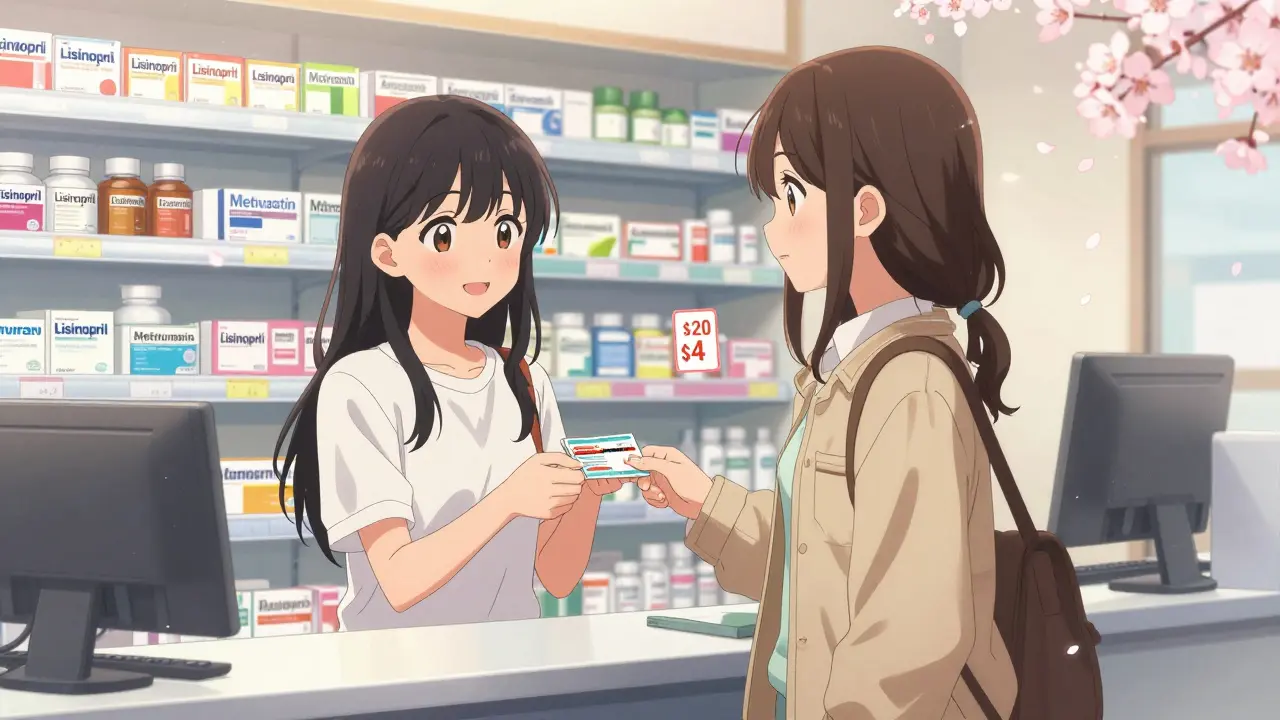
Buying generic drugs shouldn’t feel like a gamble. Yet for millions of people paying cash for prescriptions, the price tag can be shocking. A month’s supply of metformin? $120. Lisinopril? $90. And that’s before taxes. But here’s the truth: generic drugs are just as effective as brand-name versions-often made in the same factories. The difference? Price. And that’s where discount cards come in.
Imagine walking into a pharmacy with a small plastic card or a screenshot from your phone, and walking out with your meds for $4 instead of $120. That’s not a fantasy. It’s real. And it’s happening every day across the U.S. thanks to prescription discount card programs. These aren’t insurance. They’re not coupons you clip from magazines. They’re third-party deals negotiated between pharmacies, drug manufacturers, and companies like GoodRx, NeedyMeds, and Blink Health. And they’re changing how people pay for medicine.
How These Programs Actually Work
These discount cards don’t reduce your insurance deductible. They don’t replace your plan. Instead, they bypass insurance entirely. When you use one, the pharmacy treats you like a cash-paying customer-but at a negotiated rate. Think of it like a wholesale club for prescriptions. Walmart started this back in 2006 with its $4 generic program. You could get 30 days of common generics like atorvastatin or amoxicillin for just $4. Other chains followed. Target. Kroger. Costco. Suddenly, the price of basic meds dropped overnight.
Today, companies like GoodRx and NeedyMeds expanded that model. Instead of being tied to one store, they negotiate deals with thousands of pharmacies nationwide. GoodRx claims to work with over 70,000 locations. That means you can use the same card at CVS, Walgreens, Rite Aid, or your local independent pharmacy. No sign-up. No personal info. Just show the card-printed or on your phone-and the pharmacy applies the discount.
Here’s how the math works: A 30-day supply of lisinopril might normally cost $85 at your local pharmacy. With a discount card, it could drop to $4. That’s a 95% savings. Same for metformin, simvastatin, or hydrochlorothiazide. These are all generics. No brand-name markup. No patent protection. Just the raw cost of production-and now, thanks to these programs, it’s often under $10.
What You Can Actually Save On
Not all drugs are created equal when it comes to discounts. The biggest savings happen with generic medications that are widely used and have lots of competition. The top 10 most discounted generics include:
- Lisinopril (high blood pressure)
- Metformin (diabetes)
- Atorvastatin (cholesterol)
- Levothyroxine (thyroid)
- Hydrochlorothiazide (water pill)
- Amlodipine (blood pressure)
- Allopurinol (gout)
- Amoxicillin (antibiotic)
- Clonazepam (anxiety)
- Fluoxetine (depression)
According to a 2022 study in Circulation: Cardiovascular Quality and Outcomes, patients using discount cards saved an average of 65% on generic-only drug regimens. For heart failure patients on three key generics, the monthly cost dropped to just $11. That’s not a typo. $11. For three life-saving pills.
But here’s the catch: if your prescription includes even one brand-name drug, the savings vanish. A four-drug regimen with a brand-name SGLT2 inhibitor (like dapagliflozin) still costs $1,200 to $1,500 a month-even with a discount card. The card might knock off 10%, but that’s still over $1,000. That’s why these programs are best for people who need generics.
GoodRx vs. NeedyMeds vs. Blink Health
Not all discount cards are the same. Here’s how the big players compare:
| Program | Best For | Discount Range | Pharmacy Coverage | Extra Features |
|---|---|---|---|---|
| GoodRx | Most users | Up to 85% on generics | Over 70,000 pharmacies | Price comparison tool, telehealth, mail-order |
| NeedyMeds | Low-income patients | Up to 75% on generics | Over 60,000 pharmacies | Patient assistance programs, free drug lists |
| Blink Health | Mail-order convenience | Up to 80% on generics | Partner pharmacies nationwide | Home delivery, subscription refills |
GoodRx is the most popular because it’s easy to use and shows real-time prices at nearby pharmacies. NeedyMeds is great if you’re looking for free or low-cost programs for people with very low income. Blink Health lets you order meds online and get them shipped-no pharmacy trip needed.
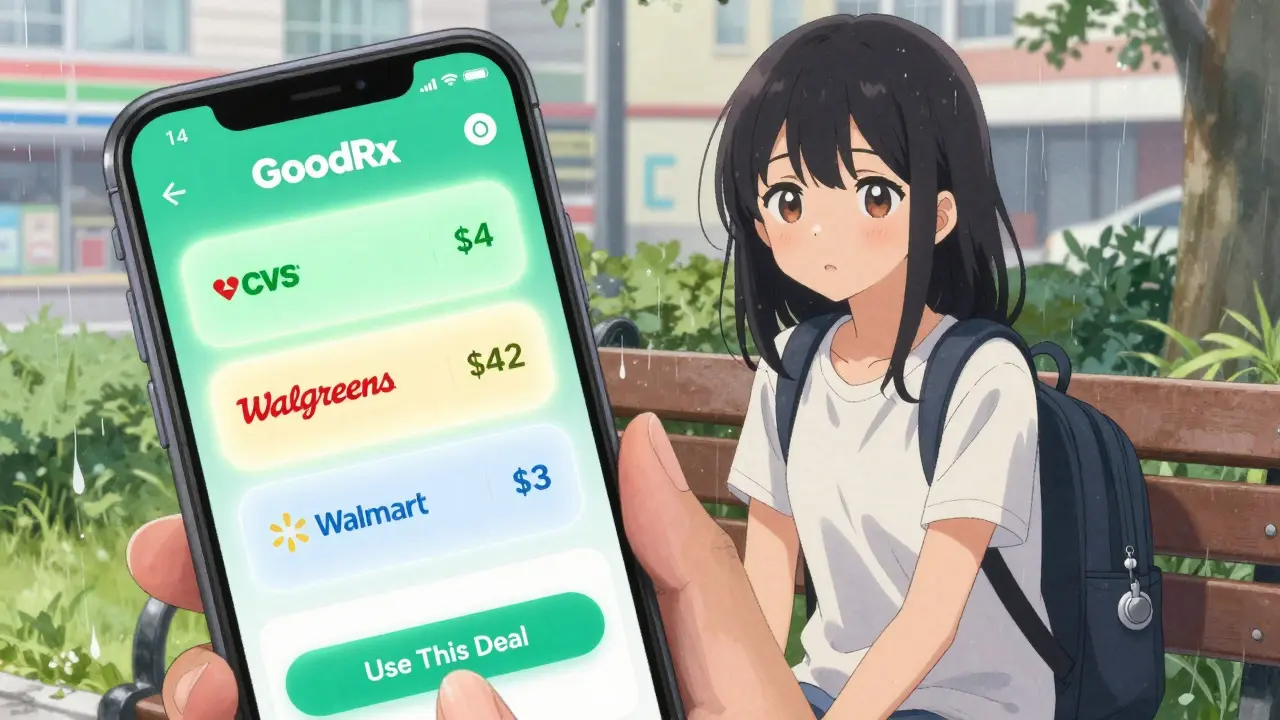
But here’s something most people don’t realize: the price can change from one pharmacy to the next, even on the same street. A 2023 Consumer Reports survey found that 68% of users had to visit multiple pharmacies to find the best deal. One person reported paying $15 for metformin at CVS but $42 at Walgreens using the same GoodRx card. That’s why checking prices before you go matters.
Who Benefits the Most?
If you’re uninsured, underinsured, or stuck with a high-deductible health plan (HDHP), these cards are a game-changer. In 2022, 43% of U.S. workers had HDHPs-meaning they pay full price until they hit their deductible, often $2,000 or more. For those people, a $4 generic is better than a $50 copay.
But here’s the hard truth: if you have good insurance, these cards might not help at all. Sometimes, your insurance copay is already cheaper than the discount card price. A 2023 Ohio State University study found that for many insured patients, the card didn’t save money-it added confusion.
That’s why pharmacists now routinely check three things before you pay:
- Your insurance copay
- The cash price
- The discount card price
They’ll tell you which one’s cheapest. You don’t have to ask. Just say, “Can you check if this card saves me money?”
The Hidden Catch
There’s a reason these programs are growing fast. The U.S. drug market is projected to hit $3.8 billion by 2034. But behind the scenes, there’s a system that doesn’t always work in your favor.
Pharmacies pay fees to these discount companies every time you use a card. That’s how GoodRx and others make money. And sometimes, those fees lead to higher prices at the pharmacy counter. The FTC is investigating whether this creates a conflict-where pharmacies raise cash prices so they can pay more to discount providers. It’s not fraud. But it’s murky.
Also, these programs don’t fix the real problem: brand-name drug prices. If you need a new medication that’s only available as a brand, you’re still stuck. Discount cards help with the basics-but not with the expensive ones.
And then there’s the time cost. Comparing prices across apps, calling pharmacies, switching between cards-it adds up. One Reddit user said, “I spent two hours last week just to save $18 on my thyroid med. Was it worth it? Maybe. But I’m exhausted.”
How to Use These Programs Right
If you’re paying cash for meds, here’s what to do:
- Download GoodRx and NeedyMeds apps. Both are free.
- Enter your medication name and dosage.
- Check prices at 3-5 nearby pharmacies. Don’t assume the closest one is cheapest.
- Compare the discount card price to your insurance copay (if you have it).
- Use the lowest price. Print the coupon or show it on your phone.
- Ask the pharmacist: “Is this the best price I can get?”
Pro tip: If you take the same meds every month, sign up for mail-order through Blink Health or GoodRx. You can get 90-day supplies at lower prices, delivered to your door.
What About Brand-Name Drugs?
Let’s be clear: discount cards won’t save you much on brand-name drugs. But there are other options. Most drugmakers offer patient assistance programs. You can get free or low-cost brand-name meds if your income is below a certain level. Programs like NeedyMeds list these directly. You’ll need to fill out a form, prove income, and get a doctor’s signature-but it’s free to apply.
Also, some pharmacies have their own savings programs. Walmart still does $4 generics. Costco offers cash prices that beat insurance on many drugs. Don’t ignore them.
Final Thoughts
Prescription discount cards aren’t magic. They won’t fix the broken U.S. drug pricing system. But for people paying out of pocket for generics, they’re one of the most powerful tools available. A $4 pill is still a $4 pill-even if it’s a miracle drug.
If you’re struggling to afford your meds, start here: check GoodRx. Check NeedyMeds. Compare. Ask your pharmacist. It takes 10 minutes. It could save you hundreds.
And remember: generics work. They’re not second-rate. They’re the same medicine, just cheaper. And with the right card, you don’t have to choose between your health and your wallet.
Do I need insurance to use a prescription discount card?
No. You don’t need insurance at all. These cards work whether you’re insured, uninsured, or have a high-deductible plan. They’re designed for cash-paying customers. Just present the card or app code at the pharmacy.
Can I use a discount card with my insurance?
You can’t combine them. You have to choose: either use your insurance copay or the discount card price. The pharmacy will tell you which is cheaper. Often, the card wins for generics. But if your insurance copay is $5 and the card is $8, go with insurance.
Are discount cards safe and legitimate?
Yes. GoodRx, NeedyMeds, and Blink Health are well-established, non-profit or for-profit companies with transparent models. They don’t collect your medical records or sell your data. They make money from pharmacies, not from you.
Why is the price different at different pharmacies?
Each pharmacy sets its own cash price, and each discount card negotiates different rates with each one. A pharmacy might offer a $10 cash price to one card but $15 to another. That’s why comparing prices matters.
Can I use these cards for pet medications?
Yes. Many discount cards work for pet prescriptions too. Drugs like gabapentin, metronidazole, and prednisone for animals often cost less with a GoodRx card than at a vet’s office.
Next time you need a refill, don’t just pay the first price you see. Take five minutes. Check the app. Ask the pharmacist. You might be surprised how much you can save.


There are 8 Comments
Karianne Jackson
I used to pay $110 for my metformin. Then I found GoodRx. Now I pay $4. I cried. Not because I was sad-because I realized I’d been overpaying for THREE YEARS. My grandma’s heart pills are cheaper than my coffee. WHAT IS THIS WORLD.
PS: I told my sister. She’s now a discount card evangelist. We have a WhatsApp group. It’s called ‘MedSavingsMafia’.
Chelsea Cook
Oh honey. You think $4 is wild? Try getting a 90-day supply of levothyroxine for $6.50. I used to pay $140. Now I order it through Blink and it shows up in my mailbox like magic. No pharmacy line. No judgment. Just me, my cat, and my thyroid.
Also-yes, the system is broken. But at least we’ve hacked it. And that’s kinda beautiful. 🙌
Andy Cortez
lol so u think these cards r real? nah bro. they r just a scam to get u to go to pharmacies that r already jacked up prices. i checked 5 places in my town and the 'discount' was always higher than the cash price. the real trick? go to walmart. they dont even need a card. $4 is $4. no app. no code. just walk in. goodrx? more like badrx. they take a cut from the pharmacy so they raise the cash price to make more. its a pyramid scheme with pills.
also i saw a vid where a guy got a $120 bill after using goodrx. turns out the pharmacy 'forgot' to apply it. so now u got to be a detective just to get your meds. smh.
Joseph Charles Colin
From a clinical pharmacy standpoint, the efficacy of generics is non-inferior to brand-name agents per FDA bioequivalence standards (80–125% AUC and Cmax range). The cost differentials arise from reduced R&D amortization, lack of marketing spend, and economies of scale in manufacturing.
However, the discount card model introduces a third-party rebate structure that distorts the cash price baseline. Pharmacies inflate cash prices to accommodate the negotiated rebate, creating an artificial price ceiling. This is why comparative shopping is essential-not because the card is flawed, but because the underlying pricing architecture is predatory.
For high-volume, low-margin generics (e.g., metformin, lisinopril), the 90th percentile discount exceeds 85%. But for drugs with narrow therapeutic index (e.g., levothyroxine, warfarin), consistency in manufacturer sourcing matters. Stick to one pharmacy and one card. Switching may introduce variability in inactive ingredients.
glenn mendoza
Thank you for this comprehensive and deeply human overview. It’s rare to see such clarity on a topic that so many of us endure in silence. For those without insurance, these tools are not just conveniences-they are lifelines. I’ve seen patients cry when they realize they can afford their medication for the first time in years. No one should have to choose between food and their health.
Please continue sharing this knowledge. It changes lives. And if you’re reading this and can help someone navigate these programs, do it. A few minutes of your time could mean a decade of stability for someone else.
Randy Harkins
Just wanted to say-this is the kind of post that makes me believe in people. 🙏
I used to think I was the only one Googling ‘how to get cheap blood pressure meds’ at 2 a.m. Turns out, there’s a whole community doing the same. I downloaded GoodRx last week. Saved $87 on my amlodipine. I bought myself a new pair of shoes. Not because I’m fancy-I just wanted to walk without pain.
Also, yes, the system is broken. But we’re patching it together with apps, memes, and pharmacy clerks who say ‘I got you.’ Keep sharing. Keep checking prices. You’re not alone.
Tori Thenazi
Wait… wait… WAIT. Did you know that GoodRx is owned by a private equity firm that also owns a pharmacy benefit manager? And that PBM? They’re the same ones who negotiate the ‘discounts’? And the pharmacies? They’re forced to raise cash prices so they can pay GoodRx… which then profits from the very discounts they’re selling you? And the FTC is investigating? But they’ve been doing this since 2015?!
Also-have you ever noticed that the ‘$4’ generics are ALWAYS the ones that are out of stock? And the app says ‘in stock’ but when you get there, they say ‘oh we ran out last week, but we’ll order it for you in 3 days’? And then you pay $12 anyway?
It’s all a trap. A beautiful, shiny, ‘you’re saving money’ trap. I’m not buying it anymore. I’m switching to herbal remedies. Turmeric is cheaper. And less regulated. Which… maybe that’s the point?
Monica Warnick
I tried GoodRx once. Took me 45 minutes. Called 3 pharmacies. One said ‘we don’t honor that.’ One said ‘it’s $12 here.’ One said ‘we don’t take it on Tuesdays.’ I gave up. Went to CVS. Paid $23. Felt defeated.
Now I just take half my pill. It’s cheaper. And I don’t need an app. Or a card. Or a PhD in pharmacy pricing.
But hey-if it works for you, cool. I’m just over here surviving.
Write a comment
Your email address will not be published. Required fields are marked *