
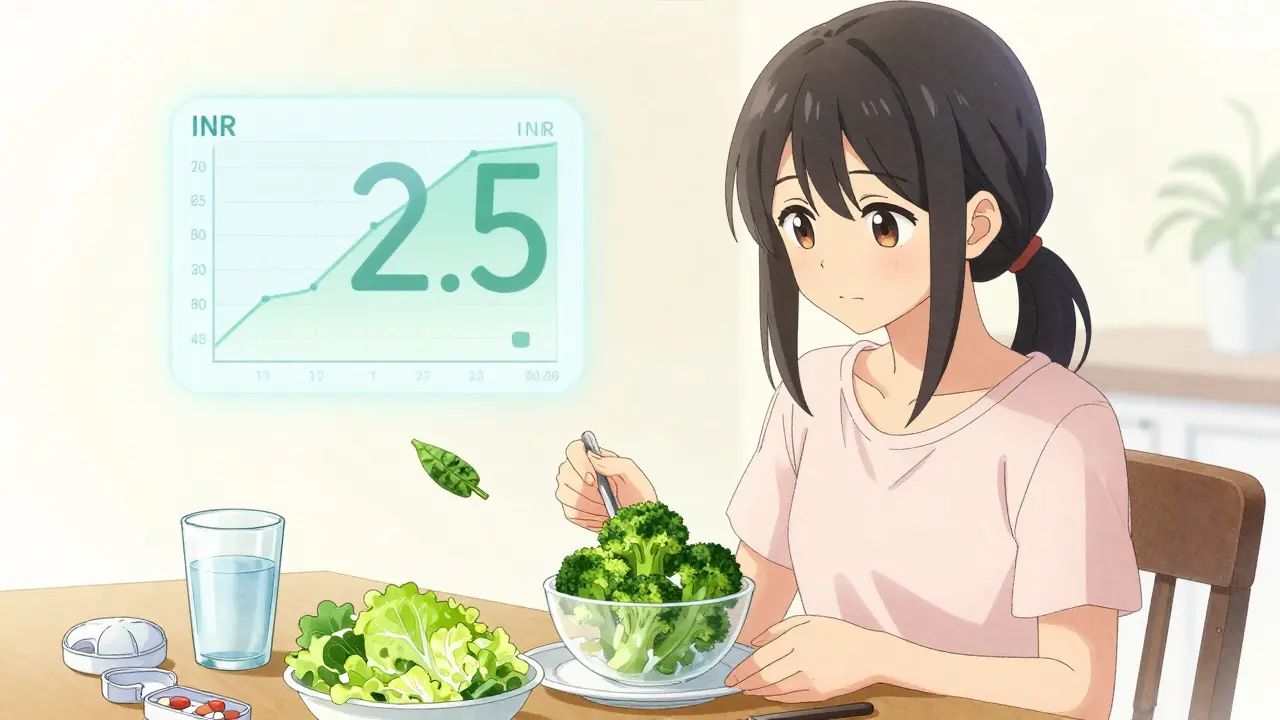
Warfarin saves lives. But it’s also one of the most dangerous medications you can take if you don’t know what to avoid. Every year, thousands of people end up in the hospital not because their blood is too thick - but because their blood became too thin. And it’s usually not the pill’s fault. It’s what they ate, took, or drank alongside it.
How Warfarin Works - and Why It’s So Sensitive
Warfarin, sold under brands like Coumadin and Jantoven, doesn’t thin your blood like water. It blocks vitamin K from helping your body make clotting factors. Without enough vitamin K, your blood takes longer to clot. That’s good if you have atrial fibrillation, a mechanical heart valve, or a history of clots. But too little clotting? That’s bleeding - inside your brain, stomach, or joints. And it can kill.
The goal? Keep your INR between 2.0 and 3.0. That’s the number doctors use to measure how long your blood takes to clot. Below 2.0? You’re at risk for clots. Above 3.0? You’re at risk for bleeding. And it doesn’t take much to throw this balance off.
Warfarin’s half-life is 20 to 60 hours. That means it sticks around. But its effect builds slowly - peak action takes 3 to 4 days. So if you start eating more spinach on Monday, you won’t see the change in your INR until Thursday. That delay is why people get caught off guard. They think, “I only had one big salad - how could that matter?” It does. Big time.
Food: The Silent Saboteur
Vitamin K is the biggest dietary factor. It’s not evil. It’s essential for healthy bones and blood. But if you’re on warfarin, you need it consistent, not high or low.
Here’s what’s packed with vitamin K:
- 1 cup cooked kale: 1,062 mcg
- 1 cup cooked spinach: 889 mcg
- 1 cup cooked broccoli: 220 mcg
- 1 cup raw lettuce: 100 mcg
- 1 egg: 0.3 mcg
That’s a 10,000% difference between kale and an egg. If you normally eat a salad with spinach once a week, then suddenly start eating kale every day? Your INR could drop from 2.5 to 1.8 in just 3 days. Your doctor might increase your dose. Then you go back to your old routine - and boom, your INR spikes to 5.0. That’s a bleeding emergency.
Most experts recommend keeping your daily vitamin K intake between 60 and 80 mcg. That’s about 1 cup of cooked broccoli or 2 cups of raw lettuce. Don’t go crazy. Don’t go cold turkey. Just keep it steady.
And yes - green tea can lower your INR. Not because of vitamin K, but because it contains compounds that may speed up warfarin metabolism. One Reddit user reported his INR dropped from 2.8 to 1.9 after drinking 3 cups a day. He cut it back to one cup, and his numbers stabilized.
Alcohol? Two drinks a night? Fine. Three or more? That triples your bleeding risk. It messes with your liver’s ability to process warfarin and also irritates your stomach lining. Combine that with warfarin? You’re asking for trouble.
Supplements: The Hidden Danger Zone
People think “natural” means safe. That’s not true with warfarin.
Here are the worst offenders:
- St. John’s Wort: Speeds up warfarin breakdown. INR drops fast. Risk of clotting skyrockets.
- Ginkgo biloba: Thins blood on its own. Doubles bleeding risk when mixed with warfarin.
- Ginseng: Can either raise or lower INR - unpredictably. One study showed INR dropped by 0.7 in just 7 days.
- Garlic supplements: Increase bleeding risk. Not the garlic in your food - the pills. 1,000 mg daily? That’s a red flag.
- Coenzyme Q10: Structurally similar to vitamin K. May weaken warfarin’s effect.
- Green tea extract: Concentrated = dangerous. Not the tea. The pills.
- Vitamin E (over 400 IU/day): Adds to blood-thinning effect. Risk of bruising, nosebleeds, internal bleeding.
And don’t forget multivitamins. Many contain vitamin K. If you switch brands - or start taking one you didn’t before - your INR can swing wildly. Always check the label. And tell your doctor what you’re taking - even if you think it’s “just a vitamin.”
Prescription Drugs: The Most Common Culprits
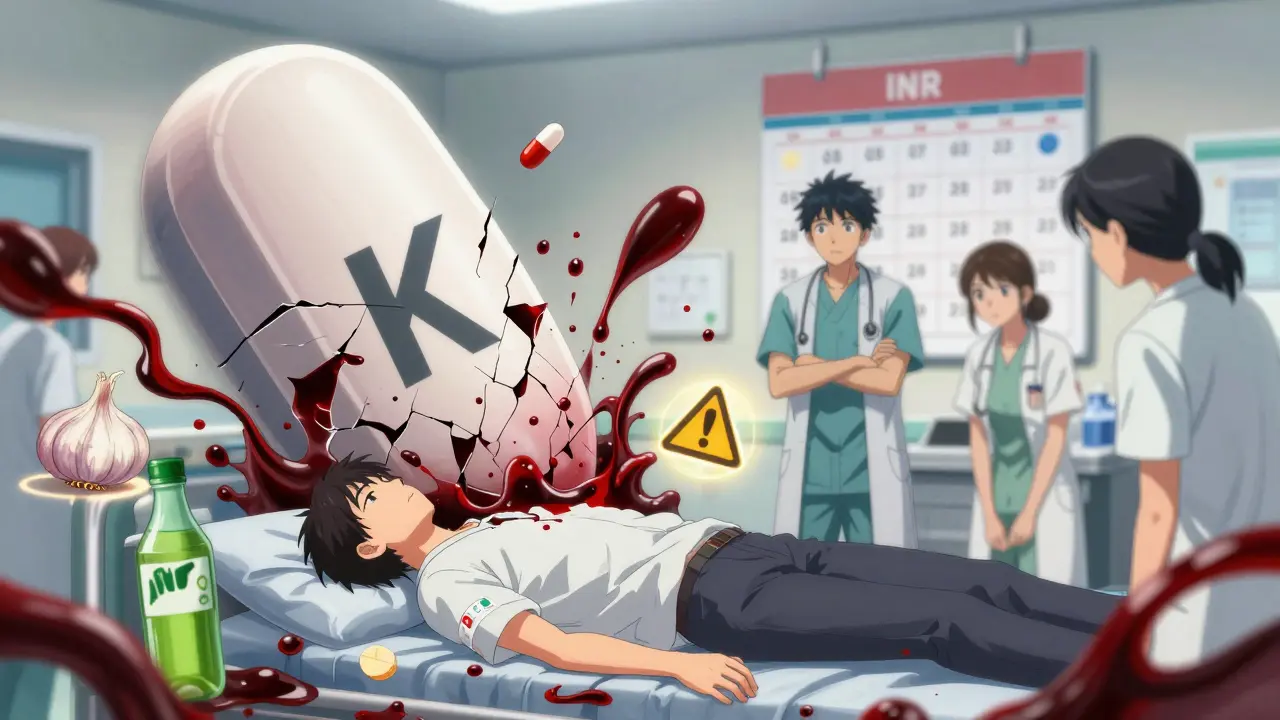
Warfarin interacts with over 300 medications. That’s more than any other blood thinner. And many of them are everyday prescriptions.
Here are the top 5 that cause trouble:
- Antibiotics - especially trimethoprim-sulfamethoxazole (Bactrim) and fluconazole (Diflucan). These slow down how fast your liver breaks down warfarin. INR can jump 50-100% in 48 hours. One patient in a 2023 study had an INR of 8.1 after taking Bactrim for a UTI. He needed a blood transfusion.
- Amiodarone - used for irregular heartbeat. It can raise warfarin levels by up to 60%. Dose reductions of 30-50% are often needed.
- NSAIDs - ibuprofen, naproxen, celecoxib. They don’t change warfarin levels, but they irritate your stomach lining. Add warfarin? You’re looking at a 3x higher risk of gastrointestinal bleeding.
- SSRIs - like sertraline and fluoxetine. They interfere with platelet function. Combine with warfarin? More bruising, more nosebleeds, more risk of brain bleeds.
- Aspirin - even low-dose. It’s not “safe” just because your cardiologist gave it to you. It adds to bleeding risk. Use acetaminophen (Tylenol) instead for pain.
And here’s the scary part: you might not know you’re taking something dangerous. A cold medicine? A sleep aid? A muscle relaxer? All could contain hidden NSAIDs or antihistamines that interact. Always check with your pharmacist before taking anything new.
What About Newer Blood Thinners?
Apixaban (Eliquis), rivaroxaban (Xarelto), dabigatran (Pradaxa) - these are the newer options. They don’t need INR checks. They have fewer food interactions. And they interact with far fewer drugs - only 30 to 50, not 300.
So why is warfarin still around?
Three reasons:
- Cost: Warfarin costs $4 to $10 a month. DOACs cost $500 to $600. Medicare patients pay $0 for warfarin. Many pay $200+ for DOACs.
- Reversibility: If you bleed, you can give vitamin K or prothrombin complex concentrate to stop warfarin’s effect. There’s no reliable antidote for most DOACs.
- Specific cases: If you have a mechanical heart valve - especially in the mitral position - DOACs aren’t approved. Warfarin is the only option.
But here’s the truth: 65% of new patients are now getting DOACs. Why? Because they’re simpler. Less monitoring. Fewer interactions. Fewer ER visits. A 2020 study found warfarin users had 17 times more healthcare visits than DOAC users.
So if you’re stable on warfarin? Great. Don’t switch. But if you’re struggling - constant INR swings, diet changes, medication confusion - talk to your doctor about switching. It might be safer.
What You Can Do - Right Now
You don’t need to live in fear. You need to be smart.
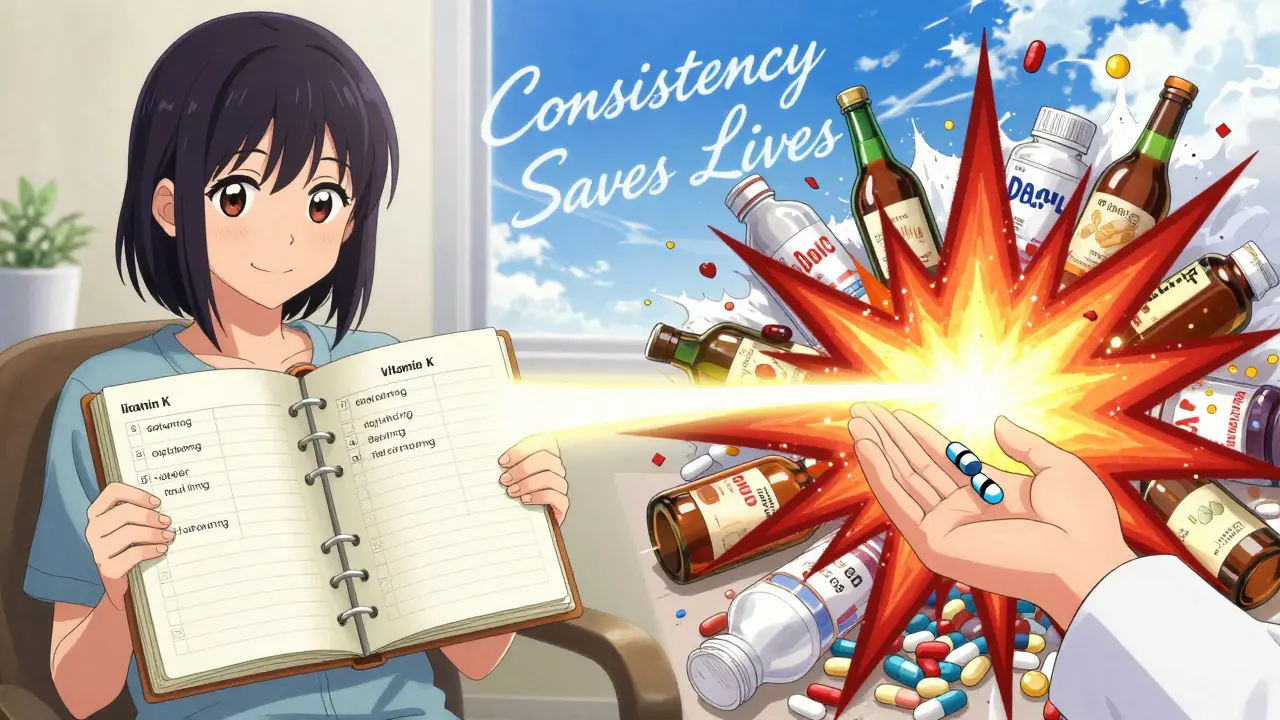
- Keep a food log. Write down what you eat - especially leafy greens - for 2 weeks. Show it to your doctor. Find your baseline.
- Use the same pharmacy. They’ll flag interactions. If you switch pharmacies, you lose that safety net.
- Check every new medication. Even over-the-counter. Use the American Society of Hematology’s interactive checker. Or ask your pharmacist: “Does this interact with warfarin?”
- Wear a medical alert bracelet. If you collapse, they need to know you’re on warfarin.
- Know the signs of bleeding: Unusual bruising, pink or red urine, black or bloody stools, severe headaches, dizziness, vomiting blood. Call 911 or go to the ER.
- Don’t change your dose. Ever. Without your doctor’s say-so. Even if you feel fine.
One patient from Melbourne told me: “I eat exactly one cup of spinach every night at 6 PM. No more, no less. My INR hasn’t budged in 18 months.” That’s not luck. That’s control.
Final Thought: Warfarin Isn’t the Problem - Ignorance Is
Warfarin has been around since the 1950s. It’s old. It’s finicky. But it’s still life-saving. The problem isn’t the drug. It’s the lack of clear, consistent education.
Patients who get proper counseling - written instructions, food charts, interaction lists - have far fewer complications. Those who don’t? They end up in the hospital. Again and again.
You don’t need to be a doctor to manage warfarin. But you do need to be informed. Stay consistent. Ask questions. Speak up. And never assume something is safe just because it’s “natural” or “over-the-counter.”
Because when it comes to warfarin, the smallest change - a new pill, a big salad, a glass of wine - can change everything.
Can I eat leafy greens while on warfarin?
Yes - but keep your intake consistent. Eating spinach every day is fine. Eating it one week and avoiding it the next will cause your INR to swing. Aim for 60-80 mcg of vitamin K daily - about 1 cup of cooked broccoli or 2 cups of raw lettuce. Don’t eliminate it. Just don’t change it.
Does cranberry juice interact with warfarin?
The evidence is mixed, but most guidelines say to avoid large amounts. One case report showed a patient’s INR jumped to 10 after drinking 8 glasses a day. It’s not a proven interaction, but the risk isn’t worth it. Stick to 1 small glass occasionally - and never drink it daily.
Can I take ibuprofen for a headache while on warfarin?
No. Ibuprofen, naproxen, and other NSAIDs increase your risk of stomach bleeding when taken with warfarin. Use acetaminophen (Tylenol) instead. It doesn’t interact with warfarin and is safe at normal doses.
How often should I get my INR checked?
When you first start warfarin, you may need checks every few days. Once stable, most people check every 4 weeks. But if you start a new medication, change your diet, or get sick, your doctor may want you tested sooner. Always follow your provider’s schedule - don’t skip tests just because you feel fine.
Is warfarin being phased out?
It’s declining - new prescriptions are mostly DOACs now. But warfarin isn’t going away. It’s still the only option for mechanical heart valves and some rare clotting disorders. It’s also much cheaper. If you’re stable on it and your doctor says you’re doing well, there’s no reason to switch.
Can I drink alcohol on warfarin?
One or two drinks a day is usually okay. Three or more? That triples your bleeding risk. Alcohol affects how your liver processes warfarin and can cause sudden INR spikes. If you drink, keep it moderate and consistent. Don’t binge. Don’t go cold turkey - either way can throw off your levels.
What should I do if I miss a dose of warfarin?
If you miss a dose and remember the same day, take it as soon as you can. If it’s the next day, skip it. Never double up. Write down the missed dose and tell your doctor at your next INR check. Missing one dose rarely causes problems - but doubling up can lead to dangerous bleeding.


There are 13 Comments
Linda Caldwell
Just eat one salad a day and don’t stress. Warfarin’s not a prison sentence. Consistency beats perfection every time. 🌱
Radhika M
I take warfarin since 2018. I eat spinach every day at dinner. Same amount. My INR is always 2.3. No drama. Just keep it steady.
CAROL MUTISO
Oh wow. So the real villain isn’t warfarin-it’s the medical system that gives you a 30-page pamphlet and says ‘good luck.’ Meanwhile, my pharmacist has memorized my meds, my grocery list, and my ex’s name. I’m not surprised I’m still alive.
Evelyn Vélez Mejía
Warfarin is not a drug-it is a philosophical test of human discipline. It forces us to confront the illusion of autonomy in modern medicine. We are told to ‘take control,’ yet our bodies are at the mercy of vitamin K fluctuations, pharmaceutical synergy, and the arbitrary whims of INR ranges. To manage warfarin is to surrender to precision in a world that glorifies chaos.
It is not about spinach. It is about ritual. It is about the quiet rebellion of eating the same broccoli at the same hour, day after day, while the world outside burns with inconsistency. The modern patient does not merely take medication-they perform a liturgy of stability.
And yet, we are ridiculed for ‘overthinking’ our diets. We are dismissed as hypochondriacs when we ask about green tea extract. But what is more rational than knowing that a single pill can be undone by a single leaf?
The newer anticoagulants are elegant, yes. But they are also expensive, irreversible, and alienating. Warfarin, in all its archaic fragility, demands engagement. It refuses to let you be passive. And perhaps that is its hidden gift.
It teaches you that health is not a checkbox. It is a daily covenant-with your body, your pharmacist, your doctor, and the humble, green, vitamin-laden earth.
Naomi Lopez
It’s fascinating how people treat warfarin like it’s some mystical potion while ignoring that it’s literally a rodenticide repurposed for human use. The fact that we’ve normalized this level of pharmacological fragility in 2025 is a testament to how little we’ve advanced in personalized medicine.
And yet, the real scandal isn’t the drug-it’s that insurance companies still force patients to use it because of cost. We’re not saving money-we’re outsourcing risk to the patient’s kitchen, their pharmacy, and their ability to read labels.
It’s like giving someone a chainsaw and telling them to trim the hedge with care. Then blaming them when they cut their foot off.
DOACs aren’t ‘luxuries.’ They’re the baseline standard of care. The fact that we still ration them like they’re gold is a moral failure disguised as fiscal responsibility.
And don’t get me started on ‘natural’ supplements. If you think ginkgo biloba is ‘safe’ because it’s from a tree, you probably also think your houseplant can diagnose cancer.
Warfarin doesn’t need better education. It needs to be retired.
Jessica Salgado
I had an INR of 6.2 last year after taking a ‘natural’ joint support pill that said ‘no warfarin interaction’ on the label. Turns out it had 200mg of vitamin K. My doctor looked at me like I’d just confessed to stealing a car.
I cried in the parking lot. Not because I was scared-I was angry. Angry that no one warned me. Angry that the label lied. Angry that I had to Google ‘warfarin and supplements’ at 3 a.m. like some kind of medical detective.
Now I keep a spreadsheet. Every pill. Every meal. Every glass of wine. My husband thinks I’m obsessed. I think he’s lucky I’m still alive.
And yes-I wear my medical bracelet. Even to yoga. Even to the beach. Because if I pass out, I don’t want some ER nurse guessing.
Virginia Seitz
Spinach? Yes. 🥬
St. John’s Wort? No. 🚫
Aspirin? Nope. 🚫
One drink? Cool. 🍷
Three drinks? Nope. 🚫
Wear the bracelet. 💙
Erik J
Interesting that the article mentions green tea extract as dangerous but doesn’t clarify that brewed tea is generally fine. Most people conflate the two. I’ve had the same cup every morning for 5 years-no issues. The real danger is concentrated supplements. That’s where the real risk lies.
Raven C
It is beyond comprehension how anyone can be entrusted with such a perilous medication without a dedicated clinical pharmacist on retainer. The notion that a layperson-often elderly, often cognitively impaired-can navigate 300+ drug interactions, fluctuating vitamin K levels, and hepatic metabolism is not merely irresponsible-it is grotesque.
And yet, we applaud the ‘resilient’ patient who ‘manages’ warfarin with a spreadsheet and a prayer. What we are really celebrating is systemic failure disguised as personal triumph.
Warfarin is not a tool-it is a relic. A relic of a time when medicine had no better options. We should be ashamed that we still ask people to live with this.
Salome Perez
As someone who’s worked in global health for two decades, I’ve seen warfarin used in villages with no refrigeration, no labs, and no pharmacists-and yet, patients survive. Why? Because they have community. A neighbor reminds them to eat the same greens. A relative brings the same brand of multivitamin. A nurse walks the same route every month to check INR.
In the U.S., we’ve turned medication management into a solo endurance race. We give people a pamphlet and say, ‘You’ve got this.’ Meanwhile, in rural India, a grandmother teaches her granddaughter how to count spinach leaves. That’s not ignorance. That’s wisdom.
We don’t need more warnings. We need more connection.
Chris Van Horn
Let me be clear: If you’re on warfarin and you’re eating kale, you’re a walking time bomb. And if you think ‘I just had one salad’-you’re not just ignorant, you’re dangerous. I’ve seen three people bleed out because they thought ‘natural’ meant ‘safe.’ Spoiler: It doesn’t. Your spinach isn’t your friend. Your ginkgo isn’t your ally. And your ‘I’m healthy’ attitude is going to kill you.
And don’t even get me started on DOACs being ‘too expensive.’ If you can afford a Tesla, you can afford Eliquis. If you can’t? Then maybe you shouldn’t be on a blood thinner at all. But you are. So shut up and take your 4 bucks of warfarin and stop acting like you’re a martyr.
Also-yes, I’m a doctor. No, I don’t need your ‘lived experience.’ I’ve seen the body bags.
amanda s
Why do Americans always act like warfarin is some unique American problem? In Europe, they use it like it’s aspirin. No drama. No panic. No ‘food logs.’ Just take it. Check it. Move on. We don’t turn medicine into a cult. We don’t worship spinach. We just live.
And stop pretending DOACs are perfect. They’re just more expensive. And guess what? People still bleed on them. The difference? You don’t know it until it’s too late. No INR. No warning. Just silence.
Warfarin is the only one that tells you when you’re about to die. And you’re mad about it?
Linda Caldwell
Someone said DOACs are better. True. But if you're on warfarin and you're doing okay? Don't fix what ain't broke. My INR's been stable for 3 years. I eat my spinach. I drink my wine. I live my life. That's the win.
Write a comment
Your email address will not be published. Required fields are marked *