Most people assume that the most expensive part of a prescription is the drug itself. But if you look behind the curtain, you'll find a massive, invisible machine of intermediaries moving pills from factories to pharmacy shelves. In the world of generic drug pricing, the money doesn't always flow where you'd expect. While a brand-name drug makes the manufacturer rich, generic drugs often make the people moving the product-the wholesalers-the real winners. This creates a strange economic paradox: the cheaper the drug is for you, the more profitable it can be for the middleman.
The Three-Tier Distribution Machine
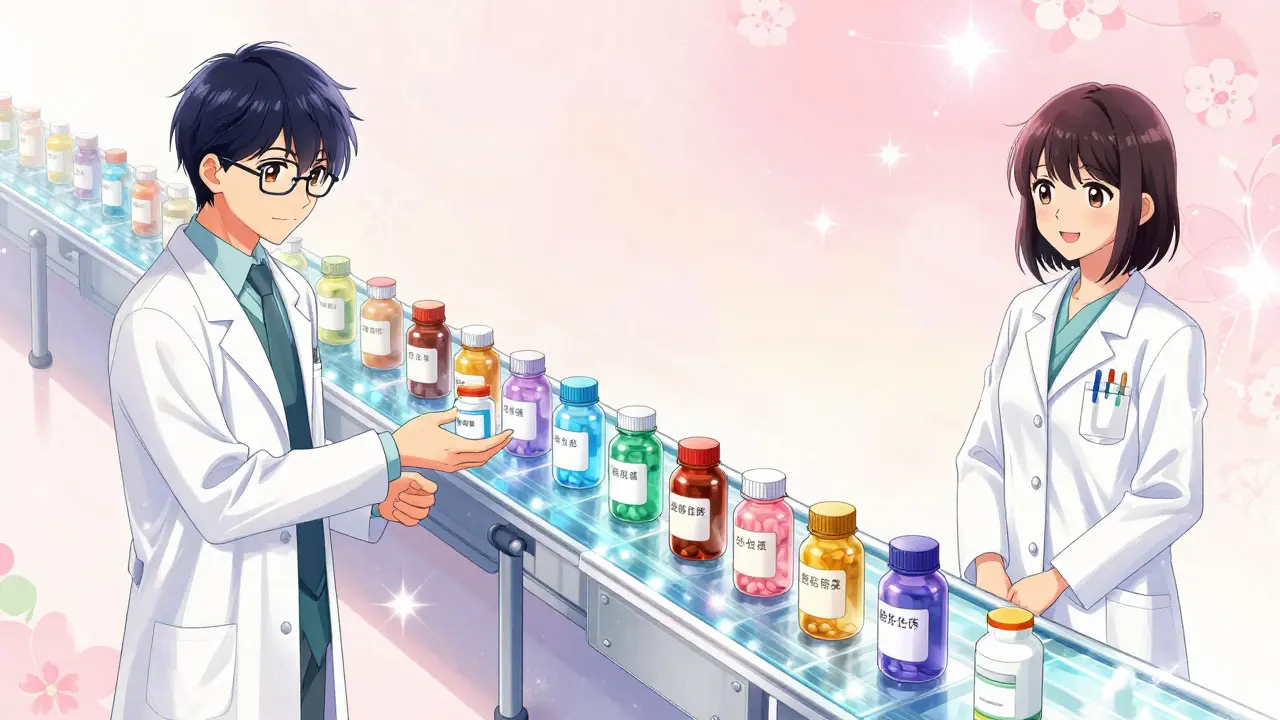
To understand how this works, you first have to look at the structure. Since the Prescription Drug Marketing Act of 1987, the U.S. has operated on a three-tier system. It's a straight line: Pharmaceutical Manufacturers the companies that chemically synthesize and package the drugs $\rightarrow$ Wholesalers the massive logistics hubs that store and ship medications $\rightarrow$ Pharmacies the retail points where patients collect their prescriptions.
This isn't just a logistical choice; it's an economic one. Imagine a pharmacy trying to call 500 different generic manufacturers every morning to stock their shelves. It would be a nightmare. Wholesalers solve this by acting as a one-stop shop. However, this convenience comes with a price. A huge chunk of every dollar spent on prescriptions-more than $1 in every $5-doesn't go toward research or chemicals, but toward the profits of the firms running this distribution chain.
The 'Big Three' and Their Market Grip
The generic distribution world isn't a free-for-all. It's dominated by a small group of giants. AmerisourceBergen, Cardinal Health, and McKesson collectively control about 85% of the U.S. wholesale market. When three companies own nearly the entire pipeline, they hold incredible bargaining power.
They can squeeze manufacturers for better deals and dictate terms to smaller pharmacies. For these giants, generic drugs are a goldmine. While branded drugs bring in more total revenue because they are expensive, generics are far more profitable relative to their cost. In some years, generics have represented only 9% of total revenue for wholesalers but contributed a staggering 56% of their gross profits. Why? Because the margins on generics are simply better for the distributor.
| Participant | Branded Drug Margin | Generic Drug Margin | The Economic Shift |
|---|---|---|---|
| Manufacturer | 76.3% (High) | 49.8% (Lower) | Value moves away from the maker |
| Pharmacy | Low | 42.7% (High) | Significant retail profit gain |
| Wholesaler | Low | High | 11x higher profit per unit |
The Math Behind the Margin
Let's get concrete. The profit difference between a brand-name drug and a generic one at the wholesale level is shocking. According to research from the USC Schaeffer Center, wholesalers make about $32 on generic drug expenditures compared to just $3 on brand-name drugs per unit. That's an eleven-fold increase in profit just by switching the product type.
But here's the catch: while the gross profit looks amazing, the net margin for wholesalers is razor-thin, sometimes as low as 0.5%. They make their money on sheer volume. They aren't looking for a huge percentage on one bottle; they're looking for a tiny percentage on billions of bottles. This is why they push generic versions so hard. The lower the cost of the inventory on their balance sheet, the higher their Return on Assets (ROA) becomes. If a generic launch happens, the wholesaler can move more volume with less capital tied up in expensive branded stock.

How Generic Pricing Actually Works
Wholesalers don't just guess what to charge. They use a few specific strategies to keep the money flowing:
- Cost-Plus Pricing: This is the simplest version. They take the production cost and add a set markup percentage. It's safe and consistent, but it doesn't care if the market is crashing or booming.
- Market-Based Pricing: Here, they keep a close eye on what other wholesalers are charging. If Cardinal Health drops a price, McKesson likely will too. This keeps them competitive but makes their profit margins a bit more volatile.
- Tiered Pricing: This is where bulk buying comes in. If a pharmacy orders 50 units, they pay full price. If they order 500, they might get a 15-25% discount. This encourages pharmacies to stockpile, which keeps the wholesaler's warehouses moving.
- Value-Based Pricing: This is common for specialty drugs. The price is based on how much the drug is perceived to help the patient or how rare it is, rather than just what it cost to make.
They also have to bake in the "hidden" costs. If a drug costs $10 to make but $2 to ship, the wholesaler can't sell it for $10 and expect to survive. The shipping cost is added directly to the wholesale price to ensure the logistics chain doesn't eat the profit.
The Ripple Effect of Shortages and Inflation
The economics of generics aren't static. Between 2021 and 2022, the market actually saw a deflationary cycle-prices were generally dropping. But then 2023 hit, and we saw a wave of generic drug shortages. When a common drug suddenly isn't available, "pockets of inflation" appear. The few wholesalers who still have stock can command higher prices, and the bargaining power shifts back and forth.
This volatility shows how much influence wholesalers have. They don't just move boxes; they influence the actual list price of medications. By leveraging price increases or competing for specialty drug distribution, they can change how much a patient ultimately pays at the pharmacy counter.

Why the System is Misaligned
Because wholesalers make so much more on generics, their interests aren't aligned with brand-name manufacturers. A manufacturer wants you to buy the expensive, branded version. The wholesaler, however, is financially incentivized to push the generic. This creates a weird tension in the pharmaceutical industry where the people distributing the product are often rooting against the companies that create the original patents.
This concentration of power in the "Big Three" also means that smaller distributors are being squeezed out. When 85% of the market is owned by three firms, there's very little room for a new player to enter and disrupt the pricing model. This lack of competition is why many experts call for more scrutiny of these pricing policies to ensure that the "middleman tax" doesn't make healthcare unaffordable.
Why are generic drugs more profitable for wholesalers than branded drugs?
While branded drugs have higher price tags, manufacturers capture most of that value. With generics, manufacturers often provide deep discounts to win contracts, which allows wholesalers and pharmacies to capture a much larger slice of the profit per unit. In some cases, wholesalers make eleven times more profit on a generic unit than a branded one.
What are the "Big Three" pharmaceutical wholesalers?
The Big Three are AmerisourceBergen, Cardinal Health, and McKesson. Together, they control approximately 85% of the U.S. pharmaceutical wholesale market, giving them immense power over drug pricing and distribution.
How does tiered pricing work in drug wholesaling?
Tiered pricing uses volume-based discounts to encourage bulk purchases. For example, a wholesaler might charge a higher per-unit price for orders under 100 units, but offer a 15-25% discount for orders exceeding 500 units. This ensures high inventory turnover for the wholesaler.
Do wholesalers affect the price I pay at the pharmacy?
Yes. Wholesalers influence the market by setting generic prices, leveraging list price increases, and managing drug shortages. Because they control the supply chain, their pricing decisions ripple down to the pharmacy's retail price.
What is the difference between gross and net margins for wholesalers?
Gross margin is the difference between the cost of the drug and the selling price. While this can be high for generics, the net margin is the actual profit after paying for warehouses, trucks, employees, and insurance. For wholesalers, net margins are often very low (around 0.5%), meaning they rely on massive volume to stay profitable.
What Happens Next?
If you're a pharmacy owner, the move is to diversify your suppliers where possible to avoid being completely dependent on one of the Big Three. If you're a policymaker, the focus is likely shifting toward increasing transparency in how these markups are calculated. As specialty drugs (like biologics) become more common, the traditional generic model will have to evolve, likely leading to even more complex pricing tiers and tighter distribution controls.