

Desloratadine vs Loratadine: Which Antihistamine Is Better for Allergy Relief?
If you’ve ever reached for an allergy pill and wondered why there are so many choices, you’re not alone. Two of the most common options are desloratadine and loratadine. Both are second-generation antihistamines, meaning they’re designed to fight allergies without making you sleepy-unlike older pills like diphenhydramine. But they’re not the same. One is the active ingredient in Clarinex; the other is in Claritin. And while they’re closely related, their differences matter-especially when you’re trying to pick the right one for your symptoms.
Here’s the thing: loratadine doesn’t even work directly. Your body turns it into desloratadine to get the job done. That means desloratadine is essentially the finished product, while loratadine is more like a raw ingredient. And that small difference changes everything-from how fast it works to how well it controls your symptoms.
Dosing: One Pill, Two Strengths
Both medications are taken once a day, which is convenient. But the doses are different. For adults, you take 10 mg of loratadine and only 5 mg of desloratadine. That’s not a mistake. Desloratadine is about twice as potent, so you need half the amount to get the same-or better-effect.
Timing matters too. Loratadine hits peak levels in your blood in about 1 to 1.5 hours. Desloratadine takes longer-around 3 hours. But here’s the twist: even though it takes longer to peak, desloratadine stays in your system much longer. Its half-life is 27 hours. That means it’s still working strong 24 hours later, with minimal dips in effectiveness. Loratadine’s half-life is shorter, around 8 to 10 hours, so some people notice their symptoms creeping back before the next dose.
Food doesn’t affect either one. You can take them with breakfast, after lunch, or on an empty stomach. No need to plan your schedule around meals.
Age Limits: Why Desloratadine Wins for Young Kids
If you’re managing allergies in a toddler, this is critical. Desloratadine is approved for children as young as 1 year old. Loratadine? Only for kids 2 and up. That one-year gap matters. For parents of infants with chronic hives or seasonal allergies, desloratadine opens up a safe, non-sedating option that wasn’t available before.
Studies in children aged 2 to 5 show desloratadine builds up to steady levels quickly. After daily dosing, average blood levels hit 7.8 ng/mL-higher than what you’d see with loratadine in the same age group. And while side effects like diarrhea or irritability can happen, they’re generally mild and rare. In fact, in pediatric trials, the rate of diarrhea was 6.1% with desloratadine versus 2.4% in placebo groups. That’s higher than placebo, but still low overall.
Side Effects: Less Is More
Both drugs are called non-sedating because they barely cross the blood-brain barrier. You’re not going to feel like you’ve had a glass of wine after taking either. But that doesn’t mean they’re identical.
Common side effects for both include dry mouth, headache, and occasional drowsiness. But multiple studies show desloratadine causes fewer of these. One large review in the Journal of Clinical Pharmacology found desloratadine had a lower tendency to cause drowsiness than loratadine. That’s important if you drive, work with machinery, or just want to stay sharp all day.
Desloratadine also has a better safety record for the heart. It doesn’t affect QRS or QTc intervals on an ECG-meaning it won’t increase your risk of irregular heartbeats. That’s not true for all antihistamines. Some older ones can be dangerous for people with heart conditions. Both desloratadine and loratadine are safe here, but desloratadine’s clean record adds another layer of confidence.
Some users report headaches with desloratadine. That’s true. But look at the big picture: on Drugs.com, 63% of desloratadine users said it helped their allergies, compared to 54% for loratadine. And only 22% of desloratadine users reported negative effects, versus 28% for loratadine. That’s a real-world advantage.
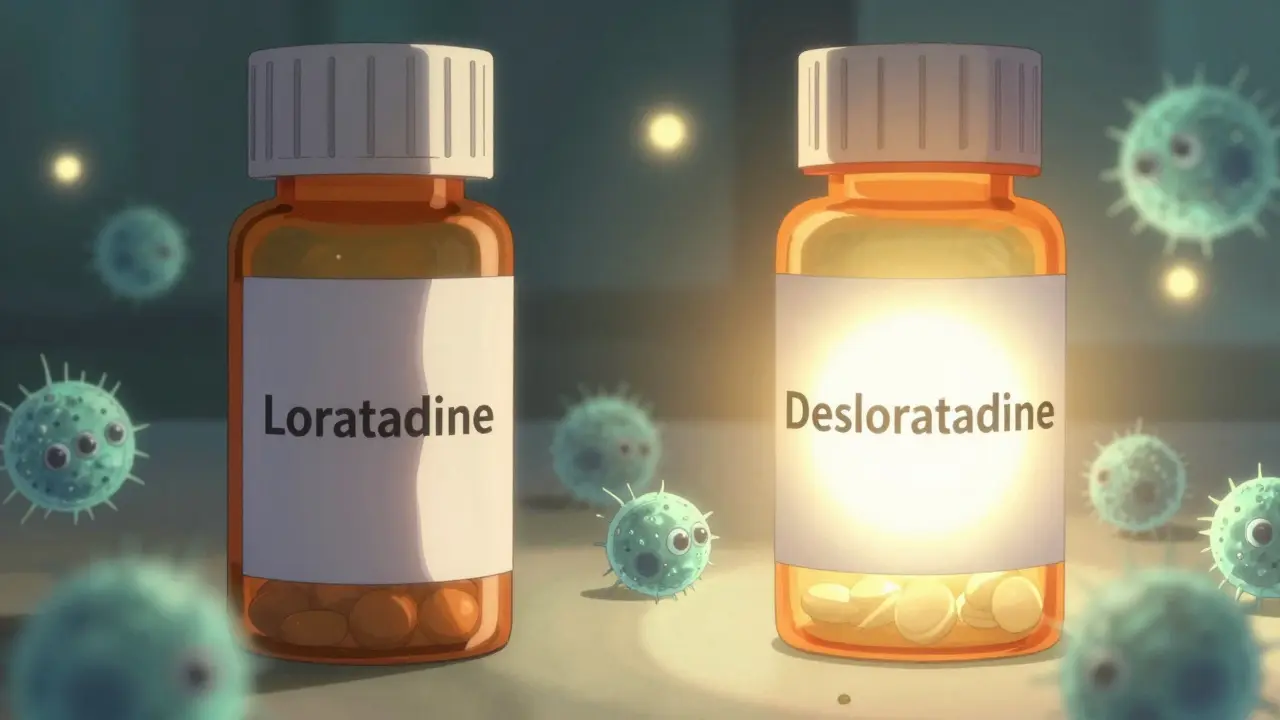
Why Desloratadine Works Better for Stubborn Allergies
It’s not just about blocking histamine. Desloratadine does that, yes-but it also does more. It reduces inflammation by calming down immune cells like eosinophils. It stops those cells from sticking to blood vessel walls and migrating into tissues where they cause itching, swelling, and congestion.
This is why desloratadine is often recommended for people with nasal congestion that won’t quit. Loratadine helps with sneezing and runny nose, but desloratadine tackles the stuffiness too. A 2021 review by the European Academy of Allergy and Clinical Immunology gave desloratadine a 4.7 out of 5 for symptom control, compared to 4.2 for loratadine-specifically because of its effect on congestion.
It also helps with itchy eyes. A lot of users on Reddit and Drugs.com mention switching from loratadine to desloratadine because their eyes stopped itching. That’s not just placebo. Desloratadine reduces the release of inflammatory chemicals like IL-4 and IL-13, which are directly linked to eye and skin allergy symptoms. A 2023 study in the Journal of Allergy and Clinical Immunology confirmed this mechanism at clinically relevant doses.
Drug Interactions and Safety
Desloratadine doesn’t rely much on the liver’s CYP3A4 enzyme to break down. That’s good news if you’re on other meds. Common drugs like ketoconazole, erythromycin, or fluoxetine won’t interfere with it. Loratadine, on the other hand, is processed through that same pathway. So if you’re taking something that affects liver enzymes, your doctor might prefer desloratadine to avoid unpredictable blood levels.
Both are safe for people with kidney or liver problems. In 2023, the FDA updated the labels to say no dosage adjustment is needed-even if your organs aren’t working perfectly. That’s a relief for older adults or those with chronic conditions.
Cost and Availability
Loratadine is cheaper. A 30-day supply of generic loratadine costs $10 to $25. Desloratadine runs $25 to $40. That’s a noticeable difference if you’re paying out of pocket.
But here’s what most people don’t realize: loratadine has been on the market since the 1990s. It became generic in 2002. Desloratadine followed in 2013. So yes, loratadine is cheaper-but it’s also older. Desloratadine is newer, with more research backing its extra benefits.
Prescription data shows loratadine is still the most popular. In 2023, it was the 47th most prescribed drug in the U.S., with over 24 million prescriptions. Desloratadine came in at 128th, with about 9 million. But growth trends are shifting. Market analysts predict desloratadine prescriptions will rise 4.2% annually through 2028, while loratadine’s growth will slow to 1.8%. More doctors are starting to recommend it for moderate to severe cases.

Who Should Take Which?
Let’s cut through the noise. Here’s who benefits most from each:
- Choose loratadine if your allergies are mild, you’re on a tight budget, and you don’t have nasal congestion. It’s effective for sneezing and itchy nose, and it’s been trusted for decades.
- Choose desloratadine if you have persistent congestion, itchy eyes, or if loratadine stopped working after a few weeks. It’s also the go-to for kids 1 to 2 years old, and for people taking multiple medications that could interfere with liver enzymes.
And if you’ve been on loratadine for a while and your symptoms aren’t fully under control? Try switching. The American College of Allergy, Asthma, and Immunology recommends giving desloratadine a shot if you haven’t seen improvement after 2 to 4 weeks on loratadine. Many users report a noticeable difference.
Real Stories: What Users Say
On Reddit, one user wrote: “I used to take Claritin every day. My eyes were still red, my nose was still stuffed. I switched to Clarinex and within three days, my eyes stopped itching. I didn’t even know I was that bothered until it was gone.”
Another said: “I tried desloratadine because it was cheaper than my last prescription. Turns out, it’s not cheaper. But it’s worth it. I don’t need to take two pills anymore.”
And a parent shared: “My 15-month-old had hives every night. The pediatrician said we could try desloratadine. We did. Within 48 hours, the hives were gone. No drowsiness. No fuss. I wish we’d tried it sooner.”
Not everyone has a success story. Some users report headaches with desloratadine. But those cases are in the minority. Most who switch say they wish they’d done it earlier.
Bottom Line: It’s Not Just About Price
Desloratadine isn’t just a “stronger” version of loratadine. It’s a smarter one. It works longer, it works better for congestion and eye symptoms, and it’s safer for younger kids and people on other meds. Yes, it costs more. But if your allergies are really affecting your sleep, your work, or your kids’ playtime, the extra cost might be worth it.
For mild, occasional sneezing? Loratadine still does the job. For everything else? Desloratadine gives you more control-with fewer side effects.
Can I take desloratadine and loratadine together?
No. Desloratadine is the active metabolite of loratadine, so taking both at the same time doesn’t give you extra benefit-it just increases your risk of side effects. Stick to one or the other. If one isn’t working well enough, switch to the other after a few days, don’t combine them.
Is desloratadine better for nasal congestion than loratadine?
Yes. Multiple clinical studies and guidelines, including those from the European Academy of Allergy and Clinical Immunology, show desloratadine provides significantly better relief for nasal congestion. This is because it reduces inflammation in the nasal passages, not just blocking histamine. Loratadine helps with runny nose and sneezing but often falls short on stuffiness.
Can children under 2 take desloratadine?
Yes. Desloratadine is approved for use in children as young as 1 year old for chronic hives and allergic rhinitis. Loratadine is only approved for children 2 and older. Always check with your pediatrician for the right dose based on weight and age.
Does desloratadine cause more drowsiness than loratadine?
No. In fact, studies show desloratadine has a lower tendency to cause drowsiness. Both are classified as non-sedating antihistamines because they barely enter the brain. Some people report mild sleepiness when starting either drug, but this usually fades after a few days. Desloratadine’s side effect profile is generally milder overall.
Is desloratadine safe for people with heart conditions?
Yes. Desloratadine does not affect the heart’s electrical activity-it doesn’t lengthen the QT interval or cause irregular rhythms. This makes it safer than some older antihistamines. Both desloratadine and loratadine are considered safe for people with heart conditions, but desloratadine has a cleaner safety record in clinical trials.
How long does it take for desloratadine to start working?
Desloratadine reaches peak levels in the blood around 3 hours after taking it. You may notice symptom relief within a few hours, but full effects usually take 1 to 2 days of daily use. Unlike some allergy meds, it doesn’t work instantly-it builds up over time. That’s why it’s important to take it consistently, even if you don’t feel symptoms right away.




There are 14 Comments
Rohit Kumar
kate jones
Kimberly Reker
Rob Webber
calanha nevin
Lisa McCluskey
Russ Kelemen
April Allen
Diana Dougan
Shubham Dixit
Sazzy De
Beth Beltway
Natasha Plebani
Kelly Weinhold
Write a comment
Your email address will not be published. Required fields are marked *